
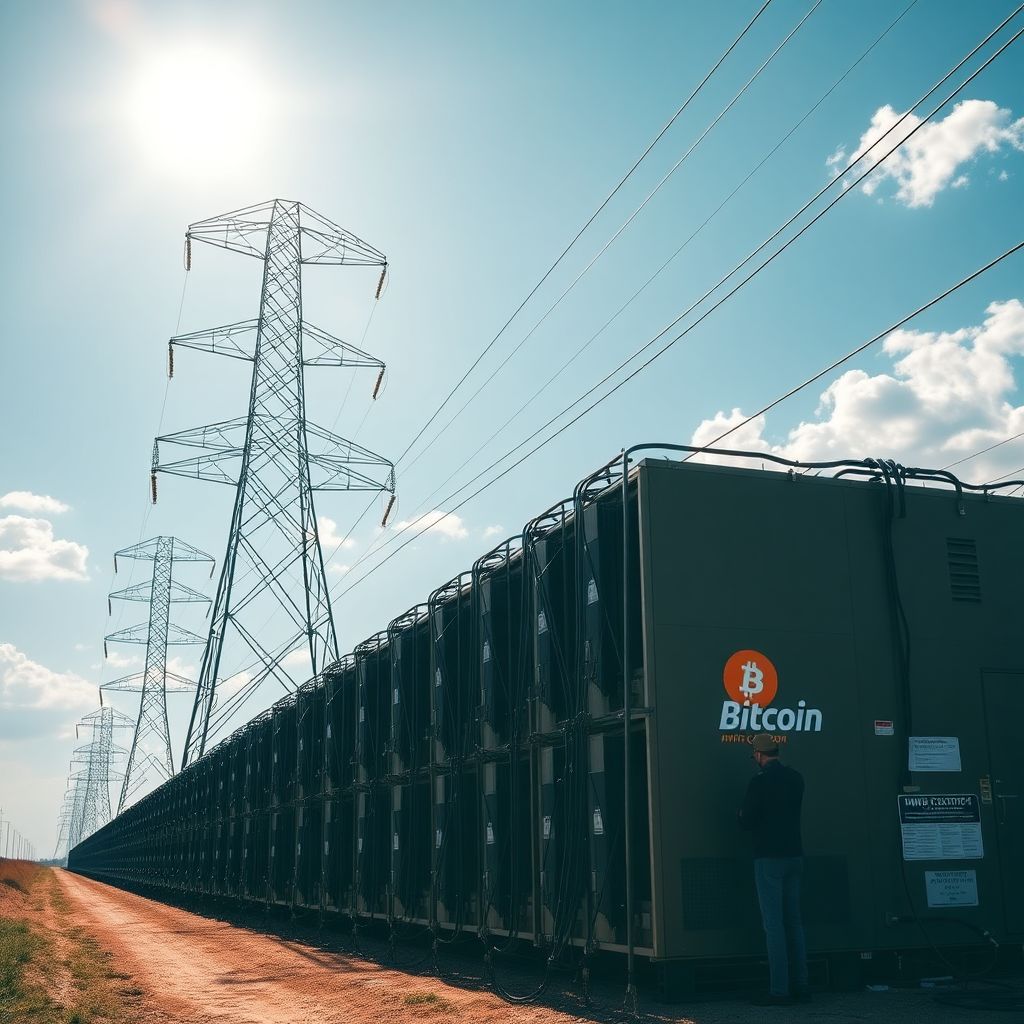
ERCOT Grid Rules Add A New Infrastructure Hurdle For Texas Bitcoin Miners
Crypto stories are often reduced to price charts and tickers, but the new grid rules from ERCOT in Texas underline a different reality: the real action increasingly sits in infrastructure policy, market design, and operational constraints. The update is not about a new token or a flashy narrative; it is about how one of the most important power markets in the United States plans to handle very large electricity users – a category that includes Bitcoin miners.
At the core of the news is a concrete change: ERCOT has outlined updated interconnection requirements for large loads on the Texas power grid. In practice, this means that any industrial-scale power consumer, such as a sizable mining facility, faces a more structured and potentially more demanding path to plugging into the grid. For an industry that built part of its Texas story on speed, flexibility, and cheap energy, that is not a minor adjustment.
The timing is critical. ERCOT has been under sustained scrutiny after periods of extreme weather, volatility in demand, and pressure to improve reliability. Against that backdrop, Bitcoin mining has emerged as a visible and sometimes controversial class of load. As a result, when ERCOT refines how big loads connect and operate, traders, founders, and compliance teams across the crypto sector want to know whether this shifts risk, cost, or opportunity.
This development also fits into a broader transition in digital-asset markets: away from purely speculative boom-and-bust cycles and toward questions that resemble traditional infrastructure investing. Instead of asking only “What is the price of bitcoin today?”, more participants are asking “Who can access affordable power? What regulations might limit that access? How resilient is the underlying system?” ERCOT’s new rules are part of that deeper layer.
What ERCOT Is Changing – And Why It Matters
The essential point is that ERCOT is tightening and formalizing how very large power consumers connect to the grid. This typically involves more detailed studies of grid impact, longer lead times, and more conditions on how and when these loads can run. For Bitcoin miners, whose facilities can draw tens or hundreds of megawatts, this is not a theoretical concern; it directly shapes where they can build, how quickly they can scale, and what their long-term operating costs will look like.
For market participants, the implications diverge depending on role:
– Miners and infrastructure companies want to know whether this slows down new build‑outs or increases capital requirements.
– Traders and investors are trying to judge whether more friction in Texas lowers hash rate growth, alters miner margins, or shifts mining to other regions, which can feed back into bitcoin’s risk profile over time.
– Compliance, legal, and risk teams must determine how these rules interact with existing contracts, demand-response programs, and any obligations miners have to curtail usage during grid stress.
In other words, the story is not simply about one rule book update. It is about how a major grid operator is redefining the boundary between high-growth digital industries and physical infrastructure that has to keep the lights on for everyone else.
The Bitcoin Mining Angle
For Bitcoin mining in particular, the mechanism is what matters. The economics of mining are famously sensitive to power cost and stability. Any change to interconnection rules can affect:
– Project timelines – Longer studies or approval processes delay revenue and can derail financing.
– Grid‑service participation – Conditions attached to large loads can reshape how miners earn from demand-response programs or ancillary services, not just from block rewards.
– Location strategy – Some regions of Texas may become less attractive if new constraints limit how big or how fast facilities can grow.
The article’s core message is that this is not just a label on a trend or a soft “sentiment” shift. It provides a tangible rule-change investors and operators can analyze. If the new ERCOT framework becomes the standard for how miners must integrate with the grid, then mining is no longer just a play on bitcoin price and hardware efficiency; it becomes a bet on energy policy, regulatory risk, and grid planning.
Why This Should Not Be Read as Instant Bullish or Bearish News
It is tempting in crypto to turn every development into an immediate market call. The prudent interpretation here is different. ERCOT’s update is a signal, not a promise of upside or a guarantee of downside.
The responsible way to read this kind of story is with discipline:
– It does not ensure that existing miners in Texas will suddenly become more profitable.
– It does not ensure that new projects are dead on arrival.
– It does add an important data point about how serious infrastructure stakeholders are treating Bitcoin mining and other large-load industries.
The real question is how the rule actually propagates through decision‑making. Do lenders change their risk models for Texas-based projects? Do developers pivot to regions with laxer interconnection standards? Do miners lean harder into flexible operations that make them more attractive grid partners? Those are medium-term questions that cannot be answered by a single headline.
The Risk Side: Dependencies, Adoption, and Operational Friction
From a risk perspective, the central issue is dependencies. Bitcoin miners depend on cheap, stable power. ERCOT depends on system reliability and political support. When those dependencies tighten through new rules, the margin for error can shrink.
There are several layers of uncertainty:
– Regulatory follow‑through – A grid rule can exist on paper but remain lightly enforced, or it can be applied aggressively. Only practice will reveal which scenario prevails.
– Adoption by other regions – If ERCOT’s approach is seen as successful, other jurisdictions might copy it, turning a local hurdle into a broader industry standard.
– Market reaction – Some miners may scale back or relocate; others may invest in on‑site generation or storage to reduce exposure to grid constraints.
Importantly, source material can confirm that ERCOT has published or updated its large-load framework. It cannot guarantee that miners will respond in one uniform way. A proposal still needs stakeholders to adjust their behavior. A new interconnection process still needs to be navigated, sometimes at significant cost.
How This Fits Into the Professionalization of Crypto
One of the subtler takeaways is that digital-asset markets are becoming more technical and operationally focused. Topics that once sat on the periphery – grid stability, permitting timelines, compliance tooling, treasury management – are now central to serious participants.
This ERCOT development underscores several broader shifts:
– From narratives to infrastructure – Investors increasingly want to understand the underlying machinery, not just the marketing story.
– From pure speculation to risk-adjusted returns – Energy price hedges, term contracts, and regulatory exposure are now core parts of mining strategies.
– From hobbyist operations to industrial players – The entities affected by ERCOT’s rules are often backed by institutional capital and subject to formal governance, audits, and reporting.
Viewed this way, the Texas grid story is less about a single market and more about the maturation of crypto as a sector that must coexist with legacy infrastructure and regulation.
Signals To Watch After the Initial Headline
The key determinant of whether this becomes a fleeting news item or a lasting theme will be the follow‑up evidence. Useful signals include:
– Developer and operator commentary – Are mining firms publicly adjusting their buildout plans or capex forecasts in response?
– Regulatory or political feedback – Do state authorities push for further changes to how miners are treated on the grid, positive or negative?
– Financing conditions – Do lenders and equity investors alter their appetite for Texas-based projects?
– Hash rate distribution – Over time, does Texas lose share of global hashrate, or do miners adapt and retain their footprint under the new regime?
– Demand-response participation – Are miners still widely involved in curtailment programs and grid services, or do tighter rules make those arrangements less attractive?
If these secondary indicators shift materially, the ERCOT update moves from a narrow technical change to a defining factor in how North American mining evolves.
How Texas Miners Might Adapt
For operators on the ground, the question is not whether ERCOT’s rules exist; it is how to live with them. Several strategic responses are plausible:
– Designing more flexible facilities that can ramp power usage up and down in line with grid needs, strengthening their case as stabilizing rather than destabilizing loads.
– Integrating on‑site or behind‑the‑meter generation, such as solar, wind, or gas, to reduce direct dependence on grid capacity, even if the facilities still connect to ERCOT.
– Pursuing smaller, modular expansions rather than single massive deployments, to potentially navigate thresholds and reduce approval risk.
– Locking in longer-term contracts with utilities or power providers that explicitly address new interconnection and curtailment conditions.
Each adaptation adds complexity and cost, but also reflects an industry that is moving beyond opportunistic scaling into long-term infrastructure planning.
Implications Beyond Bitcoin Mining
While Bitcoin miners are the most obvious group affected, ERCOT’s approach to large interconnections has implications for other high-demand digital sectors:
– Data centers for AI and cloud computing share many of the same characteristics as mining operations: enormous, concentrated electricity demand and sensitivity to downtime.
– Emerging industrial applications tied to hydrogen, synthetic fuels, or large-scale processing could face similar hurdles and learning curves.
For crypto specifically, this means that the competition for favorable energy conditions is no longer just between different mining firms. It now involves other digital and industrial players vying for the same grid capacity and regulatory goodwill.
What This Means for Crypto Investors and Observers
For readers who are not building mines in Texas, the practical takeaway is still significant:
– When evaluating mining stocks, infrastructure tokens, or related projects, grid policy should be treated as a core variable, not an afterthought.
– The headline “cheap power in Texas” is no longer sufficient; the details of interconnection, curtailment obligations, and regulatory oversight matter just as much.
– Developments like ERCOT’s rule changes can influence the long-run cost curve of mining and, therefore, the mix of players that can survive in tighter market conditions.
In a sector that often gravitates toward short‑term catalysts, tracking these slower, structural shifts can offer an edge in understanding which business models are built on solid foundations and which rest on assumptions that may no longer hold.
A Story Worth Watching, Not Overstating
For now, the ERCOT update adds one more piece to the puzzle. It is specific enough that operators and analysts can begin modeling its potential impact, but early enough that many of the consequences remain uncertain. The most accurate way to frame it is as a meaningful signal rather than a verdict on the fate of Texas mining.
As more data emerges – from hashrate distribution to project announcements and policy responses – it will become clearer whether this remains a contained, technical adjustment or evolves into a defining constraint on one of the world’s key mining hubs. Either way, it is a reminder that the future of crypto will be shaped as much by power grids and rulebooks as by price charts and narratives.
This analysis draws on information originally reported by hashrateindex.com and subsequent editorial work by industry news desks.