
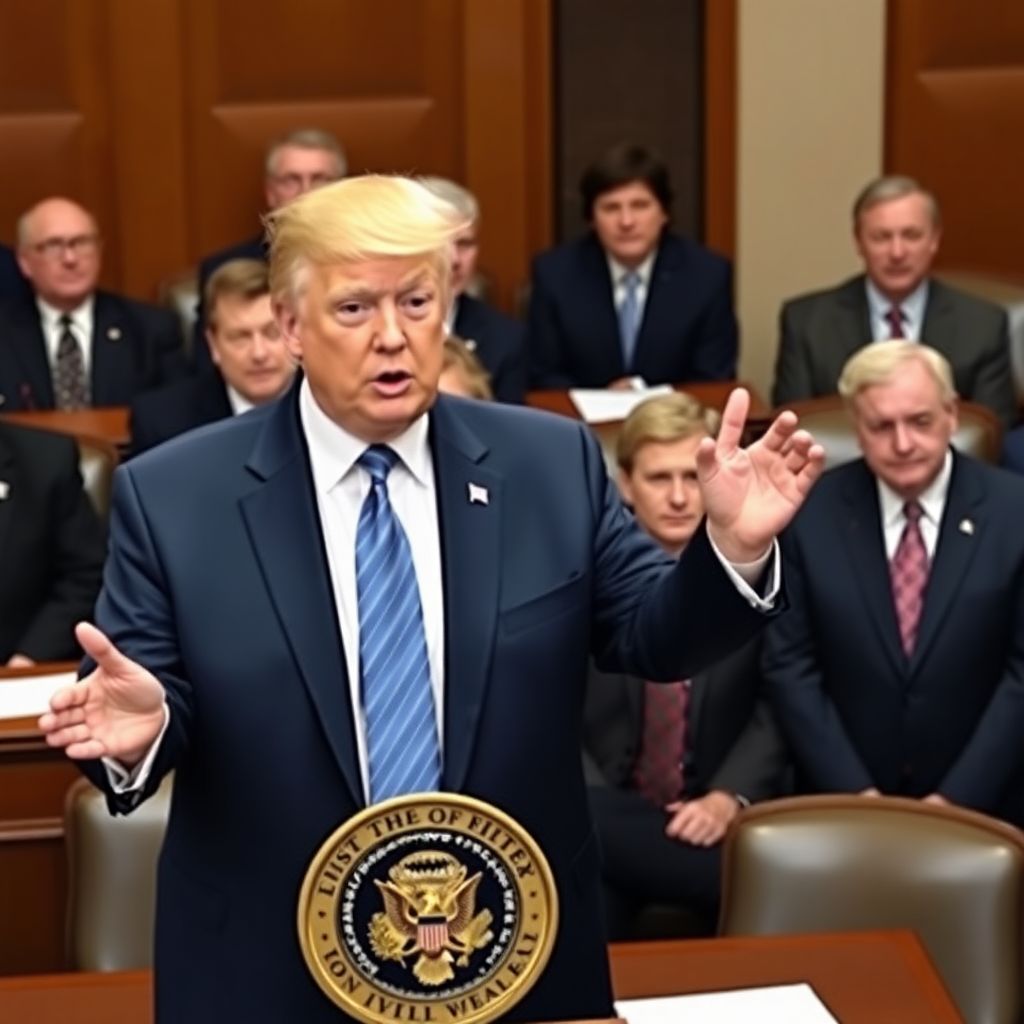
Trump pushes CLARITY Act as tribute to late ally Lindsey Graham amid shrinking Senate window
President Donald Trump is intensifying pressure on the U.S. Senate to move quickly on the CLARITY Act, a sweeping crypto market structure bill he says should be passed “in honor” of his late ally, Senator Lindsey Graham of South Carolina. Trump described Graham as a “big supporter” of the legislation and framed its passage as both a policy priority and a political tribute.
Beyond the personal angle, Trump cast the bill as a strategic necessity in the global race for dominance in digital assets and artificial intelligence. According to him, continued inaction in Washington risks allowing China to seize the upper hand in both crypto innovation and AI development, areas he argues are central to national security and economic leadership.
The sense of urgency is being amplified inside the administration. White House crypto advisor Patrick Witt called the coming days a “critical week for CLARITY,” stressing that the legislation cannot “afford to delay any longer.” He also noted that this pivotal push coincides with the one-year anniversary of GENIUS, another key initiative in the administration’s digital agenda, underscoring how long policymakers have already been debating core questions of crypto oversight.
Tight legislative calendar raises stakes
The Senate returned to Washington on Monday, July 13, after its Independence Day recess and is scheduled to adjourn again on August 8. That leaves lawmakers with a window of less than three weeks to debate and vote on the CLARITY Act before they leave town again.
So far, there is still no floor vote on the calendar. Even if the bill manages to clear the Senate in that compressed timeframe, the process would be far from over. The House of Representatives would also need to approve the legislation before it could be sent to Trump’s desk for signature and become law. In other words, every day of delay in the Senate makes the overall path to enactment significantly harder.
Law enforcement groups shift toward support
One key obstacle has already begun to ease. The CLARITY Act recently picked up the endorsement of the Federal Law Enforcement Officers Associations (FLELOA), adding to earlier backing from sheriffs’ groups. Law enforcement organizations had initially raised concerns about the bill’s implications for crime, sanctions enforcement, and illicit finance.
Their emerging support signals that negotiations have addressed at least some of these worries, removing a major political barrier that had given skeptical lawmakers cover to oppose or stall the bill. In the broader debate over crypto regulation, law enforcement buy-in is often decisive: it reassures moderates that innovation will not come at the expense of public safety or national security.
Banking lobby remains deeply uneasy
Despite progress with enforcement groups, resistance from the traditional financial sector and key Democratic lawmakers remains strong. The American Bankers Association (ABA) sent a letter to the Senate on Monday urging revisions to the bill’s treatment of stablecoin yields, a central feature of the CLARITY framework.
The association warned that vague wording around yield-bearing stablecoin products could accelerate capital flight from the banking system into digital assets functioning as de facto deposit substitutes. According to the ABA, Congress has consistently signaled that payment stablecoins should be designed primarily as tools for transactions, not as long-term store-of-value or savings vehicles.
From the bankers’ perspective, the current draft risks letting stablecoins blur that line. If investors can earn attractive yields on dollar-pegged tokens outside the banking regulatory perimeter, they may move funds out of insured bank deposits and into crypto platforms instead, potentially undermining financial stability and complicating monetary policy transmission.
White House pushes back on ‘settled’ stablecoin issue
Administration officials insist that the stablecoin yield debate has already been resolved in negotiations. Patrick Witt, responding sharply to the ABA’s criticism, said that a deal on this point is “asked and answered,” dismissing the banking lobby’s renewed objections and urging them to “give it a rest.”
That public rebuke highlights a widening fault line between the White House’s desire to formalize a regulatory framework for crypto and the banking sector’s efforts to limit competition from digital-native financial products. For the administration, locking in rules for stablecoins is essential to attract institutional capital, steer activity into compliant venues, and reduce the regulatory gray zones that have characterized the U.S. crypto market for years.
Warren brands bill a ‘sanctions evasion’ risk
On the other side of the aisle, Senator Elizabeth Warren has emerged as one of the most vocal critics of the CLARITY Act. Last week she labeled the proposal a “sanctions evasion” vehicle, arguing that its provisions could make it easier for bad actors to route funds through crypto channels outside the reach of existing enforcement tools.
This week, Warren shifted focus to ethics, renewing demands for stronger conflict-of-interest rules within the bill. She pointed to Trump’s projected $1.4 billion crypto windfall in 2025 as a case study in why ethics language matters, suggesting that high-ranking officials with large digital asset holdings could shape policy in ways that benefit their own portfolios.
For Warren and her allies, any major crypto legislation must address questions about disclosure, recusal, and restrictions on trading by senior government officials. Without those safeguards, they argue, the public cannot be confident that new rules for digital assets are being written in the national interest rather than for private gain.
Narrow math, shifting coalition
From a purely tactical standpoint, the road to 60 votes in the Senate has become steeper. To overcome a filibuster, Republicans previously needed just seven Democratic or independent senators to join them. Following Senator Graham’s death and the hospitalization of Senate Republican leader Mitch McConnell of Kentucky, the margin has shrunk, and Trump’s team now estimates that they will need support from roughly 9-10 Democrats to get the bill over the threshold.
In that context, Warren’s push for an ethics provision takes on outsized importance. If Democratic swing votes view the ethics language as a red line, it could either unlock bipartisan support or sink the bill altogether. Republicans must decide whether to accept tougher ethics constraints – potentially exposing Trump’s own financial ties to scrutiny – in exchange for a realistic shot at passing the administration’s signature crypto measure.
Market sentiment turns pessimistic
The uncertainty has not gone unnoticed by investors and political bettors. Market-based odds on the CLARITY Act’s passage have slumped to an annual low of about 38%, reflecting growing skepticism that lawmakers can align the necessary coalition before the August recess.
For traders and crypto entrepreneurs, that pessimism translates into a more cautious stance on U.S.-centric projects. Some are delaying product launches or expansion plans that depend on a clearer regulatory environment. Others are increasingly looking to jurisdictions that have already codified comprehensive crypto frameworks, such as those in parts of Europe and Asia, as more predictable venues for long-term investment.
What the CLARITY Act would mean for the crypto ecosystem
While the current debate is dominated by political maneuvering, the stakes for the industry are substantial. The CLARITY Act is designed to define how different categories of digital assets are treated under U.S. law, including when a token is regulated like a security, when it falls under commodities rules, and how stablecoin issuers must operate.
For businesses, such a framework could reduce the constant fear of retroactive enforcement and conflicting agency guidance. Exchanges, custodians, and DeFi platforms would have clearer expectations for licensing, disclosure, and consumer protection standards. That, in turn, could unlock participation from large financial institutions that have remained on the sidelines due to regulatory ambiguity and litigation risk.
Retail users could also see indirect benefits. A more unified rulebook would likely push activity toward compliant platforms with stronger transparency, better risk controls, and more robust safeguards against fraud and hacks. At the same time, stricter oversight and registration requirements might drive marginal or non-compliant projects out of the U.S. market, reshaping which tokens and services are accessible to American investors.
Geopolitics: the China and AI dimension
Trump’s warning about “letting China win on crypto and AI” reflects an anxiety shared across much of the national security establishment. Policymakers worry that if the U.S. continues to regulate primarily through enforcement actions and patchwork guidance, high-value innovation – from tokenized financial infrastructure to AI-driven trading and on-chain identity systems – will increasingly be built elsewhere.
For China and other competitors, leadership in these areas is seen as a way to reduce reliance on the U.S.-dominated financial system, soften the impact of sanctions, and expand influence over global payment rails. Supporters of the CLARITY Act argue that clear rules would encourage U.S. firms to build at home rather than offshore, preserving both economic value and strategic leverage.
Opponents counter that rushing into permissive rules could create new systemic risks and undermine established policy goals on money laundering, consumer protection, and macroeconomic stability. The debate over the bill is therefore not merely about crypto; it sits at the intersection of technology policy, finance, and great-power competition.
Ethics, transparency, and public trust
The fight over ethics provisions is emerging as one of the most consequential subplots in the CLARITY Act’s journey. If lawmakers craft robust requirements for disclosure of digital asset holdings, recusal from crypto-related decisions, and post-employment restrictions for regulators moving into the industry, they could set a precedent for how democracies govern emerging technologies where officials may have personal stakes.
Conversely, a weak or absent ethics section could deepen public suspicion that rules are being written by and for those most heavily invested in the sector. In that scenario, even a technically sound market structure bill might struggle to command long-term legitimacy, inviting future attempts to revise or repeal core provisions. For moderates in both parties, ensuring visible guardrails on conflicts of interest may be critical to selling any deal back home.
What to watch in the coming weeks
With less than three weeks on the Senate clock before the August recess, several indicators will show whether the CLARITY Act has a credible path forward:
– Scheduling of a floor vote: Placement on the Senate calendar would signal that leadership believes a viable compromise is near.
– Public movement from centrist Democrats: Statements from senators who have previously been noncommittal will reveal whether ethics language and enforcement assurances are sufficient.
– Further revisions on stablecoin provisions: Any last-minute tweaks to yield, reserve, or disclosure rules may be aimed at peeling off opposition from banks and risk-sensitive lawmakers.
– Health and attendance of key Republicans: With McConnell hospitalized and Graham gone, simple logistics of vote-counting could become decisive.
For now, Trump and his advisors are framing the CLARITY Act as a historic test: of America’s willingness to lead in digital finance, of Congress’s capacity to strike bipartisan deals on complex technology issues, and of whether the late Senator Lindsey Graham’s support for the bill can be translated into a legislative legacy. Whether that narrative prevails will be determined in a narrow and rapidly closing legislative window.