
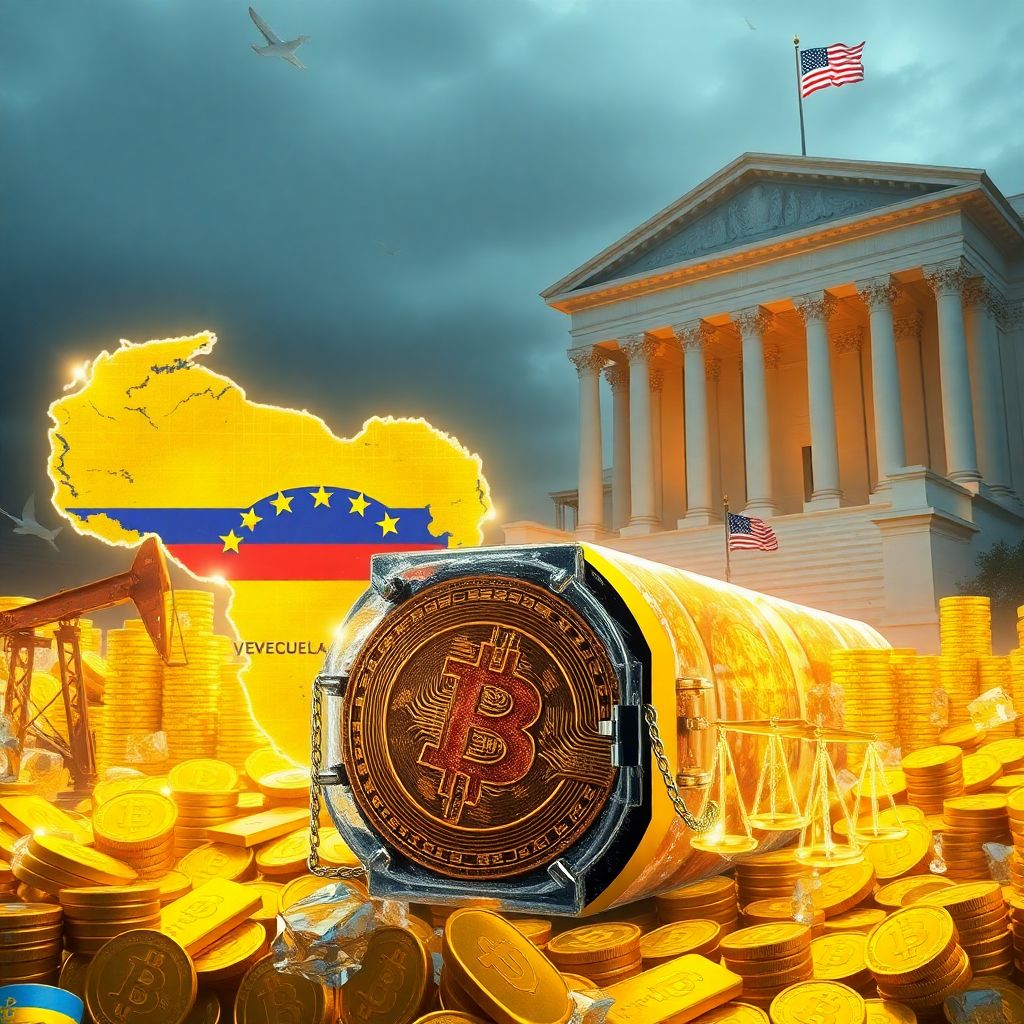
How Venezuela’s Secret Bitcoin Trove Could Shake the Market
Venezuela may be sitting on one of the largest undisclosed Bitcoin [BTC] stockpiles on the planet — potentially as much as 600,000 coins. At today’s prices, that stash is worth over 60 billion dollars and represents roughly 3% of Bitcoin’s total supply.
If control over these coins changes hands following political upheaval and they end up in U.S. custody, the impact on Bitcoin’s market structure could be dramatic — not necessarily because they are sold, but because they might be frozen for years.
This scenario would effectively remove a huge chunk of BTC from active circulation without a single trade taking place, reshaping the supply dynamics of the entire asset class.
—
A Hidden State Bitcoin Reserve
While global attention has long focused on Venezuela’s oil reserves, a quieter strategy appears to have unfolded in the background: the construction of a “shadow” Bitcoin reserve.
Starting around 2018, as international sanctions intensified, the Venezuelan state is believed to have turned increasingly to alternative financial channels:
– Gold sales and swaps from the Orinoco Mining Arc
– Forced oil-for-stablecoin deals, particularly using USDT
– Seizure and nationalization of domestic Bitcoin mining operations
Reports suggest that a substantial portion of Venezuela’s gold — estimated near 2 billion dollars’ worth — was converted into Bitcoin at average prices close to 5,000 dollars per coin. That alone could account for roughly 400,000 BTC.
As the government-backed Petro cryptocurrency faltered and lost credibility, USDT reportedly became a temporary settlement medium for oil exports. Over time, these inflows were allegedly funneled into Bitcoin, in part to avoid the risk of stablecoins being frozen by their issuers.
Adding subsequent BTC inflows from mining and other channels, current estimates place Venezuela’s Bitcoin hoard between 600,000 and 660,000 BTC.
—
How Big Is 600,000 BTC in Market Terms?
To understand the scale, it helps to compare Venezuela’s suspected holdings to other major players in the Bitcoin ecosystem:
– Germany’s 2024 government sale of roughly 50,000 BTC triggered a 15–20% price correction and weeks of bearish sentiment.
– Venezuela’s potential reserve is around 12 times larger.
– Its stash rivals or exceeds that of some of the largest corporate holders, like MicroStrategy.
– It sits just below the holdings of major spot Bitcoin ETFs and is almost double the U.S. government’s known seized BTC holdings.
In other words, if even a fraction of this reserve were abruptly sold, it could dwarf the impact of most historical government or institutional sales.
But the more important — and more likely — outcome is the opposite: not selling, but freezing.
—
Why a U.S. Seizure Would Likely Mean a Long Freeze
With the fall or capture of a political regime, state-controlled assets often become the subject of intense legal and diplomatic battles. If the U.S. or allied authorities gain access to Venezuela’s Bitcoin reserves, several outcomes are possible, but one stands out as the most probable:
1. Multi-year legal limbo
State assets are typically contested by multiple parties: successor governments, foreign creditors, victims seeking restitution, and various claimants. In the case of Bitcoin, the coins could be:
– Held in government-controlled wallets
– Parked with custodians
– Locked in escrow pending court rulings
This process can drag on for years, during which the BTC would not move or enter trading markets.
2. Strategic reserve scenario
There is a growing trend among policymakers toward viewing Bitcoin as a strategic asset or digital reserve. Political leaders in several countries have publicly floated the idea of using Bitcoin as a hedge or store of value.
If U.S. leadership opts to treat seized BTC as a long-term reserve rather than a liquid asset to be sold, that would further reduce incentives for rapid disposal and favor a slow, controlled approach — or no sale at all.
3. Rapid liquidation: unlikely but not impossible
The least likely, but most market-shocking path would be a “fire sale” of a large portion of the coins. Such a move would:
– Crash prices in the short term
– Undermine the perception of Bitcoin as a stable, maturing asset
– Hurt U.S.-based holders, institutions, and ETF investors
Politically and strategically, orchestrating a sudden dump of tens or hundreds of thousands of BTC would run counter to the interests of many powerful domestic stakeholders. That makes a rapid liquidation the least rational option on the table.
—
What Happens If 3% of BTC Supply Disappears From Circulation?
If 600,000 BTC end up frozen in legal or political limbo, the immediate effect is a drop in effective circulating supply. While Bitcoin’s maximum supply is fixed at 21 million coins, a significant portion is already illiquid or lost:
– Long-term holders who rarely sell
– Lost coins due to forgotten keys or destroyed wallets
– Institutional holdings kept in cold storage
Adding another 3% of total supply into a quasi-permanent lockbox alters the balance between active and inactive coins. For an asset built around scarcity, this matters.
In concrete terms, a major freeze would:
– Reduce the amount of BTC actually available for trading and price discovery
– Amplify the impact of new demand, especially from ETFs and large institutions
– Make each remaining liquid coin more valuable in relative scarcity terms
The market learned a smaller version of this lesson from Germany’s sale: a 50,000 BTC move triggered weeks of downside. Now imagine no sale at all, but 600,000 BTC quietly removed from the game board.
—
Market Psychology: Short-Term Volatility, Long-Term Support
In the short term, the mere uncertainty around Venezuela’s Bitcoin stockpile can fuel sharp price moves. Traders respond not just to flows but also to headlines and worst-case scenarios:
– Rumors of potential seizures or sales can spike volatility
– Fear of a government liquidation could briefly pressure prices
– Speculation about “hidden whales” influences derivatives markets and funding rates
However, the absence of panic selling and the lack of abnormal on-chain transaction patterns suggest that, so far, the market is not pricing in an imminent mega-dump of Venezuelan BTC.
Over the past years, Bitcoin has shown growing resilience to geopolitical shocks, sanctions, and regional conflicts. Each new episode has had a shorter and more muted impact on price behavior, as more of the supply migrates into the hands of long-term holders and institutional actors.
If the Venezuelan coins are eventually locked up for good, the long-term effect skews bullish:
– Less liquid supply supports higher equilibrium prices over time
– Large holders and ETFs benefit from increased scarcity
– Bitcoin’s narrative as “digital gold” and a finite asset is reinforced
—
How This Interacts With Halvings and ETF Demand
Timing is crucial. The coming years are likely to see:
– Ongoing demand from spot Bitcoin ETFs
– Continued accumulation by corporations and high-net-worth investors
– The echo effects of the latest halving, which has already cut new BTC issuance in half
A 600,000 BTC freeze would layer on top of these structural trends. With fewer new coins hitting the market and a large chunk of existing supply sidelined, the pressure tilts toward the demand side.
For ETF issuers and institutional allocators, this environment may feel increasingly similar to traditional commodities with limited supply — except Bitcoin’s supply schedule is fully transparent and mathematically enforced.
—
Geopolitics, Sanctions, and the New Role of BTC
Venezuela’s alleged Bitcoin reserve also highlights a broader geopolitical shift. Sanctioned states and politically isolated regimes have strong incentives to:
– Bypass traditional banking rails
– Avoid seizure of assets held in foreign financial institutions
– Use bearer-like digital assets to store value outside the reach of legacy systems
Bitcoin’s neutrality, censorship resistance, and global liquidity make it an obvious candidate. However, the Venezuelan case shows that even Bitcoin is not invulnerable to seizure if authorities gain access to private keys, hardware wallets, or custodians.
Future regimes may respond by decentralizing their key management, distributing reserves across multiple jurisdictions, or using more advanced custody schemes. This, in turn, could make large-scale seizures more difficult and further fragment the landscape of “state-level” Bitcoin holders.
—
What Traders and Investors Should Watch
For market participants, several indicators will matter going forward:
– On-chain movement of large, dormant wallets potentially tied to state entities
– Legal developments involving Venezuelan state assets and foreign claims
– Official statements by U.S. or transitional Venezuelan authorities about digital reserves
– Policy hints on whether seized BTC is treated as an asset to hold, auction, or liquidate gradually
Price action alone won’t tell the whole story. The real signal may come from the combination of legal decisions, public policy, and on-chain traceability.
—
Could a Controlled Liquidation Still Happen?
While a sudden dump is unlikely, a controlled, multi-year liquidation remains possible. Governments have previously auctioned seized Bitcoin in batches, using structured sales to minimize shock to the market.
A similar approach with Venezuelan BTC could look like:
– Periodic auctions of small tranches
– Pre-announced schedules to increase market transparency
– Use of professional market makers to absorb liquidity
Such a strategy would still exert downward pressure during sale windows but would be far less disruptive than a one-time sell-off. At the same time, each auction would test demand from institutions, ETFs, and large retail buyers.
—
The Bigger Picture: 2026 and Beyond
If tens or hundreds of thousands of BTC tied to Venezuela remain locked beyond 2026, Bitcoin could enter a new phase:
– A structurally reduced free-float market
– Higher sensitivity to incremental demand from funds and corporates
– A more entrenched narrative of digital scarcity, reinforced by real-world geopolitical events
Ironically, a crisis in a heavily sanctioned country might end up strengthening Bitcoin’s macro thesis. A large state’s attempt to build a “shadow reserve,” followed by a foreign seizure and long-term freeze, would vividly demonstrate both:
– Bitcoin’s utility as a sanction-evading tool, and
– Its vulnerability if key custody falls into adversarial hands.
—
Final Thoughts
Whether Venezuela’s suspected 600,000 BTC reserve is seized, frozen, or slowly distributed, it has already become a pivotal test case for Bitcoin at the nation-state level.
If those coins are locked away in legal and political limbo, roughly 3% of Bitcoin’s supply would, for all practical purposes, vanish from circulation. In a market defined by scarcity, that is not a footnote — it is a structural shift.
Short-term volatility around headlines is inevitable. But if the most probable scenario plays out — a prolonged freeze rather than a chaotic fire sale — the long-term consequence is clear: fewer liquid coins, stronger scarcity, and a potentially more powerful bull case for Bitcoin as it matures into the late 2020s.
—
This text is for informational purposes only and should not be treated as financial or investment advice. Cryptocurrency trading and investing involve significant risk, and every participant should conduct independent research and assess their own risk tolerance before making decisions.