
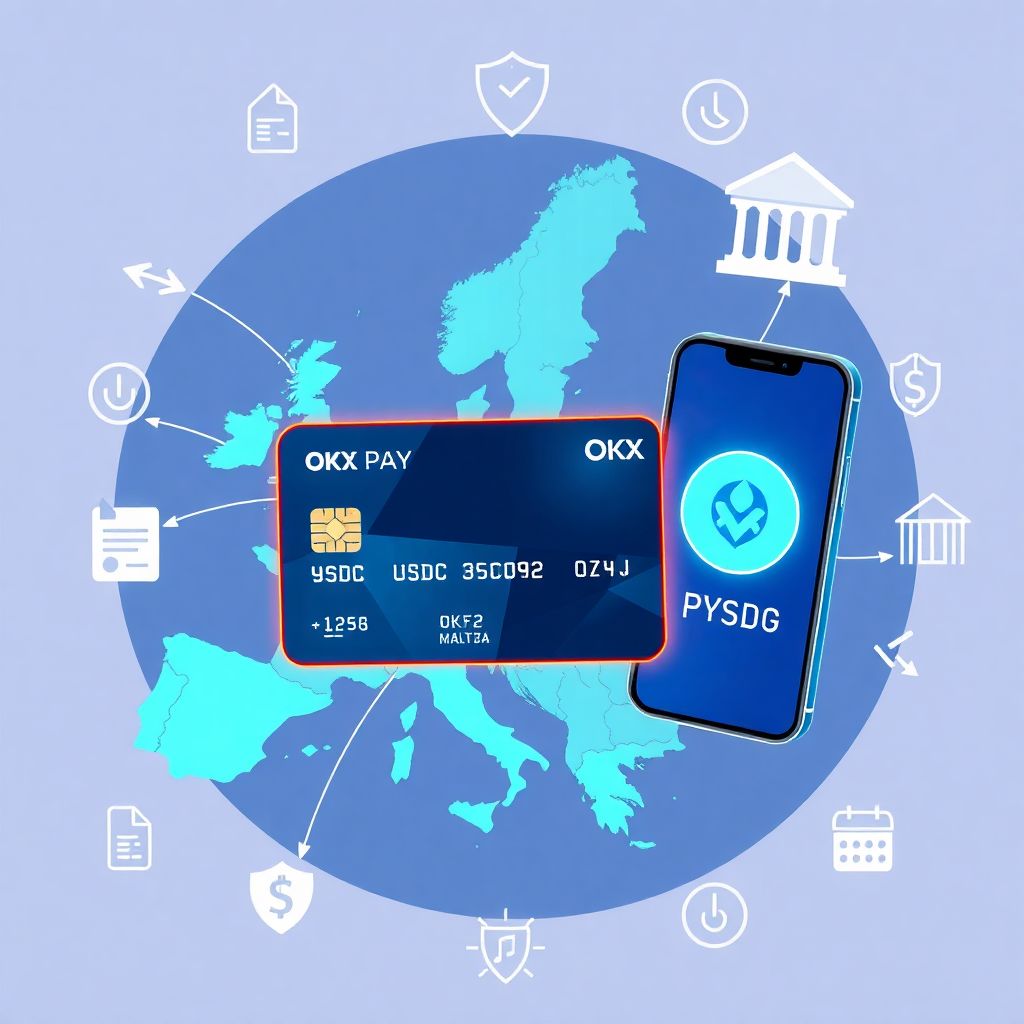
OKX has strengthened its presence in the European Union by securing a Payment Institution (PI) license in Malta, paving the way for a broader rollout of its stablecoin-based payment products across the region. The authorization allows the exchange to offer payment services such as OKX Pay and the OKX Card in full alignment with the EU’s evolving regulatory standards for digital assets.
The Maltese PI license is issued under the EU’s harmonized payments framework and is specifically structured to comply with the Markets in Crypto-Assets Regulation (MiCA) and the Second Payment Services Directive (PSD2). Together, these regimes define how crypto firms providing payment services must operate if they handle stablecoins or other digital assets in a way comparable to traditional money transfers or card payments.
Under MiCA and PSD2, crypto-asset service providers (CASPs) that want to offer payment services involving stablecoins are required to hold either a Payment Institution license or an Electronic Money Institution (EMI) authorization. OKX’s new PI status comes more than a year after the platform received its MiCA authorization from the Malta Financial Services Authority (MFSA) in January 2025, building on an existing regulatory base rather than starting from scratch.
According to OKX Europe CEO Erald Ghoos, the license is a crucial step toward embedding the company’s payments business firmly within the EU’s legal framework. He emphasized that obtaining PI authorization ensures OKX’s products “operate on a fully compliant footing,” which is becoming increasingly important as regulators pay closer attention to stablecoin usage in everyday payments.
The license covers the exchange’s key payment offerings, most notably OKX Pay and the OKX Card. These products are designed to let users spend crypto assets and stablecoins in a way that closely mirrors traditional fintech services, bridging the gap between on-chain balances and real-world transactions. By operating under a PI license, OKX can position these tools as regulated payment solutions rather than experimental crypto features.
Officially launched in late January, the OKX Card enables users to pay in stablecoins at merchants that accept conventional card payments. Among the supported assets are Circle’s USD Coin (USDC) and the Paxos-issued Global Dollar (USDG). The goal is to provide a seamless user experience: cardholders can hold stablecoins in their OKX accounts and spend them directly, without manually converting to fiat beforehand.
From a user perspective, this move could significantly improve the practicality of stablecoins in Europe. Stablecoins are often used for trading or as a store of value during market volatility, but their usage at point-of-sale has historically been limited. With a regulated card and payment infrastructure in place, OKX aims to turn stablecoins into a viable means of everyday spending, from online shopping to in-store purchases.
For merchants, the appeal lies in potentially faster settlement times, lower cross-border friction and a more global customer base, without needing to understand or directly handle blockchain infrastructure. Because OKX operates as an intermediary under a clear regulatory regime, merchants can accept card payments as usual, while OKX manages the crypto-to-fiat conversion and compliance obligations in the background.
The regulatory dimension is particularly important in the EU, where MiCA is reshaping the digital asset landscape. MiCA introduces specific rules for stablecoin issuers and intermediaries, with an emphasis on consumer protection, liquidity, reserve management and transparency. By obtaining a PI license in addition to its MiCA authorization, OKX signals that it intends not only to offer crypto trading but also to function as a long-term player in regulated payments.
PSD2 adds another layer of requirements, focusing on payment security, strong customer authentication (SCA), and competition in the payments market. Payment institutions must meet strict standards on safeguarding client funds, risk management, governance and anti–money laundering (AML) procedures. For users of OKX Pay and OKX Card, this translates into a framework where security controls and operational reliability are not optional add-ons but legal obligations.
Strategically, the Malta license offers OKX a gateway into the wider European Economic Area. Once fully passported, a PI license granted in one EU member state can, subject to regulatory notifications and approvals, allow services to be offered across multiple countries. This creates the potential for OKX’s stablecoin payments products to reach customers in numerous EU markets without requiring separate full licenses in each jurisdiction.
For the broader crypto and fintech ecosystem, OKX’s move illustrates how major exchanges are adapting to a world where “move fast and break things” is no longer tolerated in financial services. Instead, firms are increasingly building their business models around full regulatory integration, which may help normalize digital assets in the eyes of banks, regulators and mainstream consumers.
At the same time, the decision to center products around stablecoins such as USDC and USDG speaks to the growing preference for price-stable digital instruments in payments. Volatile cryptocurrencies remain popular for trading and speculation, but for day-to-day spending, both consumers and merchants tend to prefer assets that mirror fiat currency values. By supporting well-known, fiat-referenced stablecoins, OKX reduces the exchange rate uncertainty that might otherwise discourage people from paying in crypto.
There are also implications for cross-border payments. Stablecoins and blockchain rails can, in principle, bypass some of the delays and fees associated with traditional correspondent banking networks. By wrapping these capabilities in a regulated PI structure, OKX aims to offer users faster, cheaper transfers while staying within the legal expectations of European authorities. This combination of compliance and efficiency could make EU-based stablecoin payments more competitive against older systems.
However, regulatory compliance also brings heightened scrutiny. As EU authorities refine MiCA implementation and continue updating payment regulations, OKX and similar platforms will have to keep adjusting their operations, from how they handle reserves and disclosures to how they manage customer onboarding and transaction monitoring. The advantage for users is that these pressures usually translate into clearer protections and more predictable service standards.
For individuals and businesses considering whether to use services like OKX Pay or OKX Card, the Malta PI license provides an additional signal of credibility. It indicates that the company has undergone a rigorous licensing process, must adhere to ongoing supervision, and is accountable to a recognized financial regulator for its payment activities. In a market where trust remains a major barrier to adoption, this formal oversight can be a deciding factor.
Looking ahead, the combination of MiCA-aligned authorization and a PI license positions OKX to be part of the next phase of digital finance in Europe, where the line between traditional payments and crypto-native tools continues to blur. If user demand for stablecoin payments grows in response to clearer rules and more polished products, other exchanges and fintechs may follow a similar path, seeking payment licenses and building compliant, card-based or app-based spending solutions.
In this context, OKX’s Maltese PI license is more than a box-ticking exercise. It marks the transition of stablecoin payments from a niche add-on for crypto enthusiasts to an integrated, regulated service aimed at mainstream users across the EU, backed by rules that put consumer protection, transparency and stability at the forefront.