
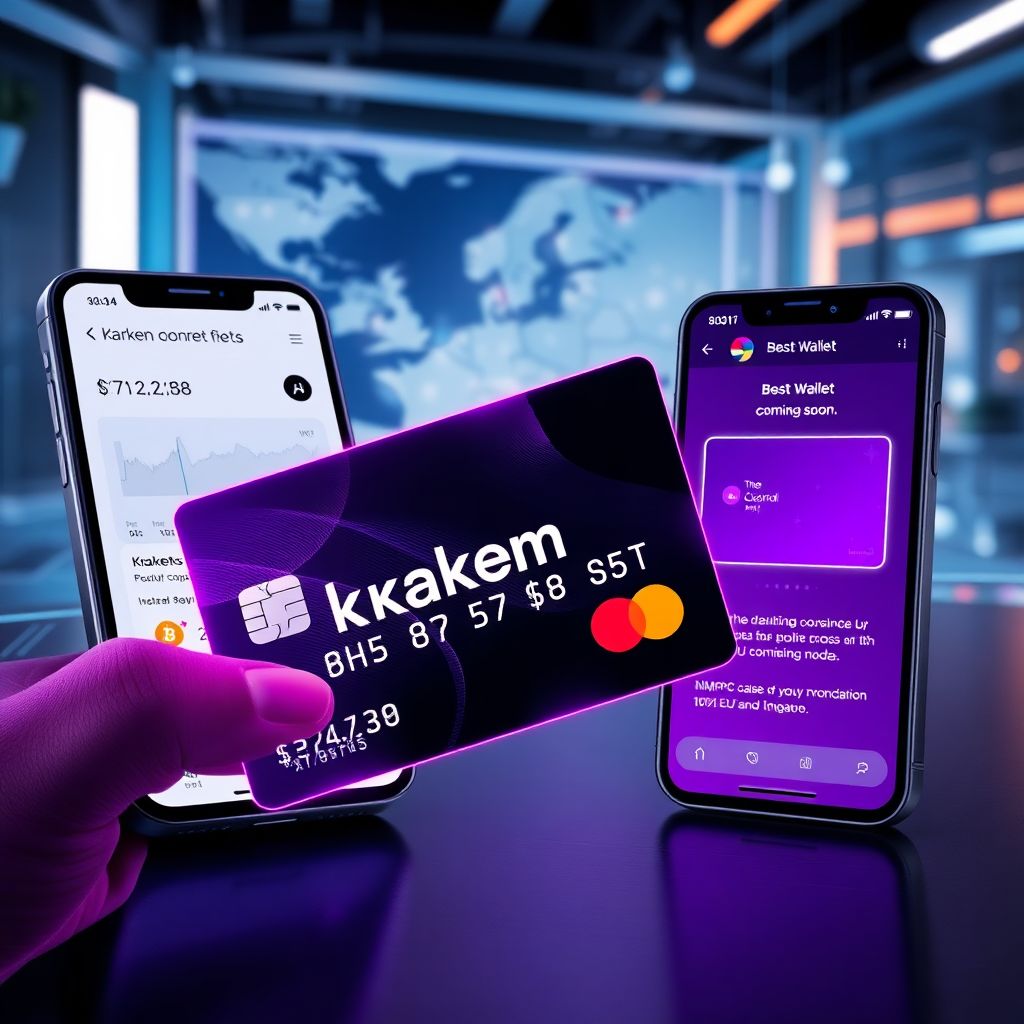
Kraken has taken another step toward turning crypto into an everyday spending tool, launching its own debit card for customers across the European Union and the United Kingdom. The new Krak Mastercard app lets users pay in fiat currency while holding their balances in digital assets – Kraken handles the instant conversion behind the scenes.
The card supports spending from multiple cryptocurrencies in real time anywhere Mastercard is accepted. According to the project’s announcement, cardholders can earn 1% cashback on every purchase and access more than 400 currencies with over 110 merchants across roughly 160 countries. Kraken has also teased several additional features under development, including a flexible yield option of up to 10% APY, currently marked as “coming soon” in the app.
What makes this move significant is not just another exchange-branded card, but the way it shifts the user experience. Instead of manually transferring funds from an exchange to a bank account and then spending through a traditional debit card, users can now simply tap-to-pay in local currency while Kraken converts crypto into fiat at the point of sale. For many, that removes one of the biggest frictions between holding digital assets and using them in daily life.
For years, crypto adoption has largely revolved around trading, yield farming, staking, and speculative activity in NFTs or new tokens. Everyday payments, despite being one of the earliest promises of cryptocurrencies, largely lagged behind. Card products existed, but they were often clunky: limited asset support, slow top-ups, prepaid-style balances, and occasional regulatory disruptions. Kraken’s launch underlines a broader shift as major players race to become the primary payment rail between Web3 assets and the traditional economy.
This raises a strategic question: if centralized exchanges are beginning to look more like full-service banks, what role will standalone wallets play in the future? That’s the gap Best Wallet is trying to fill with an approach that combines non-custodial control, institutional-grade security, on-chain discovery tools, and, eventually, its own debit-style product dubbed the “Best Card”.
Best Wallet’s roadmap points to a card that would integrate directly with its mobile wallet, which is built around Fireblocks-powered MPC (multi-party computation) technology. Instead of users parking most of their capital on centralized platforms, the idea is that they keep keys under their own control while still being able to spend via a familiar card interface. In theory, that would allow users to hold volatile assets such as BTC or ETH, or stablecoins, in a non-custodial wallet and seamlessly convert them when paying in fiat, without juggling bridges, gas tokens, or manual swaps.
The wallet itself is being developed as more than just a place to store coins. Best Wallet aims to cover the full user journey: custody, asset discovery, trading, and later, frictionless payments. The team has set an ambitious goal of capturing around 40% of the crypto wallet market by the end of 2026 by positioning the app as the easiest and safest way to interact with digital assets while still offering advanced features.
On the technical side, Best Wallet’s non-custodial architecture uses Fireblocks’ MPC-CMP infrastructure. MPC splits private key material among multiple parties so that no single point of failure can expose the full key. For users, the goal is to provide institutional-level security while keeping the interface simple enough for a retail audience. This is especially important if a future Best Card allows spending directly from the wallet, because compromised keys would effectively mean compromised spending power.
Beyond storage and security, Best Wallet is building an “Upcoming Tokens” portal designed to showcase vetted presales and early-stage projects. The objective is to give users a curated view of new tokens rather than forcing them to hunt across dozens of platforms. Alongside that, the project is integrating a DEX aggregator powered by Rubic, routing orders across more than 330 decentralized exchanges and 30 cross-chain bridges. This routing layer aims to secure better prices and deeper liquidity while hiding the complexity of multi-chain swaps from end users.
If the roadmap is realized, a typical user flow could look like this: discover a promising new token in the Upcoming Tokens section, participate in its presale using the built-in DEX aggregator, manage the position from within the same app, and eventually spend profits through the future Best Card in brick-and-mortar stores or online – all without exiting the Best Wallet ecosystem. That’s an entirely different approach from simply attaching a card to a centralized trading account.
The project’s native asset, Best Wallet Token ($BEST), is currently in presale and has already raised more than 17.5 million dollars, with the token price sitting around 0.026 dollars at the time of writing. Public projections shared by the project outline very aggressive potential returns over one and five years, pointing to possible multi‑fold increases if their growth assumptions materialize. These numbers are speculative, of course, and depend on execution, broader market conditions, and regulatory developments, but they underline how strongly the team is framing this as a long-term ecosystem play rather than a short-lived DeFi experiment.
Kraken’s card launch arrives in a landscape where several big names have already experimented with similar products. Binance, Crypto.com, and Coinbase have all introduced crypto card programs in different regions. However, many of those solutions rely on single-asset funding, require manual top-ups, or function more like prepaid cards than a truly integrated crypto-fiat rail. For users, the experience often feels like a workaround rather than a native connection between on-chain balances and real-world spending.
At the same time, browser-based and mobile wallets such as MetaMask, Trust Wallet, and Phantom are also exploring card integrations or off-ramp options. Yet, most of these wallets still resemble developer tools enriched with payment add-ons rather than end-to-end financial platforms. They excel at interacting with DeFi protocols, NFTs, and dApps, but few are ready to fully replace a neobank or everyday banking app in terms of usability, compliance, and customer support.
The direction of travel is becoming clearer: people increasingly want to hold a mix of volatile assets like BTC and ETH alongside stablecoins, earn yield where possible, and then spend in their local currency without having to learn about liquidity pools, slippage, or gas fee optimization. In this context, the race is not just about who issues a card first, but who manages to blend three layers into a single experience: secure self-custody, seamless Web3 access, and instant fiat payments.
For Kraken, the answer leans heavily on a centralized model. Users trust the exchange to custody funds (unless they withdraw), comply with regulation, and manage crypto-fiat conversions. The reward is convenience and familiar banking-style support, but this approach concentrates risk. In the event of an exchange issue, card functionality could be impacted because the funds and payments infrastructure are tied to the same centralized entity.
Best Wallet, in contrast, is betting that the future of everyday spending will be anchored in non-custodial wallets. If their Best Card works as planned, users would retain ownership of their keys and assets while a card network and payment processor handle the fiat side. This split between control (on-chain) and execution (traditional rails) could appeal to users who are wary of relying entirely on exchanges but still want day-to-day practicality.
However, delivering on this vision is challenging. Non-custodial cards must navigate strict KYC and AML requirements, card network rules, and local licensing regimes. They also need to abstract away technical complexity while retaining user control of keys – a delicate balance between security and convenience. Missteps in UX can lead to lost funds, and regulatory miscalculations can halt card programs overnight. Any project attempting this, including Best Wallet, will have to show it can operate at scale in a tightly regulated environment.
From a user perspective, comparing something like Krak Mastercard to a future Best Card involves weighing trade-offs. Kraken’s solution is ready now in the EU and UK, integrated into an established exchange with deep liquidity and a strong brand, and offers features such as 1% cashback and potentially yield on card balances. A Best Wallet card, while not yet launched, promises deeper Web3 integration, non-custodial security, and a single app where discovery, trading, and spending are tightly linked.
Another variable is ecosystem lock-in. Exchange cards are often optimized for users who trade or hold primarily on that platform, which can nudge them to consolidate activity within a single provider. Best Wallet’s thesis is the opposite: it aims to sit on top of multiple networks and DEXs as an aggregator, giving users access to many venues without requiring them to pick one exchange as their main home.
Security practices will be a key differentiator. Kraken, as a centralized exchange, invests heavily in custody and compliance, and it is responsible for protecting user funds on its platform. Best Wallet’s MPC-based architecture delegates security to a distributed key management system while pushing responsibility back to users, who must take care with device security, backups, and transaction approvals. For more advanced users who value self-sovereignty, that trade-off can be attractive; for newcomers, an exchange model may still feel safer and more straightforward.
In the broader picture, crypto debit cards are emerging as one of the main fronts in the battle over who owns the user relationship in the next phase of digital finance. Exchanges, wallets, and even neobanks are all trying to occupy the same space: the default app people open to check balances, move money, and pay for everyday items. Whichever model wins – centralized, non-custodial, or a hybrid – will shape how billions of dollars in value flow between blockchains and the traditional financial system.
Investors and users watching developments like Kraken’s card launch and Best Wallet’s planned Best Card should pay attention not only to rewards and APYs, but also to foundational questions: Who holds the keys? How is compliance handled? What happens if one provider goes offline? And how easily can funds be moved elsewhere if the ecosystem changes or regulations tighten?
As the market matures, the most successful solutions are likely to be those that feel as intuitive as current mobile banking apps but retain the open, programmable nature of crypto. Kraken’s new offering and Best Wallet’s ambitions around its own card highlight two different roads toward that goal – one starting from the exchange world and moving outward, the other starting from self-custody and moving into mainstream payments.