
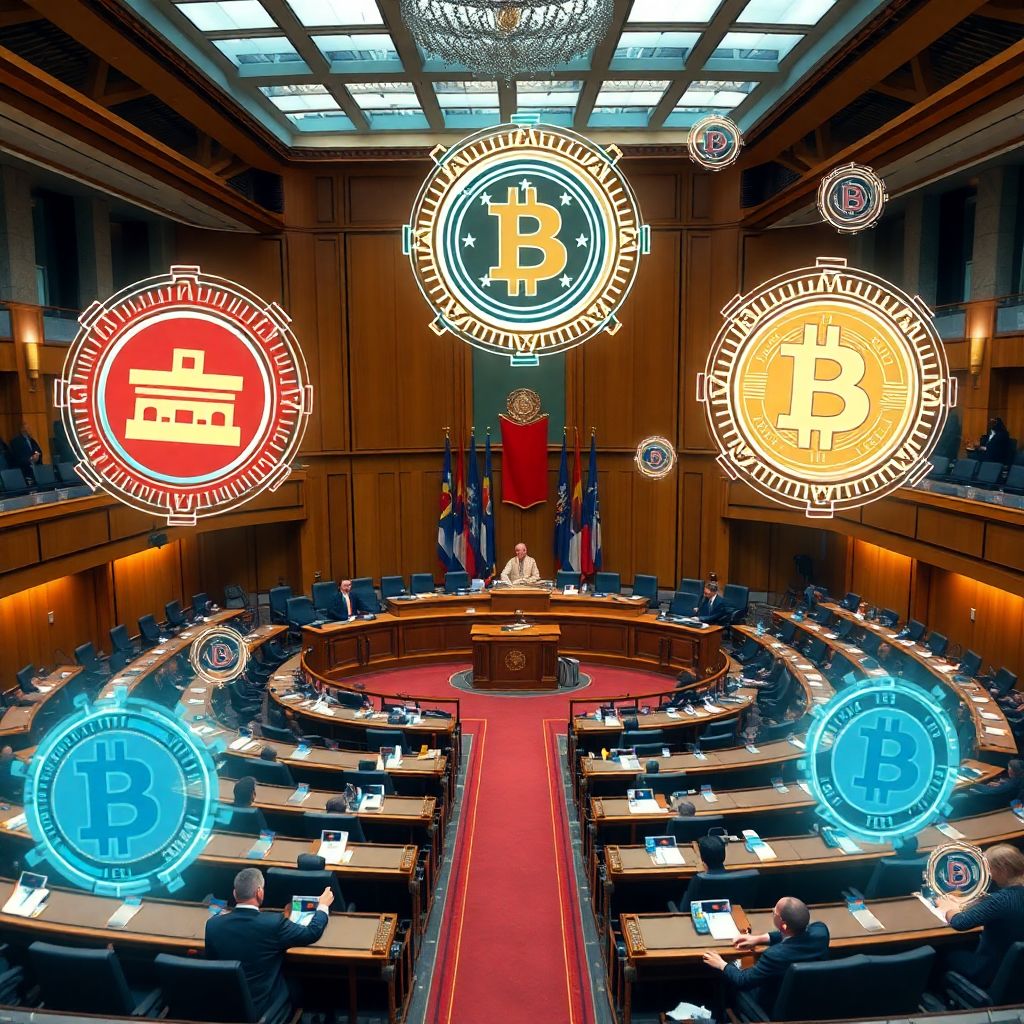
EU lawmakers push to expand crypto rulebook to DeFi, staking and NFTs
A key European Parliament committee has set out an ambitious blueprint for the next phase of crypto regulation in the bloc, calling on the European Commission to examine whether some of the fastest‑growing corners of the industry should be brought under direct supervision.
In a nonbinding report adopted by the Committee on Economic and Monetary Affairs (ECON), lawmakers urged the Commission to assess if decentralized finance (DeFi), crypto lending and borrowing, staking services and non-fungible tokens (NFTs) ought to be formally regulated, potentially by expanding the scope of the existing Markets in Crypto‑Assets Regulation (MiCA).
The document, drafted by Belgian lawmaker Johan Van Overtveldt, goes far beyond a technical review. It sets out Parliament’s strategic vision for how Europe should manage digital assets in the coming years: promote tokenization and euro‑based stablecoins, prevent regulatory fragmentation inside the bloc, and avoid being blindsided by new crypto business models that currently sit at the edge of MiCA’s framework.
From committee to Parliament’s official crypto stance
The report is an own‑initiative resolution, meaning it does not itself change the law. Instead, it provides formal recommendations to the European Commission, which is responsible for proposing any amendments to EU legislation.
ECON’s text now moves to the full European Parliament for a plenary vote, expected on July 7. If approved, it will become Parliament’s official political position on digital assets policy. That status gives the document considerable weight in upcoming regulatory debates, even though it does not automatically reopen MiCA or create immediate legal obligations for companies.
The timing is deliberate. MiCA, the EU’s flagship crypto law, is only just fully entering into force. Its transitional period ends on July 1, after which most crypto asset service providers will need formal authorization under the regulation to continue operating cross‑border in the single market. Lawmakers want to signal early where they believe the gaps and next priorities lie.
DeFi, staking, lending and NFTs under the microscope
When MiCA was drafted, policymakers deliberately left out some areas either because they were too nascent or too technically complex to regulate coherently. DeFi protocols, NFT collections, staking services and on‑chain lending platforms all largely escaped direct MiCA coverage.
That approach is now being reconsidered. ECON’s report explicitly calls on the Commission to analyze:
– Whether and how DeFi activities and protocols fall within the logic of MiCA’s framework
– If retail and institutional staking services should be treated as regulated financial activities
– The risks and consumer protection issues around crypto lending and borrowing platforms
– The appropriate regulatory treatment of NFTs and tokenized financial instruments
The Commission has already launched a public consultation on expanding MiCA’s perimeter to include such activities, and the committee’s report aligns with that review. Lawmakers are particularly concerned that unregulated yield‑generating products could expose EU consumers to hidden leverage, liquidity risks and opaque governance structures.
At the same time, the report stops short of demanding immediate, heavy‑handed oversight. Instead, it asks the Commission to carefully evaluate where existing financial rules can be applied by analogy, and where bespoke crypto‑specific provisions are needed to avoid stifling innovation.
Warning against a patchwork of national crypto laws
A central theme of the text is the call for a genuinely unified digital asset market across the EU. Parliament’s economic committee stresses that MiCA must be applied in a consistent way in all member states if Europe is to maintain a “level playing field” for crypto firms.
The report explicitly warns national governments against introducing additional domestic requirements on top of MiCA, arguing that such unilateral rules could fracture the single market and push companies to relocate to jurisdictions with more predictable frameworks.
This concern is not theoretical. Several member states have been tempted to bolt on extra registration, disclosure or tax rules for crypto businesses. ECON’s message is that any further regulation of digital assets should be coordinated at EU level, not left to individual capitals, to avoid regulatory arbitrage and confusion for investors.
A striking shift on euro‑denominated stablecoins
Perhaps the most noticeable change in tone comes around stablecoins. After years of skepticism and even hostility from many officials, the report openly welcomes euro‑denominated stablecoins that comply with MiCA, and “encourages” their development to support the bloc’s payments ecosystem.
Lawmakers argue that well‑regulated euro stablecoins could:
– Complement tokenized commercial bank deposits
– Interact smoothly with wholesale central bank digital currencies
– Enable faster, cheaper cross‑border payments inside and outside the EU
– Boost the competitiveness and depth of European capital markets
– Strengthen the international role of the euro in digital finance
This marks a clear evolution in thinking. In 2023, Johan Van Overtveldt himself called for much tighter restrictions on cryptocurrencies in the wake of the regional banking turmoil involving Silicon Valley Bank, Signature Bank and Silvergate Bank. That crisis had a direct crypto angle: Circle, the issuer of the USDC stablecoin, held about $3.3 billion of reserves at Silicon Valley Bank when it collapsed, briefly causing USDC to trade below its dollar peg.
During that period, Van Overtveldt likened cryptocurrencies to drugs, reflecting deep mistrust of the sector. His latest report, however, distinguishes between speculative tokens and carefully regulated euro‑backed stablecoins that operate inside a clear legal framework. The implication is that risks can be managed without abandoning the technology altogether.
Coexistence of public and private digital money
The committee’s enthusiasm for euro stablecoins dovetails with its broader position on the future of money in Europe. Earlier in the same week, ECON backed legislation to lay the groundwork for a digital euro, a potential central bank digital currency issued by the European Central Bank.
Lawmakers emphasize that public (central bank) and private (commercial and fintech) forms of digital money should coexist rather than compete head‑on. In their view, a healthy digital ecosystem will include:
– A digital euro providing a secure, state‑backed anchor
– Bank deposits and tokenized bank liabilities supporting credit creation
– Regulated stablecoins offering programmable, borderless payment options
By supporting euro‑denominated stablecoins under MiCA while also advancing digital euro legislation, Parliament is signaling that Europe does not want to choose a single dominant model for digital money. Instead, it aims to design an interoperable landscape where different instruments serve different use cases.
Tokenization as a strategic priority
Beyond narrow crypto policy, the report places tokenization at the heart of the EU’s financial modernization agenda. Lawmakers call for promoting tokenization “across financial services,” from securities settlement and collateral management to trade finance and asset servicing.
In practical terms, that could mean:
– Wider experimentation with tokenized bonds, equities and fund shares
– Using distributed ledger technology to shorten settlement cycles and reduce intermediaries
– Opening up new forms of fractional ownership for real estate, infrastructure or private assets
– Streamlining cross‑border issuance and listing of financial instruments
The committee believes that, if properly regulated, tokenization can lower costs, improve transparency and make European capital markets more attractive globally. The report positions MiCA and any future updates as part of a broader digital‑finance toolbox, rather than a standalone crypto rulebook.
The unresolved question of interest‑bearing stablecoins
One contentious issue the Commission is already revisiting is MiCA’s restriction on interest‑bearing stablecoins. Under the current regulation, asset‑referenced tokens and e‑money tokens face tight rules if they offer yield directly to holders, reflecting concerns that such features blur the line between payments instruments and investment products.
The ongoing review, and ECON’s call for a broader assessment of crypto activities, reopen debate on whether these restrictions are proportionate. On the one hand, banning or limiting interest‑bearing stablecoins may reduce systemic risk and avoid uncontrolled shadow banking. On the other, critics argue that it could stifle useful innovation, especially in on‑chain capital markets and liquidity management.
Parliament’s report does not prescribe a precise outcome, but by flagging the topic it ensures interest‑bearing stablecoins will be part of the next regulatory conversation.
What this means for DeFi and staking providers
For DeFi developers, staking platforms and crypto lending services, the committee’s stance is a clear signal that the EU is preparing to move from observational mode to active rule‑making.
In the near term, nothing changes overnight: MiCA’s existing provisions come into full force, but DeFi, pure protocol‑level activities and most NFT projects remain in a grey area. However, ECON’s recommendations suggest several likely directions:
– Front‑end interfaces, aggregators and custodial “DeFi‑like” services that are run by identifiable entities may be brought into a licensing regime similar to crypto asset service providers.
– Centralized staking providers and pooled staking services could be treated more like investment or payment services, requiring disclosures, capital rules and consumer safeguards.
– Crypto lending platforms targeting EU users might face requirements on risk management, governance, transparency of collateral and clear rules for dealing with defaults.
Firms operating in these segments would be well‑advised to monitor the Commission’s review closely, document their risk controls and prepare for a future in which operating at scale in the EU market requires formal authorization.
Implications for investors, startups and traditional finance
For retail and institutional investors, the drive to expand MiCA’s scope is primarily about protection and clarity. Clearer rules around staking, lending and DeFi interfaces should, in theory, reduce outright scams, improve disclosure of risks and make it easier to compare offerings.
For startups, the picture is more nuanced. On one side, additional regulation means higher compliance costs and legal complexity, especially for small teams. On the other, a harmonized EU framework can provide valuable legal certainty and access to a huge single market if they are willing to meet the standards.
Traditional financial institutions may be among the biggest winners. Banks, brokers and asset managers have been wary of deploying large‑scale crypto or tokenization projects due to regulatory ambiguity. A clearer, extended framework under MiCA could unlock more experimentation with tokenized securities, stablecoin‑based settlement and on‑chain fund distribution, all under supervisory structures they already know how to navigate.
The road ahead: slow, but directional
Even if Parliament adopts ECON’s resolution in July, the legislative process will be gradual. The Commission must decide whether and how to propose amendments or new laws; member states in the Council will have their own views; and technical details will take years to negotiate.
Yet the direction of travel is increasingly visible:
– MiCA is not the final word on crypto in Europe, but the foundation
– DeFi, staking, lending and NFTs are moving from the fringes of discussion into the core of the regulatory agenda
– Euro‑denominated stablecoins are shifting from being seen as a threat to being treated as a potential asset for European payments and market competitiveness
– Tokenization is being framed as a strategic tool to modernize the EU’s financial system
For now, the message from EU lawmakers is twofold: innovation in digital assets is welcome, especially when it reinforces the euro’s role and improves financial efficiency; but unregulated growth at the system’s edges-especially in yield‑bearing and leverage‑driven products-will not be allowed to continue indefinitely.
Market participants that adapt early to this reality, building compliant, transparent and euro‑friendly products, are likely to be best positioned as Europe writes the next chapter of its crypto regulation.