
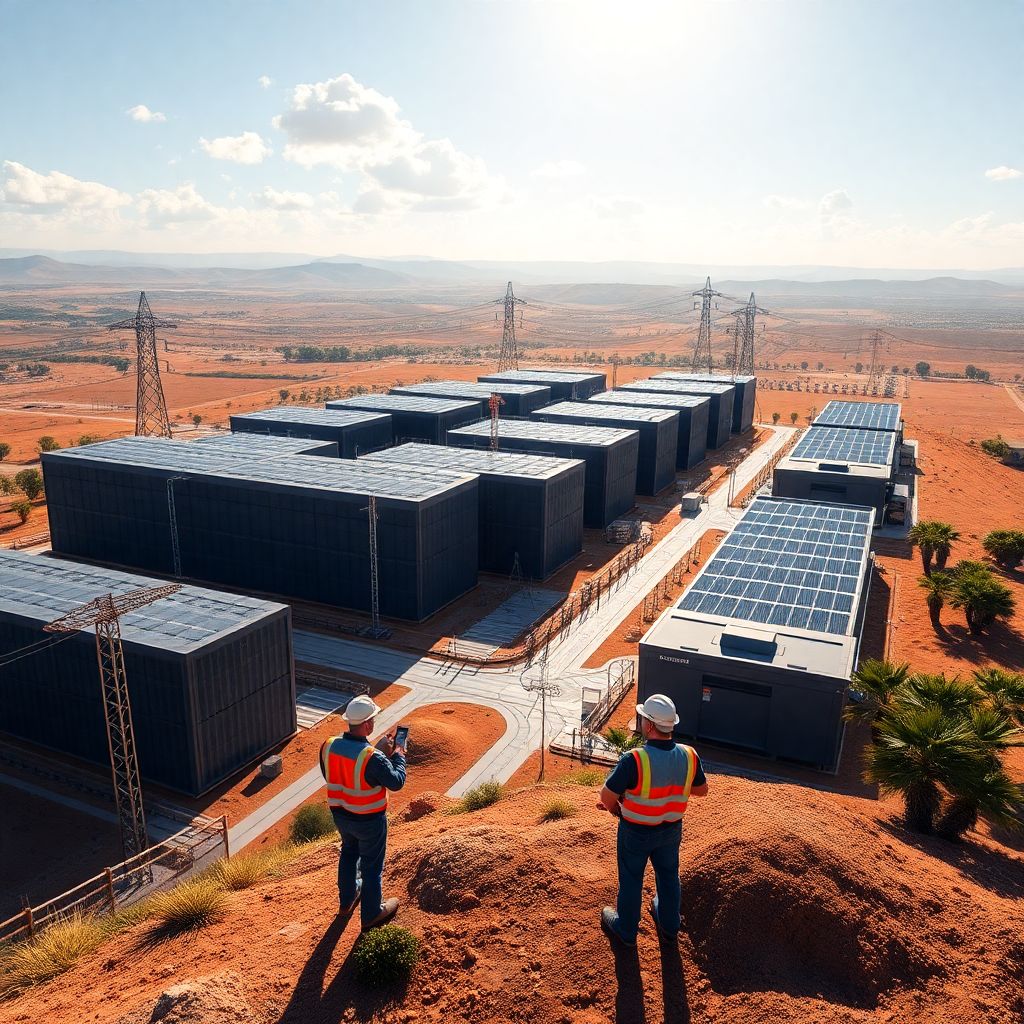
Bitcoin miner IREN has made its first major move into Europe, completing the acquisition of Spanish data center developer Nostrum Group as it races to transform itself into a global AI cloud infrastructure provider.
Under the deal, IREN gains access to roughly 490 megawatts of secured, grid-connected power capacity in Spain, along with a development pipeline and a team of more than 50 specialists across engineering, construction, development and operations. This new Spanish footprint lifts IREN’s total global power portfolio to around 5 gigawatts, with the Iberian assets now accounting for about 10% of its overall capacity.
Co-founder and co-CEO Daniel Roberts highlighted Spain’s strategic role in IREN’s expansion. The country offers a mix of abundant renewable energy and strong fiber connectivity, which together form a compelling foundation for high-performance computing and AI workloads. According to Roberts, Europe is not only one of the largest markets for AI infrastructure, but also one of the fastest-growing, and Spain stands out as one of the most attractive gateways into the region.
The Nostrum acquisition underscores IREN’s rapid shift away from a pure-play Bitcoin mining model toward a more diversified, AI-focused infrastructure business. AI cloud services, built around long-term contracts with enterprise and institutional clients, promise steadier, more predictable revenue streams compared with the inherently volatile economics of Bitcoin mining, which are tied to network difficulty, energy prices and large price swings in BTC itself.
This pivot comes at a time when Bitcoin miners around the world are reassessing their business models. Rising mining difficulty, periodic halving events, and increased competition have compressed margins and forced operators to look for alternative uses for their power and data center assets. The explosive growth of AI and high-performance computing has emerged as a natural fit: the same large-scale, energy-intensive infrastructure used for crypto mining can be repurposed to run GPU clusters and AI workloads.
IREN is far from alone in making this transition. Other major mining players are already building or converting facilities in Europe specifically for AI computing. HIVE Digital has been retooling a portion of its operations in Sweden for AI workloads, while Bitdeer is actively developing AI-ready data center capacity in Norway. Together, these moves point to a broader industry trend: traditional crypto miners are evolving into hybrid or full-scale digital infrastructure providers.
Financial results from IREN’s March 31 quarter illustrate how this transition is playing out in real time. Bitcoin mining is still the company’s main revenue driver, bringing in 111.2 million dollars over the period. By comparison, AI cloud services generated 33.6 million dollars. However, the direction of travel is clear: AI cloud revenue climbed from 17.3 million dollars in the previous quarter, while mining revenue declined from 167.4 million dollars.
IREN attributed the drop in Bitcoin mining income to a combination of lower average BTC prices and the decommissioning of older, less efficient mining hardware. That hardware retirement frees up power and facility capacity that can be redirected to high-value compute for AI. Meanwhile, the growing AI cloud segment demonstrates how quickly demand for GPU-based infrastructure is ramping, even as the company continues to rely heavily on Bitcoin for now.
Analysts have suggested that this pattern could deepen over time. Some expect IREN to gradually phase out a significant portion of its Bitcoin mining operations, retrofitting existing sites and power allocations to support AI cloud workloads instead. As of March 31, the company reported having about 150,000 GPUs either installed or on order. On current estimates, that GPU fleet could underpin an annual revenue run rate of around 3.7 billion dollars once fully deployed and monetized.
The acquisition of Nostrum tightens the link between this GPU buildout and IREN’s geographical diversification. Spain’s secured 490 megawatts of capacity offer a substantial runway for future growth in AI data centers, especially as the company targets clients across Europe that need latency-sensitive, large-scale computing power. The presence of an experienced local team also reduces execution risk, supporting faster development timelines and smoother integration with IREN’s global platform.
In the broader market context, the timing of IREN’s pivot aligns with several converging trends. Interest in AI infrastructure has surged as enterprises rush to deploy generative AI, machine learning and data-intensive analytics. At the same time, chip manufacturers and hardware providers have scaled up GPU production, while debt and equity markets have increasingly rewarded companies that position themselves as AI infrastructure leaders. Large technology firms’ aggressive capital spending on data centers has further validated the long-term demand outlook.
For Bitcoin miners specifically, AI is more than a side business; it is becoming a structural hedge. Mining revenue is cyclical and sensitive to macroeconomic factors, from monetary policy to regulatory developments. AI cloud services, in contrast, can be underpinned by multi-year contracts, capacity reservations and service-level agreements, which smooth out earnings and make cash flows more visible. This shift can also make companies more attractive to institutional investors seeking exposure to the AI theme rather than to cryptocurrency price volatility.
Spain’s role in this story extends beyond its immediate benefits for IREN. The country has been positioning itself as a European hub for renewables, including solar and wind, which are crucial in an era where both regulators and customers scrutinize the environmental footprint of data centers. Locating AI infrastructure near abundant green power not only lowers operating costs over time but also helps meet sustainability targets and appeal to clients with strict ESG requirements.
From a technical standpoint, pivoting from Bitcoin mining to AI computing involves more than just swapping ASICs for GPUs. Cooling solutions, power distribution, network architectures, and software stacks all need to be optimized for AI workloads, which tend to be more variable and complex than hashing algorithms. The Nostrum acquisition suggests that IREN is not only buying power capacity but also leveraging local expertise in designing and constructing facilities that meet these new requirements.
Over the next few years, competition for AI compute in Europe is likely to intensify. Cloud hyperscalers, regional providers, and specialist AI infrastructure firms are all racing to lock in customers and secure long-term power contracts. IREN’s early move into Spain, backed by gigawatt-scale global capacity and a large GPU pipeline, positions it as a serious contender in this race rather than a niche mining company dabbling in AI on the side.
There are also regulatory and geopolitical dimensions that could further shape IREN’s European strategy. Data sovereignty rules, privacy regulations, and local requirements around critical infrastructure may encourage enterprises to favor regional data center operators or facilities physically located within the EU. By establishing a robust base in Spain, IREN can address these concerns while offering European clients lower latency and better compliance alignment than purely overseas providers.
For investors and industry observers, the key question is how quickly the revenue mix will shift. If AI infrastructure demand continues to surge and hardware deployment stays on schedule, IREN’s AI cloud segment could move from being a fast-growing secondary business to a primary driver of profits. In parallel, Bitcoin mining may evolve into a complementary activity, used opportunistically when network conditions and energy prices are favorable, rather than as the core identity of the company.
Ultimately, IREN’s acquisition of Nostrum and its expansion into Spain mark more than a geographic milestone. They signal a broader transformation of what a “Bitcoin miner” can be: not just a participant in a single crypto network, but a versatile operator of large-scale, energy-intensive digital infrastructure that can flex across multiple high-demand computing markets. As AI reshapes the global technology landscape, IREN is betting that its future lies less in mining blocks and more in powering the algorithms that define the next generation of software and services.