
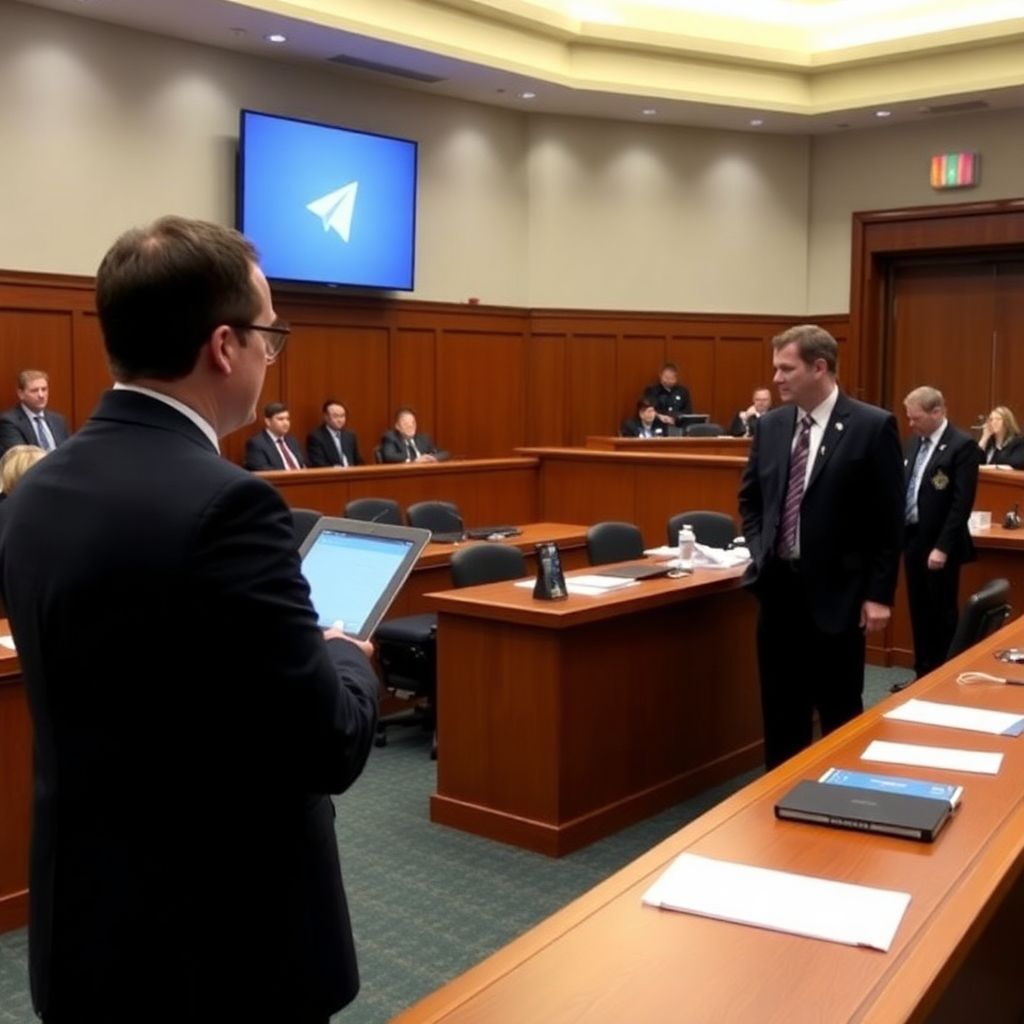
Australia drags Telegram to court over alleged failures to curb terrorist content
——————————————————————————-
Telegram, the encrypted messaging app with more than a billion users worldwide, is facing a high‑stakes legal showdown in Australia over claims it repeatedly failed to remove extremist and terrorism‑related material from its platform.
The country’s online safety watchdog, the eSafety Commissioner, has filed civil penalty proceedings in the Federal Court, accusing Telegram of breaching Australia’s Online Safety Act. According to the regulator, Telegram did not adequately respond to user complaints about “pro‑terror” content and left clearly illegal material accessible for weeks.
Alleged breaches of Australia’s Online Safety Act
The eSafety Commissioner says the case follows a year‑long investigation into how Telegram handles harmful content flagged by users. Regulators allege that once Telegram became aware of specific extremist posts, it did not act quickly or decisively enough to remove them.
Some reported content, the watchdog claims, remained online for up to three weeks, despite being identified as unlawful. Under the Online Safety Act, major platforms are expected to move much faster in dealing with material that incites violence, promotes terrorism or glorifies mass attacks.
The regulator also accuses Telegram of failing to introduce effective measures to stop repeat violations. Rather than simply reacting to individual posts, platforms are increasingly expected to disrupt the broader networks that spread extremist material. In Telegram’s case, eSafety alleges that accounts, channels and groups used primarily to disseminate pro‑terror content were not consistently removed or disabled.
Failure to detect known extremist material
One of the most serious claims is that Telegram did not proactively detect and block content that has already been widely identified as extremist by authorities and tech companies worldwide. According to eSafety, the platform allowed material linked to the 2019 Christchurch mosque attacks in New Zealand and the 2022 mass shooting in Buffalo, New York, to circulate before it was eventually taken down.
These specific incidents have become reference points in global debates over content moderation. Footage from both attacks is now on many platforms’ internal blocklists, with automated tools designed to spot and remove copies as soon as they are uploaded. Australia’s regulator argues that Telegram fell short of the emerging industry standard by not effectively filtering such content before it spread among users.
Potential multi‑million‑dollar penalties
By taking Telegram to court, the eSafety Commissioner is seeking significant financial sanctions. Under the Online Safety Act, serious or systemic violations can trigger fines of up to 54.6 million Australian dollars, roughly 35.8 million US dollars.
The final amount, if any penalties are imposed, will depend on how the court assesses both the scale of non‑compliance and Telegram’s overall conduct in Australia. Beyond the money, the case is also meant to send a signal to global platforms: operating at scale in the country comes with legal obligations to protect users from some of the most dangerous forms of online content.
Telegram’s public stance: “freedom of expression”
Telegram has not released a detailed formal response to the Australian lawsuit. However, the company’s official social media presence has leaned heavily on free‑speech messaging. Around the time the case became public, Telegram’s main account published a video under the caption “freedom of expression,” implicitly framing the dispute as part of a broader battle over digital rights.
This aligns with the public persona of CEO Pavel Durov, who has spent years presenting Telegram as a bastion of privacy and unfiltered communication. The platform’s encryption, minimal data collection, and resistance to content takedown demands have made it especially popular among activists, dissidents and users in authoritarian states – but the same features have drawn criticism from governments and security agencies that say it is also used by extremist networks and criminal groups.
Rising global legal pressure on Pavel Durov and Telegram
The legal clash in Australia does not exist in isolation. Around the world, authorities are ramping up pressure on Telegram and its founder.
In Russia, the Federal Security Service has charged Durov with facilitating terrorist activities. Russian officials claim Telegram failed to remove channels, chats and bots allegedly used by Ukrainian intelligence, terrorist cells and extremist organizations for planning attacks, recruiting members and running cyber fraud schemes. The authorities have initiated steps to place Durov on an international wanted list.
Telegram has again avoided detailed public comment on the Russian charges. Instead, the company posted an image of Durov making an obscene hand gesture, a defiant visual response that fits his cultivated image as a tech rebel unwilling to bend to state demands.
Ongoing criminal investigation in France
Durov’s legal troubles extend into Western Europe as well. He remains under investigation in France following his arrest at Le Bourget Airport in August 2024. French prosecutors have charged him with involvement in the dissemination of illegal content via Telegram, including material linked to organized crime.
Authorities in France argue that by providing a communication tool that allegedly facilitates criminal operations and failing to impose sufficient controls, Telegram bears some responsibility. Durov, for his part, has repeatedly warned that governments are using such arguments to justify intrusive interference in digital communications and to erode long‑standing privacy protections.
The broader debate: online safety vs digital rights
At the core of the Australian case – and the wider legal pressure on Telegram – lies a difficult question: where should the line be drawn between free expression, user privacy and public safety?
Governments increasingly insist that platforms must move beyond a neutral “we just host content” posture. Laws like Australia’s Online Safety Act demand that large tech companies detect, prevent and remove certain types of material, ranging from child sexual abuse to terrorist propaganda.
Platforms like Telegram counter that aggressive monitoring can easily morph into blanket surveillance, undermining the very privacy and freedom that made the internet transformative. Durov has argued that what was once a promise of open information exchange is being reshaped into a tool of control – with states pressuring tech firms to police speech, track users and hand over data.
How encrypted platforms are adapting
Telegram’s situation highlights a practical dilemma: content‑moderation expectations are rising precisely as users flock to encrypted and semi‑encrypted platforms that limit what companies can see.
Some services have invested in hybrid models – using metadata, user reporting and automated matching of known illegal files to cut down on extremist content without fully scanning private messages. Others are experimenting with stricter enforcement in public and semi‑public spaces (like large channels and groups), while keeping one‑to‑one chats largely untouched.
The Australian lawsuit suggests regulators increasingly view large open channels and public groups on messaging apps as functionally similar to social networks, and therefore subject to the same safety rules. How the court interprets Telegram’s duties in those spaces could set an important precedent for other encrypted messaging services.
Possible outcomes and implications for the tech industry
If the Federal Court finds Telegram in breach of the Online Safety Act and imposes substantial fines, it could reshape how global platforms weigh the costs of operating in highly regulated markets. Some companies may choose to invest heavily in expanded moderation teams, automated detection tools and clearer user reporting systems to avoid similar clashes.
Others might opt to limit or restructure certain features – for example, capping group sizes, restricting anonymous channels, or introducing stricter onboarding for users who want to create large broadcast lists. In extreme cases, platforms may even reduce or withdraw services from jurisdictions where compliance requirements are seen as too intrusive or technically unworkable.
On the other hand, if Telegram successfully defends itself, it may embolden other platforms to push back against sweeping safety laws, arguing that governments are overstepping and imposing unrealistic expectations on communication tools.
The crypto angle: financial compliance and reputational risk
While the Australian case centers on terrorism‑linked content rather than financial activity, it lands at a time when Telegram’s ecosystem is increasingly intertwined with digital assets. The platform has been developing its own crypto‑related products, including a native wallet, and has long been a hub for crypto communities, token launches and digital finance projects.
Heightened scrutiny over extremist content can spill over into financial regulation, as authorities become more sensitive to the potential for crypto payments, on‑chain tipping or tokenized ecosystems to be misused for funding illegal activity. If Telegram is perceived as a high‑risk environment from a security perspective, it could deter institutional partners or payment providers from deeper integration.
Conversely, demonstrating strong compliance on content and user protection might help the platform argue that it can safely host financial services and Web3 projects without becoming a haven for abuse.
What this means for everyday Telegram users
For most users, the immediate impact of the Australian proceedings will be limited. Chats will continue to function, and there’s no suggestion of an imminent ban. However, if regulators win, Telegram could be forced to implement stricter moderation practices globally, not just in Australia, simply to avoid fragmentation of its service.
That might mean faster takedowns of flagged channels, more active monitoring of large public groups, clearer reporting tools, or revised terms that explicitly ban certain categories of speech and imagery. Users who rely on Telegram for political activism or sensitive communications may worry that tighter enforcement could blur into broader surveillance – especially in countries where the line between terrorism and dissent is politically contested.
At the same time, many users – particularly those in countries that have experienced extremist violence – may welcome a firmer stance against channels that glorify attacks or distribute propaganda.
A test case for the next phase of platform regulation
Australia’s lawsuit against Telegram crystallizes a shift in how governments deal with global tech companies. Rather than relying solely on informal pressure or voluntary codes, regulators are increasingly willing to haul platforms into court, test the boundaries of new safety laws and seek eye‑watering fines for non‑compliance.
Whatever the outcome, the case will feed into a global conversation that goes beyond one app or one founder: can platforms simultaneously uphold robust privacy, protect free expression and still meet the growing expectation that they actively suppress the worst forms of online content? As Durov faces legal challenges in multiple jurisdictions, Telegram has become a high‑profile proving ground for that unresolved question.