
Apollo’s 90M MORPHO Deal: Can It Reverse the Token’s 40% Q4 Drawdown?
Morpho, the DeFi lending protocol and on-chain vault curator, has entered 2026 with another heavyweight institutional partner on its roster. After securing attention from players like Bitwise and Anchorage Digital as an institutional-grade, on-chain capital deployment venue, Morpho has now announced a fresh arrangement with global asset manager Apollo.
According to Morpho’s Friday statement, Apollo has secured the right to acquire up to 90 million MORPHO tokens over the next 48 months. Based on current market prices, that potential allocation is valued at roughly 115.2 million dollars, underscoring just how seriously traditional finance continues to probe the DeFi space.
However, the structure and implications of the deal have sparked divided opinions across the digital asset industry. On one side, some see the move as further validation that large, sophisticated investors are increasingly comfortable experimenting with DeFi-native assets and protocols. Richard Galvin, CIO at Digital Asset Capital Management, framed the development as another data point in a broader, bullish institutional adoption trend.
Others have been more cautious. Jeff Dorman, CIO at Arca, warned that market participants should not rush to interpret Apollo’s announcement as a straightforward token purchase commitment. He pointed out that the language in the release is deliberately loose and drew a parallel to a previous case involving HASH, in which an institution reportedly received tokens at highly favorable terms simply for publicly aligning itself with the network. In his view, without clear disclosure of pricing, vesting, or lock-up conditions, it is premature to assume aggressive open-market buying by Apollo.
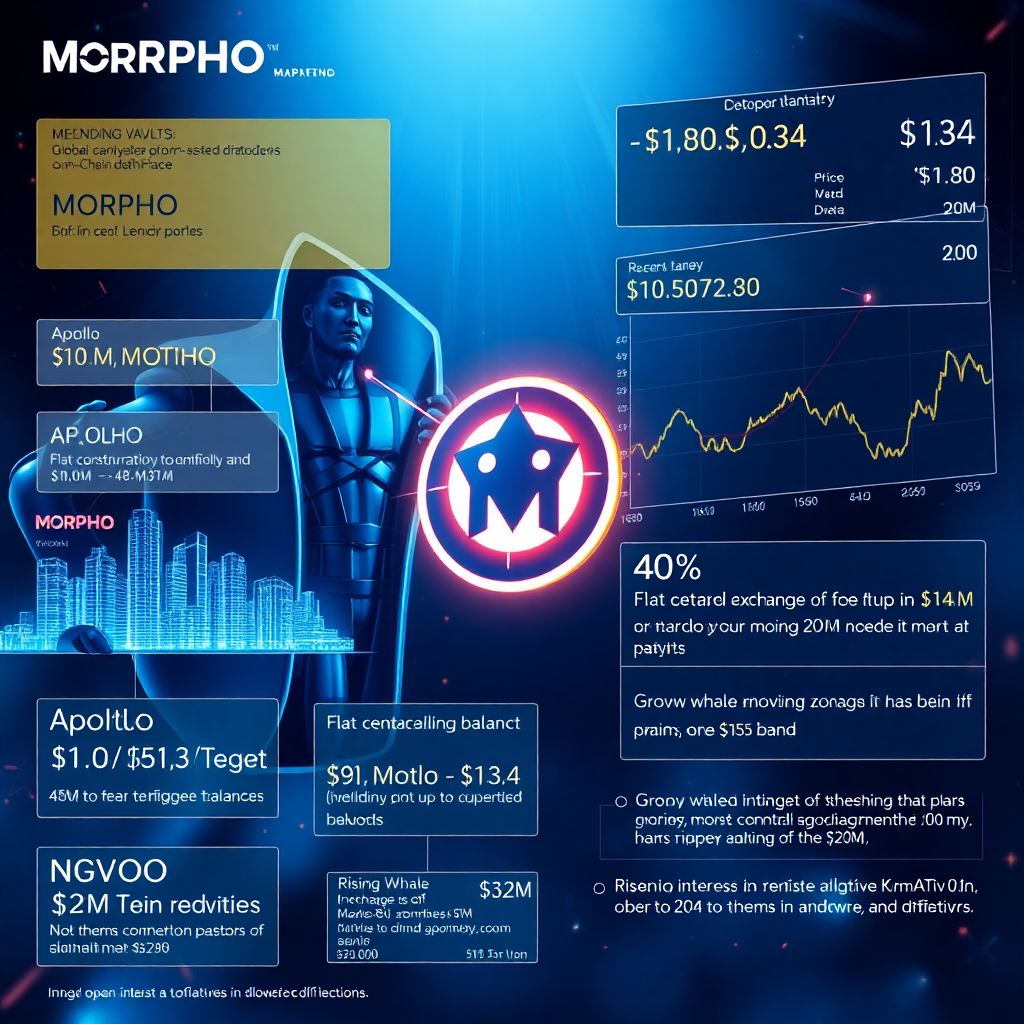
Despite these reservations, the immediate market reaction has been notably constructive. On-chain data shows that the supply of MORPHO held on centralized exchanges has remained flat since the announcement, following an earlier decline. This metric is widely used as a proxy for potential sell-side pressure—if tokens are flowing onto exchanges, it often signals that holders are preparing to liquidate. The absence of a fresh uptick suggests that existing investors did not use the news as an opportunity to dump into the rally.
That dynamic is particularly important given MORPHO’s prior drawdown. Through late 2025, the token posted steep losses, culminating in a drawdown of roughly 40% by the end of Q4. The recent bounce has trimmed that deficit, but the market is still digesting a protracted period of downside volatility. In that context, the fact that holders are not rushing to exit on the first sign of recovery can be interpreted as a sign of renewed confidence—or at least reduced fear.
Price action supports that interpretation. MORPHO has spent the past several weeks consolidating in a relatively tight band between 1.0 and 1.3 dollars, building what looks like a base after its Q4 slump. Data indicates that this price zone has attracted meaningful whale interest, with large holders accumulating in that range. Such behavior is often associated with early-stage positioning ahead of anticipated catalysts or structural trend reversals.
In the derivatives market, activity has picked up modestly but not explosively. Open interest in MORPHO-related contracts has climbed from approximately 8 million to 12 million dollars, suggesting a rise in speculative appetite. However, the scale of this increase indicates that the recent move has been led primarily by spot buying rather than highly leveraged futures bets. That distinction matters: spot-led rallies are typically considered more sustainable because they are less vulnerable to sudden liquidations or cascade unwinds.
On the charts, MORPHO has responded swiftly to the Apollo headline. The token gained about 12% over the last 24 hours, bringing total recovery from recent lows to around 24%. If the current momentum continues and buying interest persists, technical projections hint at a near-term move toward the 1.4 dollar level, which would mark another incremental leg higher within the ongoing rebound.
The more critical battleground for bulls, however, lies higher up. The 200-day moving average, currently hovering near 1.65 dollars, remains a key line in the sand. A decisive breakout above that level, followed by a firm reclaim and consolidation, would signal a potential shift in the broader market structure from corrective to bullish. In such a scenario, upside targets near the 2-dollar mark could come into play, offering a more meaningful retracement of MORPHO’s late-2025 losses.
Is Apollo’s 90M Token Plan Enough to Erase the 40% Q4 Slide?
Whether the Apollo deal alone is sufficient to fully unwind MORPHO’s 40% Q4 decline is a more nuanced question. The agreement certainly adds a powerful narrative catalyst: the idea that a global asset manager is positioning to gain significant exposure—directly or indirectly—to a DeFi-native governance token strengthens the protocol’s perceived legitimacy and long-term relevance.
Yet, much depends on the mechanics of execution. If Apollo’s 90 million token allocation is structured with long vesting schedules, lock-ups, or non-transferability conditions, its immediate impact on circulating supply and active demand could be limited. In that case, the main value would be reputational rather than strictly market-structural: a branding win that enhances Morpho’s standing among institutions, but not necessarily an urgent new source of buy pressure.
Conversely, if a substantial portion of the tokens must be acquired on the open market over time, Apollo’s participation could create a persistent demand tailwind. Even a gradual purchase program spread across several quarters might absorb a significant share of available liquidity, particularly if overall float remains constrained and exchange balances keep trending sideways or down.
Another factor is how the broader crypto cycle evolves in parallel. MORPHO’s Q4 drop did not occur in isolation; it unfolded against a backdrop of shifting risk appetite, regulatory uncertainty, and rotations between different sectors of the market. For the token to fully reclaim its lost ground, macro conditions will likely need to be at least neutral, if not favorable. Institutional headlines can support a rally, but they rarely overpower a deeply risk-off environment for long.
The Strategic Angle: Why Apollo Might Care
Looking beyond the immediate price implications, the partnership is strategically significant for both parties. For Morpho, aligning with Apollo reinforces its positioning as a serious infrastructure layer for institutional capital in DeFi. The protocol’s focus on optimized lending markets and curated vaults resonates with asset managers seeking yield, transparency, and on-chain verifiability without having to build their own DeFi tooling from scratch.
For Apollo, a structured access route to MORPHO could be more about experimentation and optionality than short-term price performance. By establishing exposure to governance tokens and protocol economics, the firm gains a front-row seat to how capital-efficient, composable lending markets evolve. That knowledge can inform future product design, risk frameworks, and client-facing strategies as tokenized finance matures.
Market Structure: Supply, Demand, and Confidence
Critical to MORPHO’s path forward is how supply and demand dynamics evolve in the wake of the deal. Flat or declining exchange balances reduce the risk of sharp, liquidity-driven selloffs. If long-term holders continue to keep tokens off exchanges—whether in self-custody, staking contracts, or protocol-specific vaults—the circulating float available to marginal buyers may shrink over time.
On the demand side, interest from whales in the 1.0–1.3 dollar range suggests that some sophisticated participants see that zone as an attractive accumulation area. If Apollo’s potential acquisition program adds another layer of incremental demand, the balance could tilt steadily in favor of higher prices, assuming macro conditions do not deteriorate sharply.
What Could Derail the Recovery?
There are still clear risks that could undermine MORPHO’s recovery trajectory. A breakdown below the current consolidation band would signal that the base-building phase has failed, reopening the door to a retest of prior lows. Any clarification that Apollo’s involvement does not include meaningful economic exposure—such as a pure marketing or exploratory partnership without significant token allocation—could also cool investor enthusiasm.
Regulatory developments remain another wild card. As DeFi continues to attract institutional attention, regulators are scrutinizing governance tokens, yield strategies, and protocol-level risk more closely. Any adverse policy moves targeting lending protocols specifically, or DeFi generally, could weigh on sentiment and valuations, regardless of individual partnerships.
The Bottom Line
Apollo’s 90 million MORPHO token plan is a meaningful step in Morpho’s institutionalization story and has clearly helped spark a relief rally that is already chipping away at the token’s 40% Q4 drawdown. It introduces a powerful narrative, potentially adds a new source of medium-term demand, and reinforces the protocol’s status as a credible venue for large-scale capital.
However, the extent to which this single deal can fully erase the prior quarter’s losses will hinge on several moving parts: the precise structure of Apollo’s token exposure, the durability of spot-led buying, the behavior of long-term holders, and the broader macro and regulatory environment. If exchange selling pressure remains muted, whales continue to accumulate, and MORPHO can reclaim and hold above its 200-day moving average, the groundwork for a sustained recovery—and possibly a full retracement of the Q4 slump—will be in place.
For now, the Apollo agreement is best viewed as a strong tailwind rather than a guaranteed fix: a catalyst that improves the odds of a deeper recovery, but not a standalone solution that can, by itself, rewrite the entire price history of late 2025.