
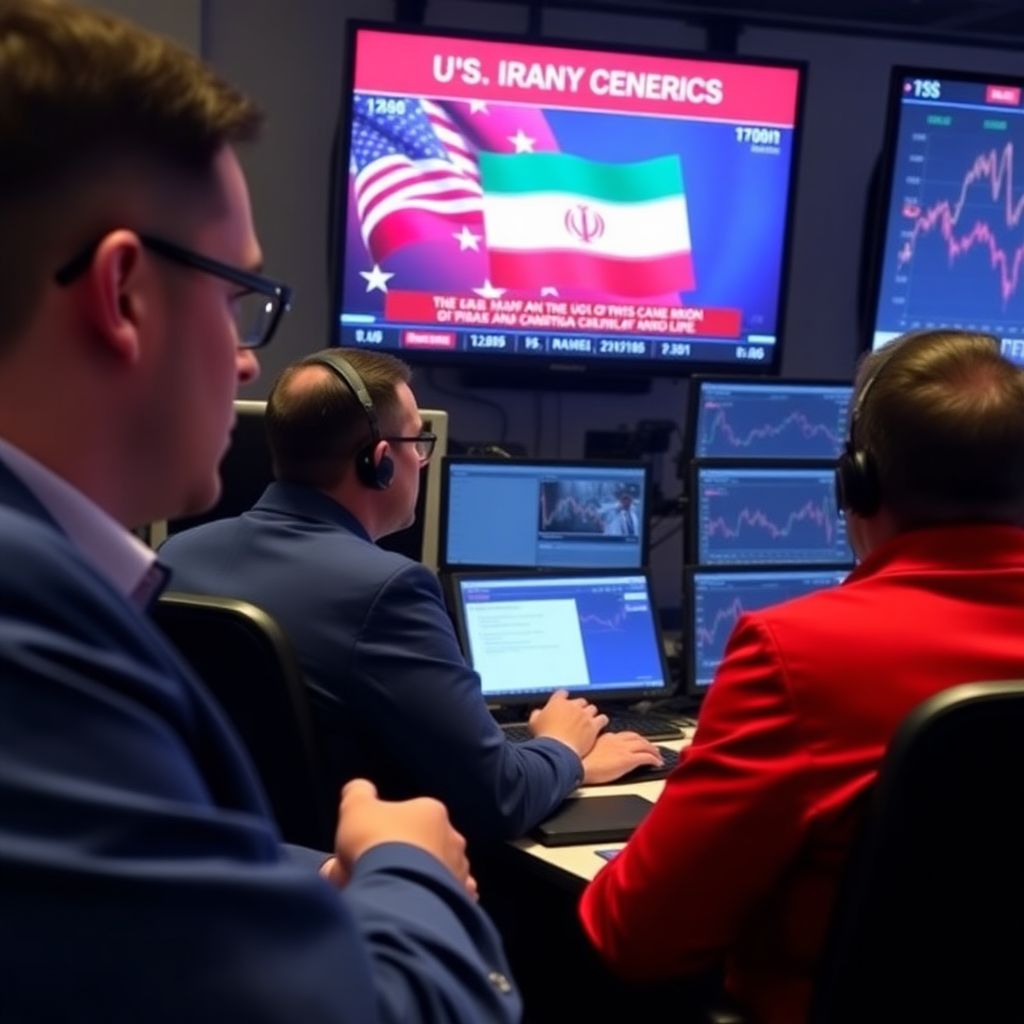
‘Resilient after a 40% crash’: Why Bitcoin stayed surprisingly stable during U.S.-Iran tensions
When Donald Trump entered the White House as a pro-crypto president, many traders saw his administration as a tailwind for digital assets compared to Joe Biden’s tenure. That optimism, however, collided head‑on with geopolitics in early 2026, putting Bitcoin through one of its most volatile and politically charged phases yet.
The turning point came with “Operation Epic Fury,” launched on 27 February under President Trump. The operation rattled global markets and abruptly ended the New Year optimism that had pushed Bitcoin to a mid‑January peak of about 96,000 dollars. By 28 February, BTC had plunged to roughly 65,000 dollars, a drawdown of around 40%, and repeated attempts to reclaim the 75,000‑dollar level failed.
Volatility became the new normal. Price swings widened, liquidity thinned, and short‑term traders were whipsawed as Bitcoin struggled to establish a clear direction. The turbulence intensified when Trump escalated rhetoric against Iran, injecting nuclear threats into an already tense situation.
On his social platform, Truth Social, Trump issued a stark warning:
“A whole civilization will die tonight, never to be brought back again. I don’t want that to happen, but it probably will.”
The remark sent shockwaves through global politics and financial markets alike. Crypto, which had just begun to show modest bullish signs, quickly turned cautious again. Yet, in relative terms, Bitcoin and the broader crypto sector weathered the storm far better than many expected.
Compared with the S&P 500, gold, and other traditional assets, Bitcoin did not experience the kind of panic-driven capitulation that might normally be associated with nuclear brinkmanship. Instead, it exhibited a degree of resilience that surprised both critics and supporters. A telling detail emerged from a report by prediction-market platform Polymarket: Iran was reportedly accepting cryptocurrency payments as tolls from ships transiting the Strait of Hormuz, underscoring Bitcoin’s functional role even amid geopolitical crisis.
Financier and former White House Communications Director Anthony Scaramucci highlighted this resilience in a recent conversation with Michael Novogratz, CEO of Galaxy Digital. Scaramucci observed:
“One thing that is sticky and seems resilient after crashing 40% is Bitcoin.”
Novogratz agreed on the underlying strength, while emphasizing the current market stalemate:
“We’re stuck between some sellers and some buyers. And volumes are way down. It’s a lot less exciting. But there’s no force sellers anymore.”
That last point goes a long way toward explaining why Bitcoin held steady. The market had already flushed out many overleveraged participants during the 40% drawdown from 96,000 to 65,000 dollars. With fewer forced liquidations, even severe headlines could not trigger the same kind of cascading sell-offs seen in earlier cycles.
Despite those constructive structural factors, sentiment remained fragile. The Crypto Fear and Greed Index hovered between “Fear” and “Extreme Fear” from 28 February onward and sat firmly in the “Extreme Fear” zone at the time of writing. The index reflected a market that was defensive and risk‑averse, even as prices showed signs of stabilization. Investors were clearly wary of overcommitting capital while nuclear threats and military operations dominated the news cycle.
Trump’s rhetoric also carried domestic political consequences. His nuclear threats intensified calls for his removal under the 25th Amendment, with growing speculation about whether his presidency could survive such a high‑stakes confrontation. According to Polymarket, the probability of Trump being impeached before the end of his term stood at about 65% at the time of reporting, showing how seriously the possibility was being priced in.
This political uncertainty cast a shadow over Trump’s earlier pro‑crypto stance. During his campaign and early presidency as the 47th President of the United States, he had positioned himself as a supporter of digital assets, promising friendlier regulation and a more open environment for innovation. Now, the very leader who once energized the crypto sector had become a source of macro and geopolitical risk, forcing investors to reassess how much of Bitcoin’s performance could really be tied to a single administration’s policies.
Not everyone bought into the apocalyptic narrative. Peter Schiff, Chief Economist and Global Strategist at Europac and a well‑known Bitcoin critic, dismissed Trump’s nuclear threats as a bluff. In his view, traditional markets were not behaving as they would if a genuine existential threat were taken seriously:
“If they believed there was a reasonable probability that Trump would actually kill Iranian civilization tonight, stocks would be a lot lower and oil a lot higher.”
Schiff followed up with a more pointed question:
“If investors don’t believe Trump, why would the Iranian leadership?”
His argument hinted at a broader interpretation: markets collectively judged the risk of actual nuclear conflict as low, even if the rhetoric was extreme. That skepticism helped prevent a full‑scale flight to safety and contributed to the relative stability seen in both equities and crypto.
A pivotal shift came on 8 April. At around 5:20 AM IST, the Prime Minister of the Islamic Republic of Pakistan, Shehbaz Sharif, announced that an immediate ceasefire had been agreed from both sides. The statement injected a “breath of fresh air” into a global environment that had been suffocating under the weight of escalation fears.
Crypto responded quickly. With the prospect of imminent conflict receding, risk assets found relief. At press time, the total cryptocurrency market capitalization was approximately 2.45 trillion dollars, rising 4.42% over the previous 24 hours. Bitcoin, meanwhile, was trading around 71,884.44 dollars, posting a 5.04% gain over the same period. The move back into the green reflected not just optimism about the ceasefire, but also renewed confidence in Bitcoin’s ability to withstand macro shocks.
—
Why Bitcoin held up: key drivers behind its resilience
To understand why Bitcoin did not completely unravel during the U.S.-Iran tensions, it helps to look beyond headlines and focus on the structure of the market and the evolving role of BTC in the global financial system.
1. The forced-seller flush had already happened
The drop from 96,000 to 65,000 dollars effectively acted as a cleansing event. Highly leveraged traders, speculative late entrants, and weak hands were shaken out during that 40% crash. Once these positions were liquidated, the market was left with more resilient holders-long-term investors, institutional allocators, and entities with lower leverage.
This is what Novogratz meant when he said, “there’s no force sellers anymore.” Without a large overhang of precarious margin positions, even terrible geopolitical news struggled to trigger the kind of domino‑style liquidations that characterized earlier Bitcoin crashes. That structural shift reduced downside reflexivity: bad news still hurt, but it no longer guaranteed a cascading meltdown.
2. Bitcoin’s emerging “digital macro asset” status
Over the last few cycles, Bitcoin has gradually evolved from a niche speculative instrument into a macro asset held by hedge funds, corporates, and in some cases, nation‑state-related entities. As that transition unfolds, BTC increasingly trades in tandem with broader risk assets, while still retaining its unique properties of programmability, censorship resistance, and global accessibility.
During the U.S.-Iran tensions, Bitcoin did not act as a pure “digital gold” safe haven, nor did it behave like a meme coin detached from reality. Instead, it settled into a middle ground: vulnerable to risk‑off sentiment, yet supported by a base layer of conviction buyers and strategic holders who see it as a long‑term hedge against monetary and geopolitical instability.
3. Real-world usage in conflict-adjacent regions
The reported acceptance of cryptocurrency by Iran as toll payments from ships crossing the Strait of Hormuz is not just a curious anecdote-it’s a concrete example of how digital assets can function under sanctions and in conflict zones. When traditional payment rails are constrained by geopolitics, neutral settlement assets like Bitcoin or other crypto can provide an alternative.
This kind of practical utility gives Bitcoin a “floor” of demand that is not purely speculative. If states or state‑adjacent actors are willing to use crypto for cross‑border transactions when under pressure, then Bitcoin’s relevance grows precisely when traditional systems are stressed.
4. Liquidity normalization and lower trading volumes
Novogratz’s comment about volumes being “way down” is another clue. Lower trading volumes usually mean more muted price discovery in both directions. With fewer participants aggressively buying or selling, the market can drift or range instead of violently trending.
In this environment, big moves require either huge orders or extreme news that forces participants off the sidelines. While nuclear threats were certainly dramatic, many sophisticated investors appeared to share Schiff’s skepticism regarding the probability of an actual strike. As a result, there was fear-but not enough belief in a worst‑case scenario to push sidelined capital into emergency repositioning.
5. The paradox of fear: high anxiety, limited action
The persistent readings of “Fear” and “Extreme Fear” on the Crypto Fear and Greed Index illustrate a paradox common in markets: high anxiety does not always translate into aggressive selling. When traders are already underweight risk, or when they have already cut positions during previous sell‑offs, the marginal seller becomes scarce.
By the time Trump’s rhetoric reached its most alarming tone, many participants had already de‑risked. There was still emotional fear, but fewer actual positions to unwind. That dynamic helped cap downside pressure during the peak of the U.S.-Iran tensions.
6. Question marks over Trump’s pro-crypto credentials
Initially, Trump’s image as a pro‑crypto leader was expected to support the asset class through friendlier regulation and institutionalization. But as political pressure mounted-reflected in the roughly 65% probability of impeachment being priced in-markets had to factor in the risk that his administration could end abruptly or lose influence.
This undercut the simplistic “pro‑Trump = good for Bitcoin” narrative. Instead, traders began to focus more on deeper, non‑political drivers: supply dynamics, global adoption, institutional accumulation, and macro liquidity. Ironically, the questioning of Trump’s reliability may have nudged the market toward a healthier perspective, where Bitcoin is valued less as a political play and more as a structural, long‑duration asset.
7. Safe-haven narrative vs. risk-asset reality
Bitcoin’s performance during the crisis also added nuance to the ongoing debate about its role as “digital gold.” BTC did not surge dramatically as a pure hedge, nor did it completely collapse as a high‑beta tech proxy. Instead, it absorbed the shock, stabilized after a major drawdown, and then rallied once the ceasefire reduced near‑term tail risks.
This behavior suggests that Bitcoin is moving toward a hybrid identity: part macro hedge, part growth asset, and part neutral settlement layer for a multipolar world. That complex profile may not satisfy purists on either side of the debate, but it matches what the market actually did.
8. The ceasefire as a catalyst for risk-on rotation
Once Shehbaz Sharif announced an immediate ceasefire, the biggest tail risk-an escalating military conflict with nuclear undertones-started to fade. This shift opened the door for a risk‑on rotation. Capital that had been parked in cash or defensive assets began to flow back into equities and crypto, with Bitcoin often serving as the first destination for renewed speculative appetite.
The quick 5‑plus percent bounce in BTC and the 4‑plus percent increase in total market cap within 24 hours highlighted how much dry powder had been waiting for a clearer macro signal. It also showed that Bitcoin’s upside reflexivity remains intact: once fear recedes, the same structural features that limit downside (fewer forced sellers, strong holders) can amplify rallies.
9. Lessons for future geopolitical shocks
The U.S.-Iran standoff, Operation Epic Fury, and the subsequent ceasefire offer a preview of how Bitcoin might behave in future geopolitical crises. Key takeaways include:
– Large pre‑event drawdowns can make Bitcoin more stable during peak tension by clearing leverage.
– Real-world usage in sanctioned or conflict‑prone regions can support underlying demand.
– Political “allies” of crypto can quickly become sources of volatility, making overreliance on any single administration risky.
– Markets can price in extreme rhetoric as low‑probability events, muting the impact on assets like BTC.
For investors, the episode underscores the need to understand not just price charts, but also the interplay between macro politics, market structure, and on‑chain adoption.
—
Bitcoin’s ability to remain relatively firm after a 40% crash and through nuclear‑level threats from a sitting U.S. president does not mean it is immune to geopolitical risk. What it does show is that the asset has matured: its holder base is deeper, its use cases broader, and its behavior more nuanced than in previous cycles.
In an era where political shocks can develop overnight, that kind of resilience is precisely what keeps Bitcoin in the conversation-not just as a speculative trade, but as a permanent fixture of the global financial landscape.