
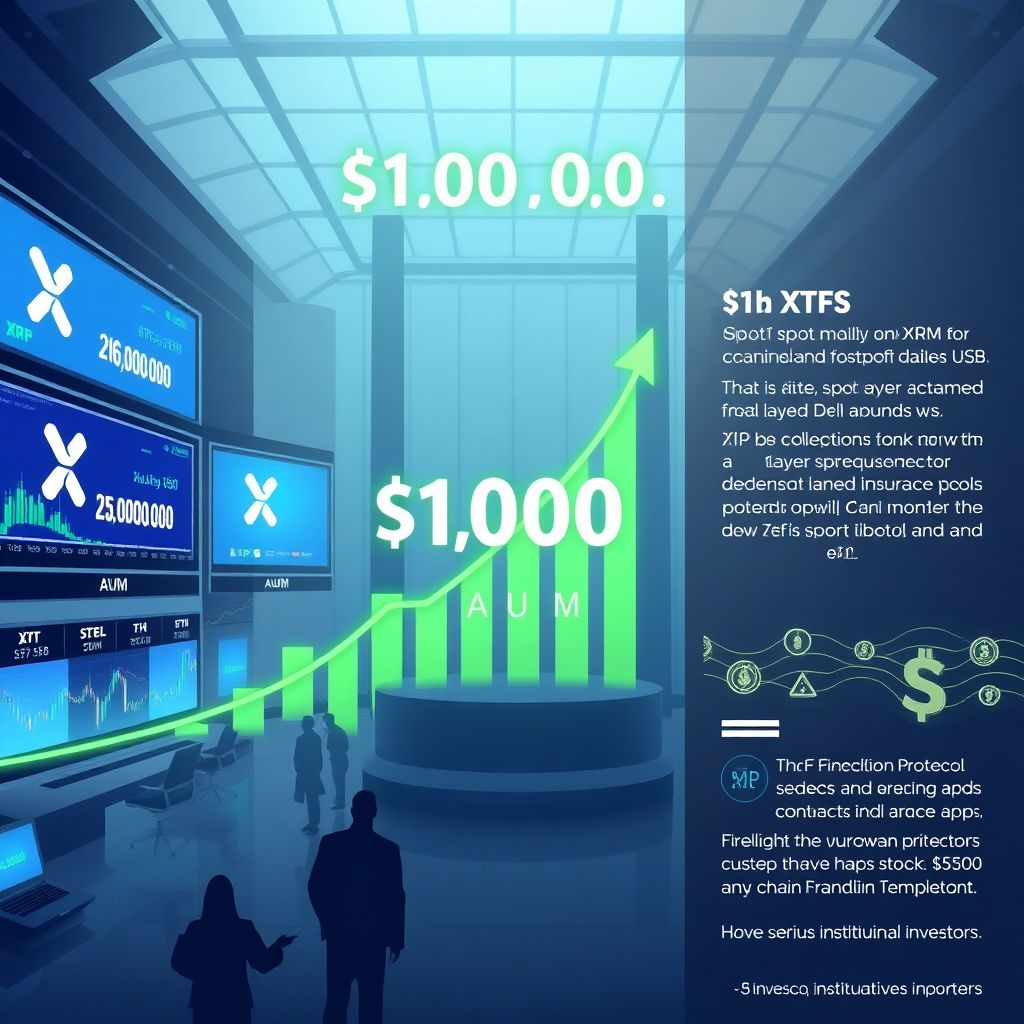
How XRP spot ETFs are racing toward the $1 billion mark
U.S. spot XRP exchange‑traded funds are rapidly emerging as one of the hottest corners of the crypto ETF universe. As of 2 December, these products have logged twelve straight days of net inflows, pushing their total assets under management (AUM) to roughly 844.9 million dollars. At this pace, the one‑billion‑dollar threshold is no longer a distant target but an imminent milestone.
The momentum really accelerated at the start of December. On 1 December alone, spot XRP ETFs pulled in about 89.65 million dollars, followed by another 67.7 million dollars in fresh capital the next day. That run has made XRP the fastest‑growing spot crypto ETF category in the U.S., outpacing the early growth profiles of several larger, more established assets.
Institutional players have noticed. Major asset managers, including Invesco and Franklin Templeton, have already filed to roll out their own XRP ETF products. Their entry signals that demand is not coming solely from retail traders chasing short‑term moves, but also from professional investors seeking regulated, exchange‑listed exposure to XRP without having to handle wallets, custody, or on‑chain operations.
In the broader crypto ETF landscape, XRP’s rise is happening alongside solid growth in other altcoin‑focused products. Spot Solana ETFs, for instance, now hold around 651 million dollars in AUM after a string of inflows. Meanwhile, the giants of the space remain spot Bitcoin and Ethereum ETFs, sitting at approximately 57.7 billion and 12.8 billion dollars, respectively. Against that backdrop, XRP is carving out a niche as a rapidly scaling, mid‑tier ETF asset with room to expand.
XRP staking finally lands – via DeFi insurance
While capital is pouring into exchange‑listed products, a separate, quieter transformation is underway on‑chain. For years, XRP’s ecosystem has been criticized for a lack of native yield opportunities compared to networks like Ethereum or Solana. That gap is beginning to close with the arrival of new staking‑driven protocols built around XRP.
A key development is the launch of the Firelight Protocol, incubated by Sentora and supported by the Flare ecosystem. Instead of offering simple “deposit and earn” yields, Firelight uses XRP staking to power an on‑chain insurance model for decentralized finance. In practice, XRP holders can stake their tokens to provide coverage to DeFi protocols facing smart‑contract and liquidity risks.
The concept is straightforward: DeFi continues to lose over a billion dollars a year to hacks, exploits, and protocol failures. Traditional insurance options are slow, opaque, or non‑existent for many on‑chain projects. Firelight attempts to fill that gap by building a decentralized risk pool, where staked XRP backs insurance guarantees. In return, stakers receive a share of the premiums and potential additional yield mechanisms, turning idle tokens into productive capital.
For XRP, this is more than just another yield farm. It is a structural shift that connects the asset to a fundamental DeFi primitive—insurance. By anchoring real economic value to the token through coverage services, Firelight and similar projects aim to increase XRP’s utility beyond payments and speculation, potentially improving its long‑term investment case.
If such models gain traction, they could complement rather than compete with XRP ETFs. While ETFs cater primarily to investors seeking regulated price exposure, on‑chain staking and insurance mechanisms appeal to users comfortable with blockchain interactions who want to capture protocol‑level returns.
SEC clamps down on ultra‑leveraged crypto ETFs
As spot XRP products advance, the regulatory environment around more exotic crypto funds is tightening. The U.S. Securities and Exchange Commission has drawn a clear line against a new wave of ultra‑leveraged ETFs designed to magnify returns on volatile assets to extreme levels.
These were not plain‑vanilla leveraged funds. Several proposals sought 3x to 5x exposure on assets such as Bitcoin, Ether, Tesla, and Nvidia using derivatives. In early December, the SEC pushed back forcefully, sending nine warning letters on 2 December to major issuers, including Direxion, ProShares, and Tidal Financial.
The regulator’s stance goes beyond routine skepticism. It reflects a view that products offering multiple‑times leverage on assets already known for sharp intraday swings carry disproportionate risk for everyday investors. The concern is that retail traders, attracted by the prospect of outsized gains, might underestimate the compounding losses and volatility drag inherent in leveraged funds.
At the core of the dispute is Rule 18f‑4 under the Investment Company Act of 1940, which governs how much leverage a registered fund can take on through derivatives and similar instruments. The rule caps a fund’s value‑at‑risk (VaR) at 200 percent of its reference benchmark. Several of the proposed crypto and single‑stock leveraged ETFs would have blown past that ceiling, particularly those aiming for 5x exposure.
Even 3x products now find themselves under stricter scrutiny. The SEC has effectively told issuers: either tone down the leverage to stay within the risk limits or withdraw the applications entirely. For now, that shuts the door on the most aggressive leveraged crypto ETFs in the U.S. market.
This regulatory hard stop is one reason spot products like XRP ETFs are gaining relative importance. With ultra‑leveraged offerings off the table, investors looking for ETF‑based crypto exposure are channeled toward unlevered spot and, in some cases, modestly levered futures products, which regulators consider less dangerous for retail participants.
XRP ETF inflows and the role of market liquidity
The surge in XRP ETF inflows has not happened in a vacuum. It coincides with a powerful, liquidity‑driven rebound across the crypto market. Bitcoin has jumped from around 84,000 to 94,000 dollars in a short span, restoring risk appetite and dragging altcoins higher, including XRP.
This rally has been fueled by a confluence of factors: roughly 492 million dollars in short liquidations, renewed inflows into multiple crypto ETFs, and a sharp shift in monetary conditions. The U.S. Federal Reserve has paused its quantitative tightening program and injected about 13.5 billion dollars in net liquidity, supporting risk assets across the board.
In that environment, XRP’s bounce looks less like an isolated, asset‑specific story and more like part of a broader scramble into higher‑beta plays. For many investors, buying XRP ETFs is a relatively simple, regulated way to gain exposure to that move without dealing directly with crypto exchanges.
However, the article’s key point is that these flows appear to reflect a burst of liquidity rather than a confirmed, long‑term trend reversal. When macro conditions loosen abruptly, risk assets often stage violent rallies, but those moves can fade just as quickly if the underlying environment remains fragile.
Macro picture: rally against a bearish backdrop
Despite the recent strength in XRP, Bitcoin, and other crypto assets, the bigger macro narrative has not changed significantly. The prevailing trend is still judged as broadly bearish, with several layers of uncertainty weighing on global markets.
Volatility is edging higher ahead of major central‑bank decisions. Investors are trying to anticipate whether the U.S. will move toward a rate cut, how aggressively it might do so, and how other central banks—including the Bank of Japan—will respond. The BOJ’s long‑running yield‑curve policies and its impact on global carry trades continue to pressure risk assets and major currency pairs.
In this context, the latest crypto rally is best understood as a short‑term reaction to a sudden easing of financial conditions rather than as proof that a new, durable bull cycle has begun. If central banks re‑tighten or if economic data worsens, liquidity could be withdrawn as quickly as it was supplied, putting renewed pressure on speculative assets like XRP.
For ETF investors, that means the path to a 1 billion dollar AUM milestone is not guaranteed to be a straight line. Volatile inflows and outflows are likely as sentiment swings between optimism and fear in response to macro headlines.
What makes XRP ETFs attractive right now?
Even with the macro caveats, several structural factors are working in XRP’s favor from an ETF perspective:
– Regulated access: Many institutions and traditional investors are not allowed or are unwilling to hold XRP directly. ETFs provide exposure within familiar brokerage accounts, solving compliance and custody challenges.
– Diversification beyond Bitcoin and Ethereum: Investors who already own BTC or ETH ETFs may see XRP as a way to diversify within crypto without venturing into illiquid or unregulated tokens.
– Narrative around utility: XRP’s long‑standing focus on payments and settlement, plus new DeFi use cases like Firelight’s insurance model, supports a narrative of “real‑world utility,” which some investors prefer to purely speculative tokens.
– Growing institutional involvement: Filings from firms like Invesco and Franklin Templeton lend credibility and can help attract larger pools of capital once those products launch.
These elements create a feedback loop: more AUM leads to more visibility, which in turn can draw more issuers and investors, accelerating growth.
How DeFi innovation could reinforce ETF demand
There is also an emerging synergy between what happens on‑chain and what happens on exchanges. As XRP’s DeFi ecosystem matures—through staking, insurance, and other yield‑generating mechanisms—it can strengthen the fundamental case for holding XRP over the long term. That, indirectly, can benefit ETF products tied to the asset’s price.
If XRP becomes central to DeFi risk management, payment rails, or cross‑chain infrastructure, long‑term investors may view it as more than just a trading vehicle. ETFs then serve as a simple wrapper around that evolving fundamental story, making it easier for traditional capital to participate.
Furthermore, successful protocols like Firelight can attract developers, liquidity providers, and new projects to the XRP ecosystem. A richer on‑chain environment typically implies more transaction activity, higher fee generation, and potentially stronger demand for the underlying token—factors that can support price and, by extension, ETF inflows.
Risks investors should weigh
Despite the bullish headlines around inflows and DeFi innovation, XRP remains a high‑risk asset class, especially when accessed via market‑linked products like ETFs. Among the key risks:
– Regulatory uncertainty: Crypto regulations continue to evolve. Changes in the treatment of XRP, ETFs, or staking models could impact both prices and product availability.
– Market volatility: Sharp swings driven by macro shocks, liquidations, or sentiment shifts can translate into large drawdowns in a short period.
– Protocol and smart‑contract risk: On‑chain insurance models reduce some risks but introduce others, including smart‑contract bugs, governance failures, or unexpected correlations during market stress.
– Liquidity reversals: The recent rally is heavily tied to liquidity injections and short squeezes. If those conditions reverse, demand for XRP ETFs could cool rapidly.
Investors considering XRP ETFs or on‑chain staking initiatives need to evaluate whether their risk tolerance, time horizon, and portfolio strategy align with such uncertainties.
Outlook: Closing in on $1 billion, but with caution
XRP spot ETFs are on a clear trajectory toward the 1 billion dollar AUM mark, helped by sustained inflows, improving sentiment, and the growing involvement of heavyweight asset managers. Parallel developments in DeFi—especially staking‑powered insurance protocols—are adding another layer to XRP’s evolving investment thesis.
At the same time, the backdrop is far from risk‑free. A strict regulatory stance on leveraged products, unresolved macro headwinds, and the inherent volatility of crypto markets mean that this surge could still prove to be a liquidity‑driven spike rather than the start of a long, smooth ascent.
For now, XRP sits at a crossroads: increasingly integrated into traditional finance through ETFs, while simultaneously expanding its utility in decentralized finance through staking and insurance. How successfully it navigates regulatory scrutiny, market cycles, and technological execution will determine whether today’s rapid ETF growth becomes a durable trend or a temporary phenomenon.