
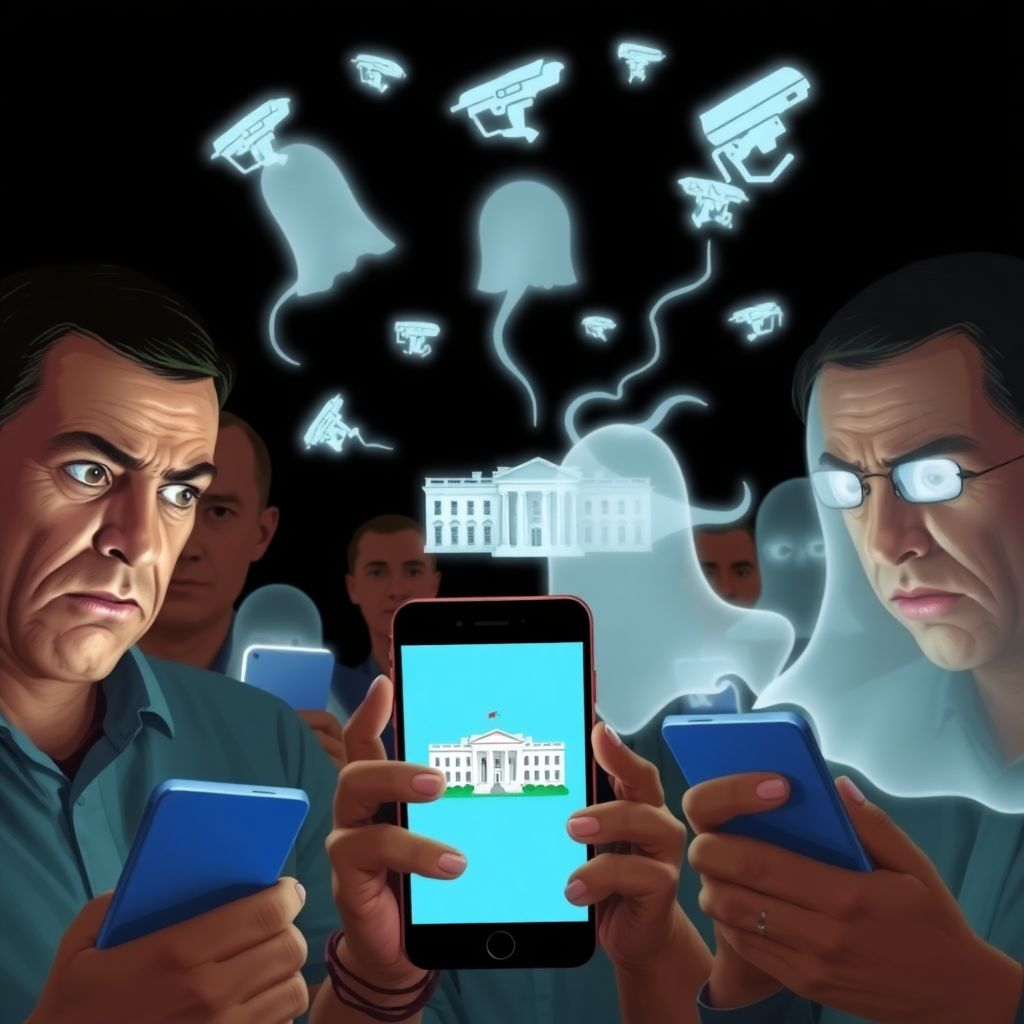
White House news app triggers alarm over tracking, data collection and security risks
The official White House mobile app, launched as a tool to deliver breaking news and policy updates directly to citizens, is already facing scrutiny from security researchers and privacy-conscious users. What was marketed as a “direct line to the White House” has quickly become the focus of debate over location tracking, data harvesting and potentially weak security protections.
According to its description, the app allows users to receive real-time alerts on major government announcements, watch livestreams and follow updates on policy developments. On the surface, these are standard features for a modern government communication tool. Underneath, however, researchers say the software may be capable of much more than just pushing notifications and streaming video.
Early users highlighted worrying permission requests, including access to device location, shared storage and network activity. These concerns were largely aired by individuals examining the app’s behavior and code, although many of the most serious claims have not yet been independently confirmed by third-party auditors. Still, the very idea that a federal government app may possess extensive tracking capabilities has proven enough to trigger a wider privacy debate.
A key point of contention is the possibility of GPS-based tracking. A software developer known as Thereallo and a security engineer identified as Adam, who also works as an infrastructure architect, say they have discovered evidence in the code that the app is able to access a device’s global positioning system. Technically, they say, the application appears able to gather precise location data from users’ phones.
What troubles them is not just the presence of location functionality, but its apparent lack of justification. Adam points out that the app contains no map, local news, geofenced alerts, event discovery, weather functions or any other visible feature that would logically require location data. In their view, including GPS capabilities in an app that does not obviously depend on them is a red flag, especially when the app is produced by the federal government.
Thereallo further claims to have found code that could allow the app to ping and log the device’s location at frequent intervals: roughly every 4.5 minutes while the app is in use (foreground) and about every 9.5 minutes when it is running in the background. Even though activation of this tracking reportedly still requires specific permission and configuration, the researcher warns that “the infrastructure is there, ready to go,” suggesting that only a single function call could enable continuous tracking.
Beyond location, the app appears designed to collect other data points. According to the researchers’ analysis, it records how users interact with it, including notification engagement and in-app message clicks. It also appears able to collect phone numbers and email addresses in certain circumstances. The Google Play listing indicates that personal data such as phone numbers may be gathered during installation and use, while the app’s presence in Apple’s App Store directs users to the White House’s broader privacy policy for details.
The White House’s stated policy notes that the application automatically stores information about an originating IP address and other basic technical details. It also allows for the retention of voluntary user information, such as names and email addresses of subscribers, although it says these details are not required for accessing the app’s core functions. In practice, however, the combination of IP addresses, interaction logs and contact data can be highly revealing about an individual’s identity and habits.
For many users, the issue is less about whether data is collected, and more about who is collecting it and for what potential purposes. Countless private apps gather extensive personal information, from location to behavioral analytics, often for targeted advertising. But when the same practices are associated with a government-backed app, the stakes can feel higher. Some see such tools as potential components of a wider surveillance infrastructure, even if they are initially framed as convenience services.
Adam raises a separate set of concerns focused on the app’s overall security posture. He argues that the software may be vulnerable enough that a determined attacker with moderate technical skills could intercept its data or modify its behavior. He notes that someone on the same public Wi-Fi network-whether in a coffee shop, an airport, or even a government building-might be able to capture the app’s application programming interface (API) traffic using a proxy tool, depending on how the encryption and certificate validation have been implemented.
He also warns that on jailbroken or rooted devices, where system protections are weakened or removed, it may be possible to hook into the app at runtime and change how it operates. That could, in theory, allow a malicious actor to inject false information, harvest additional data, or manipulate how users see official communications. While such attacks are not trivial to execute, they highlight the need for especially robust protections in software distributed by high-profile institutions.
The controversy around the White House app underscores a longstanding tension between digital governance and civil liberties. Governments increasingly rely on mobile channels to communicate with the public, respond to crises and distribute information rapidly. Yet as these tools grow more sophisticated, they also bring the potential for unprecedented visibility into citizens’ lives-who they are, where they go, and how they react to official messaging.
Experts argue that transparency is vital in this context. If an official app is capable of location tracking, they say, that capability should be clearly justified, explicitly disclosed in plain language and strictly limited to well-defined purposes, with safeguards against mission creep. Users should be able to understand whether data is used solely for technical functionality and aggregate analytics, or whether it might feed into law enforcement, intelligence or political operations.
Another issue is data retention and sharing. Privacy advocates want clarity on how long logs of IP addresses, device identifiers, interaction histories and any collected contact details are stored, who inside the government has access to them, and whether they can be shared with other agencies or private contractors. Without clear retention limits and access controls, even relatively mundane data can become sensitive over time, particularly when combined across multiple databases.
Legal frameworks also play a role. In many jurisdictions, government entities must adhere to stricter rules than private companies when it comes to tracking citizens. Even if the White House app’s data practices technically comply with existing law, critics say that the spirit of constitutional protections around privacy and freedom of association demands extra caution. They point out that patterns of app usage-such as when and from where users open it-could indirectly reveal political interests or affiliations.
For everyday users, the debate raises practical questions: should they install a government app that may request broad permissions? How can they reduce their exposure if they still want timely official information? Security professionals generally advise scrutinizing requested permissions, disabling location access unless absolutely necessary, restricting background activity where possible and turning off personalized analytics or diagnostic sharing in device settings.
The episode also sparks a wider conversation about standards for public-sector software. Some industry observers argue that government apps, given their unique trust implications, should undergo mandatory independent security and privacy audits before release. Results could then be summarized in accessible language for the public, explaining what data is collected, how it is protected and what risks remain. Such measures could help rebuild confidence where suspicion is now growing.
In the longer term, this situation illustrates a broader challenge: how to modernize government communications without unintentionally normalizing pervasive tracking. As more public services go digital, the line between useful convenience and intrusive monitoring can easily blur. The White House app controversy shows that citizens are paying close attention to that line-and that they increasingly expect not just functionality, but demonstrable respect for their privacy in the process.