
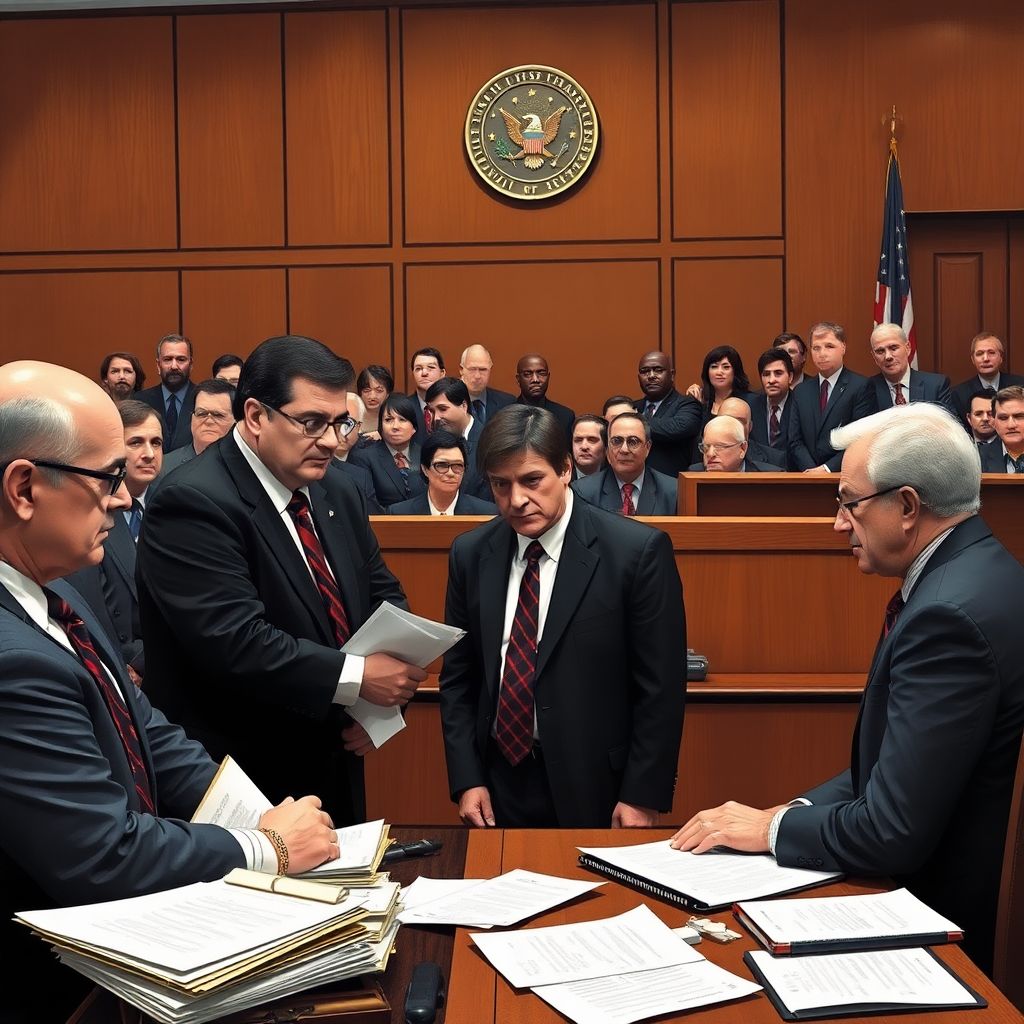
US prosecutors have urged a federal judge to reject Sam Bankman-Fried’s attempt to secure a new criminal trial, arguing that the former FTX CEO has not come close to meeting the strict legal threshold required for a retrial.
In a filing responding to Bankman-Fried’s February motion, government lawyers said his claims about “new” witness testimony are legally inadequate and factually unconvincing. According to the submission, the defense is trying to reframe evidence and witnesses that were already known ahead of the 2023 trial, rather than presenting genuinely new information discovered only after the verdict.
At the center of the dispute are statements attributed to two former FTX insiders: Ryan Salame, a former FTX Digital Markets co-CEO, and ex-employee Daniel Chapsky. Bankman-Fried’s lawyers argue that their accounts could cast doubt on the prosecution’s portrayal of FTX’s financial condition and the handling of customer assets in the run-up to the exchange’s collapse.
Prosecutors counter that this is not “newly discovered evidence” in any meaningful legal sense. Both Salame and Chapsky were known to the defense before trial, they argue, and any information they might now provide could have been pursued and presented earlier. Under US law, a defendant seeking a retrial must typically show that the new evidence was not discoverable with reasonable diligence before or during trial and that it would likely lead to a different verdict.
The government’s brief stresses that Bankman-Fried is instead trying to re-litigate issues that were already argued before the jury and rejected. In their view, nothing in the proposed testimony fundamentally alters the core facts that led to his conviction on seven counts of fraud and conspiracy tied to the misuse of billions in customer funds.
This latest filing is part of an ongoing post-conviction battle following one of the most high-profile criminal cases in the history of the crypto industry. FTX, once valued in the tens of billions of dollars, collapsed in late 2022 after a run on customer deposits exposed a massive shortfall and alleged commingling of assets between the exchange and its trading affiliate, Alameda Research.
In November 2023, a jury found Bankman-Fried guilty on all counts, concluding that he orchestrated and directed a scheme to divert FTX customer money to Alameda for risky trading, political donations, venture investments, and personal spending. In 2024, he was sentenced to 25 years in prison, along with supervised release and significant financial penalties.
Despite the verdict, Bankman-Fried’s legal team has pursued a two-track strategy: seeking a new trial at the district court level and simultaneously appealing his conviction to the US Court of Appeals for the Second Circuit. The motion for a new trial focuses on the alleged impact of Salame’s and Chapsky’s potential testimony, while the broader appeal is expected to challenge aspects of the trial itself, such as evidentiary rulings, jury instructions, and interpretations of fraud statutes.
Judge Lewis Kaplan, who presided over the original trial, ordered the government to respond to the retrial motion by March 11. While the prosecutors have now laid out their opposition, the judge has not yet decided whether to hold a hearing or summarily deny the request. Until that ruling is issued, the status of the retrial bid remains unresolved.
The legal standard facing Bankman-Fried is steep by design. US courts rarely grant new trials based on claims of newly discovered evidence, particularly when the evidence relates to witness testimony rather than clear-cut factual revelations like exculpatory documents or scientific proof. Judges generally look for evidence that would probably change the outcome of the case, not merely provide additional fodder for cross-examination or an alternative narrative.
Prosecutors argue that even if Salame and Chapsky were to testify exactly as the defense suggests, their statements would not undermine the extensive evidence already presented at trial. That evidence included internal communications, financial records, and testimony from other high-ranking FTX and Alameda executives who pleaded guilty and cooperated with the government. Those witnesses described in detail how customer funds were directed to Alameda and how the true financial picture was allegedly concealed from investors, lenders, and users.
The government also points out that tactical choices by the defense-such as which witnesses to call and which theories to emphasize-do not become grounds for a retrial simply because they proved unsuccessful. Courts are typically reluctant to second-guess trial strategy after the fact unless there is clear evidence of ineffective assistance of counsel meeting a very high bar.
Running parallel to the courtroom maneuvers has been sporadic public speculation about whether Bankman-Fried might eventually seek or receive a presidential pardon. Attention intensified after he posted praise for then-President Donald Trump’s stance on cryptocurrencies on social media on February 1, which some commentators interpreted as an attempt to curry political favor.
However, those discussions have not translated into any concrete movement. In early January, Trump was quoted as saying he had no intention of pardoning Bankman-Fried, signaling that, as things stand, the former FTX chief’s realistic paths to relief are confined to the judicial system: appeals, post-trial motions, and, in the distant future, possible sentence reductions or other standard legal mechanisms.
From a broader industry perspective, the outcome of Bankman-Fried’s post-trial efforts will be closely watched. The FTX case has become a touchstone in debates over regulation, enforcement, and the accountability of crypto founders and executives. A successful retrial motion would be extraordinary and could reopen questions about how the case was investigated and prosecuted. A firm denial, on the other hand, would reinforce the finality of the verdict and signal that the justice system views the trial as fundamentally sound.
For now, the immediate question is narrow but critical: will Judge Kaplan find that the proposed testimony from Salame and Chapsky is truly new, material, and likely to change the result? Legal analysts note that judges typically give significant weight to the completeness of the original trial and the strength of the jury’s conclusions. Given the scope of evidence already presented, the bar for Bankman-Fried is particularly high.
In practical terms, even if the retrial motion is denied, the appeal to the Second Circuit will proceed. Appeals courts review whether legal errors occurred that might have affected the verdict, not whether the jury made the “right” call on the facts. That process can take months or even years, and outcomes range from full affirmance of the conviction to partial reversals, new sentencing hearings, or, in rare cases, orders for a new trial.
For Bankman-Fried personally, the stakes could not be higher. A successful challenge could lead to a reduced sentence or a new chance to argue his case before another jury. Failure would leave the 25-year prison term and fraud convictions firmly in place, cementing his fall from the top of the crypto world to one of its most infamous cautionary tales.
Until the court issues its next orders, the case remains in a holding pattern: prosecutors insisting that nothing truly new has emerged, the defense arguing that key voices have yet to be fully heard, and a federal judge tasked with deciding whether the law allows the story of FTX and its founder to be told again in a second trial.