
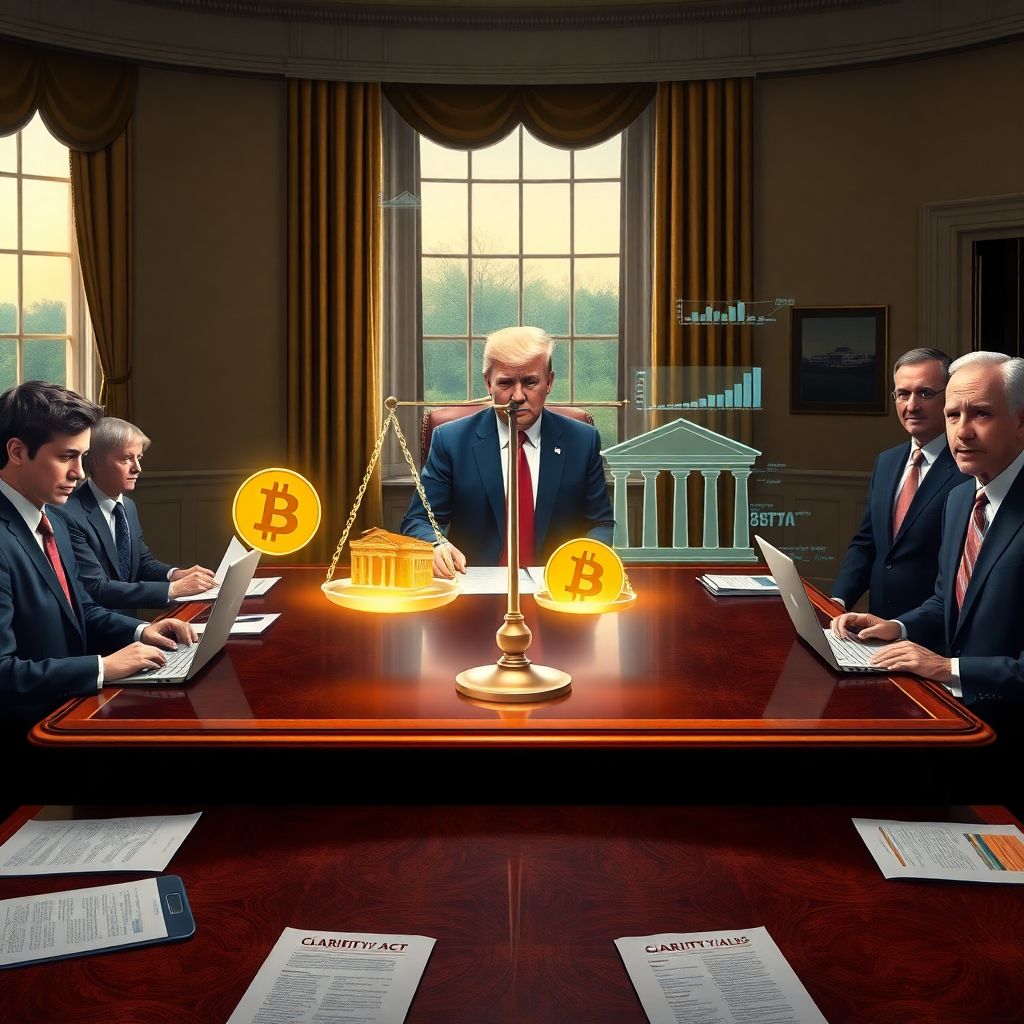
Trump pushes for legislative ‘compromise’ on crypto bill: What’s changing and why it matters
Donald Trump, now in the White House and under pressure ahead of the November midterms, is moving to resuscitate a once-stalled crypto market structure bill by forcing a political and industry “compromise” — with stablecoin yields at the center of the fight.
According to reports, administration officials will sit down with both crypto firms and traditional banks on 2 February in an attempt to broker a deal that can get the legislation, known as the CLARITY Act, moving again. The goal: find common ground on how much yield stablecoin issuers can offer without provoking a backlash from the banking sector.
The clash over stablecoin returns has become the main roadblock. Crypto companies argue that yield-bearing stablecoins are a core part of decentralized finance and a key tool for attracting users, while banks fear they will lose deposits and face unfair competition from products they see as “banking in disguise,” but without equivalent regulatory burdens.
Tensions boiled over in mid-January when Coinbase, one of the biggest and most influential U.S.-based exchanges, abruptly pulled its support for the draft bill. The firm pointed to “too many issues” in the text, singling out provisions that would effectively prohibit stablecoin rewards and heavily restrict tokenized securities. That withdrawal detonated the fragile coalition behind the legislation.
As a result, a previously scheduled Senate Banking Committee vote on the CLARITY Act was postponed, throwing the bill into uncertainty. The breakdown opened a rift between policymakers, banks, and the digital asset industry, each accusing the other side of intransigence while the clock ticks toward the election.
The White House was reportedly frustrated with the derailment. Officials privately urged Coinbase to return to negotiations instead of walking away from the table, signaling that the administration sees the bill not as an optional side project but as a priority piece of financial legislation. The Senate Banking group was simultaneously told to ramp up work on affordable housing, effectively pushing the crypto debate to the margins — at least temporarily.
Layered on top of this legislative gridlock is a broader sense of urgency. A severe winter storm, the prospect of a government shutdown, and the time crunch before midterms all raised fears that the crypto bill would quietly die. Many in the industry began to assume that meaningful market structure rules would be punted to some undefined future Congress.
The new push from the Trump administration has therefore revived hopes that a major regulatory framework for digital assets could still pass this year. If agreed, it would be the most significant piece of crypto legislation since the GENIUS Act, which established a basic policy framework for stablecoins. Where GENIUS focused primarily on issuing standards and backing, the CLARITY Act aims to tackle the broader “market structure” question: who can issue, trade, custody, and earn yield on digital assets — and under what rules.
Industry groups see the February meeting as a crucial opening. Summer Mersinger, CEO of the Blockchain Association, which represents firms such as Coinbase, Kraken, and Ripple and has been invited to the White House talks, emphasized the importance of bipartisan cooperation. She stressed that only a cross‑party agreement can deliver a stable, long‑term regulatory environment and keep the United States competitive as a global crypto hub.
A similar message came from Cody Carbone, CEO of The Digital Chamber, another major crypto trade organization. He praised the administration for bringing all stakeholders together, framing the outreach as a rare opportunity to align the interests of banks, fintechs, exchanges, and policymakers instead of letting each camp lobby in isolation.
Trump himself leaned heavily into pro‑crypto messaging during his 2024 presidential campaign, courting digital asset firms and promising “regulatory clarity” after years of fragmented enforcement and conflicting signals from different U.S. agencies. The renewed effort to pass the CLARITY Act is widely viewed as a test of whether that campaign rhetoric will translate into concrete policy.
At the same time, the crypto industry is not leaving its fate solely in the hands of the administration or Congress. The sector is mobilizing politically with unprecedented intensity ahead of the midterms. The pro‑crypto super political action committee Fairshake has assembled a war chest of 193 million dollars, positioning itself as a decisive player in key races.
Josh Vlasto, a spokesperson for Fairshake, stated that with the elections looming, the group is “united behind our mission,” which he defined as opposing politicians viewed as hostile to crypto and supporting candidates who back digital asset innovation. The sheer size of Fairshake’s fundraising highlights just how seriously the industry is taking this election cycle.
Since July alone, Fairshake has pulled in an additional 74 million dollars. Of that, Coinbase and Ripple have each contributed 25 million dollars, and venture capital firm a16z has added 24 million dollars. These contributions underscore how united major industry players are around the political strategy of influencing regulation through electoral leverage.
Analysts now rank Fairshake as the second‑largest super PAC in terms of funding, a remarkable position for a group focused explicitly on digital assets. This status underlines the growing lobbying and electoral clout of the crypto sector, which once existed on the fringes of finance but now has the resources to shape campaign narratives and policy agendas.
The battle over stablecoin yield is more than a narrow technical dispute. Stablecoin issuers typically generate returns from underlying assets such as Treasury bills or other short‑term instruments and can choose whether to share part of that yield with users. Banks argue that if these products function like interest‑bearing accounts, they should face similar capital, liquidity, and supervisory requirements. Crypto firms counter that overregulation would crush innovation, drive activity offshore, and push U.S. users toward less transparent, foreign alternatives.
For lawmakers, the task is to reconcile these positions without creating regulatory arbitrage or systemic risk. A possible compromise could involve caps on stablecoin yields for retail users, stricter disclosure rules about how reserves are invested, and clearer lines between what counts as a payments stablecoin versus an investment product. Another option is to channel higher‑yield stablecoin products through licensed entities or qualified investors, leaving low‑risk, low‑yield versions widely available to the public.
The CLARITY Act is also expected to tackle tokenized securities, another area that triggered Coinbase’s objections. Many in the industry want a framework that allows traditional assets like bonds, funds, or real estate to be represented on‑chain without automatically triggering the most restrictive rules designed for legacy markets. Policymakers, however, are wary of recreating shadow banking in a digital wrapper.
Trump’s renewed involvement signals that the administration may be willing to spend political capital to land a deal. For the White House, delivering a high‑profile piece of crypto legislation before the midterms would allow it to claim victory on innovation, jobs, and financial modernization, while also presenting itself as tough on risk through clear guardrails and enforcement powers.
For investors, traders, and builders, the outcome of these negotiations could reshape the U.S. crypto landscape. A balanced law might bring long‑sought legal certainty, encourage institutional adoption, and keep major firms headquartered in the United States. An overly restrictive or poorly designed regime could push liquidity and talent to more permissive jurisdictions.
Over the coming months, the key questions will be whether banks and crypto firms can accept limitations on stablecoin yield, how tokenized securities will be categorized and supervised, and whether bipartisan consensus can hold under the pressure of election‑year politics. The February meeting at the White House is only the opening move in what is likely to be a complex and contentious legislative endgame.
What is clear is that neither the administration nor the industry wants to see another multi‑year stalemate. With billions in campaign funds now tied to the future of digital assets, and with the United States competing against other financial centers for crypto leadership, the push for a “compromise” on the CLARITY Act has become one of the most closely watched regulatory stories of the year.
Disclaimer:
This material is for informational purposes only and should not be considered investment advice. Trading, buying, or selling cryptocurrencies involves significant risk, and every reader should conduct their own research and carefully assess their risk tolerance before making any financial decisions.