
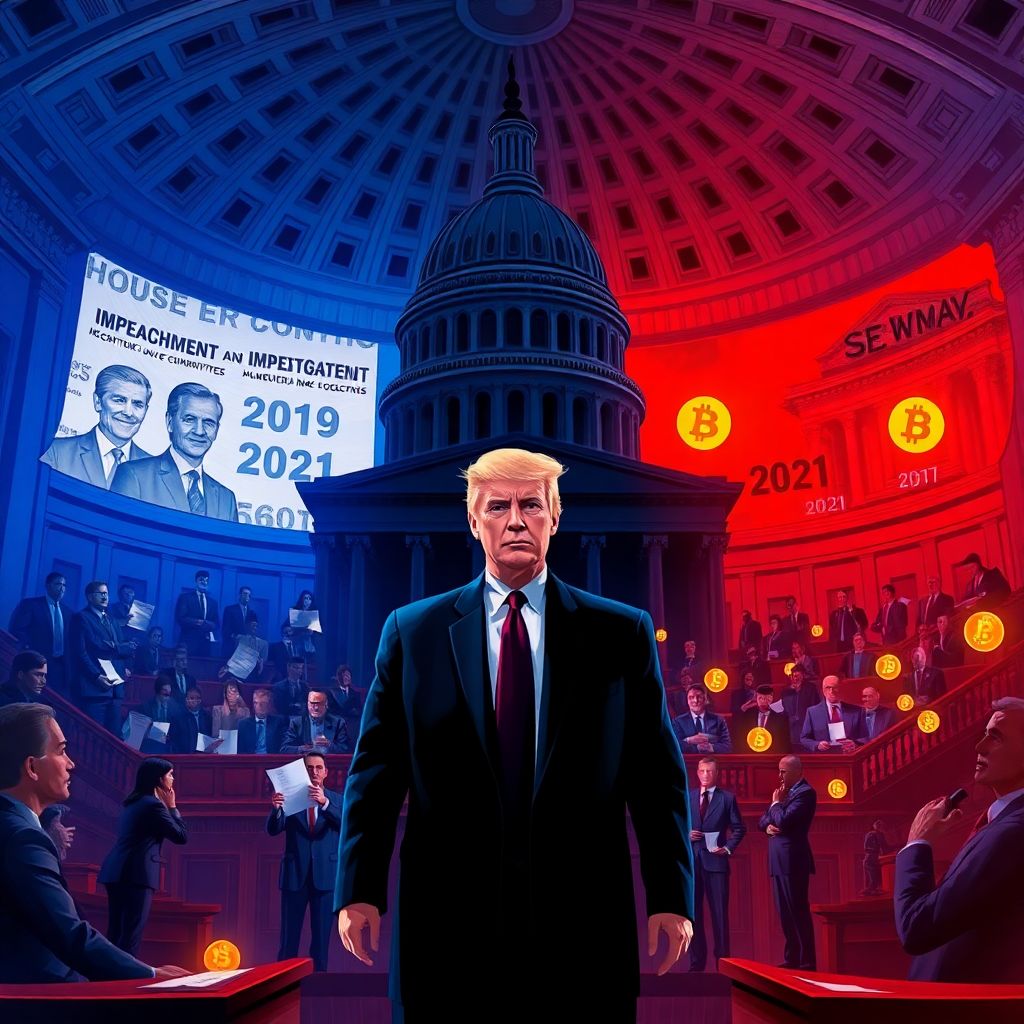
Trump warns GOP: ‘Democrats will impeach me’ if they win the midterms
US President Donald Trump has issued a stark warning to Republican lawmakers: if the party loses control of Congress in the upcoming midterm elections, he expects Democrats to move quickly to impeach him, threatening to upend his agenda for the remainder of his term.
Speaking to House Republicans on Tuesday, Trump framed the midterms as a personal and political survival test, arguing that a Democratic victory would almost inevitably lead to impeachment proceedings.
“You’ve got to win the midterms, because if we don’t win the midterms, it’s just going to be — I mean — they’ll find a reason to impeach me,” he told the closed-door gathering. “I’ll get impeached.”
His comments underscore how deeply the White House sees the midterms as a referendum not just on Republican control of Congress, but on the future of Trump’s presidency and the policy agenda he has tied to it, including his controversial stance on cryptocurrencies and digital assets.
A presidency shadowed by impeachment
Trump is already a historically singular figure in American politics, having been impeached twice during his first term in office.
The House first impeached him in 2019 on charges of abuse of power and obstruction of Congress, after he was accused of pressuring Ukraine’s government to interfere in the 2020 election by digging up political dirt on Joe Biden.
His second impeachment came in January 2021, just days before he left office. This time, the House charged him with inciting an insurrection following the violent attack on the US Capitol on January 6, 2021.
In both cases, the Senate acquitted him, allowing him to avoid removal from office. Those acquittals have fueled Trump’s public image as a political survivor, but they have also entrenched partisan divisions around the impeachment process itself.
Now, he is openly suggesting that a third impeachment is not only possible, but likely, if Democrats retake the House.
Midterms as a verdict on Trump and his agenda
All 435 seats in the House of Representatives and a third of the Senate will be on the ballot in November. If Republicans lose their majority in one or both chambers, the balance of power in Washington would shift dramatically, altering what the administration can realistically accomplish in the final two years of Trump’s term.
Recent polling shows Democrats with an edge heading into the election, reflecting widespread unease about the economy, the cost of living, and broader questions about Trump’s leadership. His approval rating has slipped to around 42%, with many voters saying they do not believe he is doing enough to ease rising economic pressures.
Betting markets mirror those concerns. Traders are pricing in nearly an 80% chance that Democrats will win control of the House, while odds suggest a roughly two-thirds probability that Republicans will hang on to the Senate. That split outcome — a Democratic House and Republican Senate — is precisely the scenario under which impeachment is most politically plausible but conviction in the Senate remains uncertain.
Impeachment as political weapon and rallying cry
Trump’s impeachment warning serves multiple political purposes.
On one level, it is a blunt assessment of what a Democratic-controlled House is legally empowered and politically inclined to do. The Constitution gives the House the sole power to impeach a president; with even a narrow majority, Democrats could push through articles of impeachment on a simple party-line vote.
On another level, the warning is a clear attempt to galvanize the Republican base. By telling supporters that his own presidency is on the line, Trump is seeking to transform what might otherwise be viewed as a routine midterm cycle into an existential fight for his survival and his agenda.
For Democrats, impeachment is both an instrument of accountability and a potential political risk. While it could energize their own base and signal a hard line on alleged abuses of power or questionable financial dealings, it might also be seen by some voters as partisan overreach, especially if the Senate is unlikely to convict.
Crypto policy at the heart of the battle
Beyond the broader political implications, Trump himself has linked the possibility of impeachment to his stance on cryptocurrency and digital assets. His administration and Republican allies in Congress have pushed an ambitious set of crypto-related policies, from defining market structure rules to limiting the role of central bank digital currencies (CBDCs).
A key priority for Republican lawmakers is a comprehensive crypto market structure bill that would establish a clear framework for how the sector is regulated in the United States. The legislation is seen as foundational for exchanges, token issuers, and institutional investors seeking regulatory certainty. Senate Banking Committee Chair Tim Scott has said the bill is scheduled for another vote as soon as Thursday next week, underscoring its importance in the Republican agenda.
If Democrats seize control of the House, that legislative roadmap could be thrown into chaos. Committee chairs, hearing schedules, and enforcement priorities would all shift, potentially slowing or reshaping the entire crypto regulatory push.
Democratic criticism over Trump’s crypto dealings
Some Democrats have already signaled that they view Trump’s crypto-related activities as grounds for serious investigation — and possibly impeachment. Figures such as Representative Sean Casten and Senator Jon Ossoff have argued that Trump’s dealings in the digital asset space, including hosting a closed-door dinner for top holders of his personal memecoin, raise questions about conflicts of interest and possible ethical or legal violations.
To these critics, the intersection of presidential power, personal financial interests, and a largely unregulated crypto market is a red flag. They argue that any use of public office to promote or benefit from specific tokens, exchanges, or investment vehicles could warrant scrutiny under existing ethics rules and anti-corruption laws.
An impeachment based partly or largely on crypto-related allegations would be unprecedented, reflecting how quickly digital assets have moved from financial fringe to the center of political controversy.
Fractures inside the GOP over digital money
Trump’s crypto agenda has not only attracted attacks from Democrats; it has also exposed fault lines within Republican ranks.
A conservative bloc within the GOP has been fiercely opposed to central bank digital currencies, warning that a digital dollar controlled by the Federal Reserve could enable new forms of financial surveillance or centralized control over private transactions.
Last year, these hardline conservatives used their leverage to stall a package of crypto bills, insisting that a clear and enforceable ban on CBDCs be included before they would agree to move forward. The standoff threatened to derail a broader legislative slate, including the so‑called GENIUS Act, which was intended to encourage innovation and clarify regulatory responsibilities across agencies.
To break the impasse, Republican leaders agreed to attach a CBDC ban to a must-pass defense authorization bill, securing enough support from the holdouts to advance the crypto package. But when the final defense funding bill emerged without the promised CBDC prohibition, many of those conservatives felt betrayed, further straining internal party cohesion on digital asset policy.
What a Democratic House could do
Should Democrats capture the House, they would gain enormous power over the investigative and legislative agenda. Committee chairs could launch oversight inquiries into Trump’s crypto dealings, business relationships, and policy decisions. Subpoenas could target communications with exchanges, token issuers, donors involved in digital assets, and advisers who helped shape the administration’s approach to the sector.
With control of key committees, Democrats could also rewrite or shelve Republican-led crypto bills. They might push for more aggressive consumer protections, stricter anti-money-laundering requirements, tighter rules on politically exposed persons holding or promoting tokens, and stronger guardrails on stablecoins and decentralized finance platforms.
Any impeachment effort would begin in the House Judiciary Committee and other investigating panels, which would collect documents, hold hearings, and draft potential articles of impeachment. If passed by the full House, those articles would trigger a trial in the Senate, where a two‑thirds vote is required to convict and remove a president from office.
The Senate: firewall or pressure point?
Even if the House were to impeach Trump again, the Senate remains the critical battlefield. Current betting odds suggest a 67% chance that Republicans will retain control of the upper chamber after the midterms, making a conviction on impeachment charges unlikely.
A Republican-controlled Senate has previously shielded Trump from removal, and many of the same structural incentives remain in place: partisan loyalty, fear of primary challenges, and concerns about alienating Trump’s core supporters. At the same time, another impeachment trial — especially one focused on issues like financial conflicts or crypto dealings — could put individual senators under intense scrutiny from voters and donors alike.
If the Senate again acquits Trump, the result would be a familiar pattern: a deeply polarized impeachment process that exposes sharp partisan divides without changing who occupies the Oval Office, but potentially reshaping the political narrative and legislative agenda.
How impeachment talk affects crypto markets and regulation
The mere prospect of impeachment has implications beyond politics, particularly for the crypto industry. Markets tend to react to uncertainty, and the idea that a sitting president could face a third impeachment over, in part, digital asset dealings adds another layer of volatility and regulatory risk.
Crypto companies that have aligned themselves publicly with Trump’s agenda, including those that have contributed millions of dollars to political committees supporting him ahead of the midterms, now face a more complex landscape. If Democrats gain power and pursue aggressive investigations, firms with close ties to the administration could find themselves under the microscope for lobbying, campaign finance, or disclosure issues.
At the same time, a shift in congressional control could accelerate the push for clearer, stricter rules. Many in the industry, even those wary of heavier regulation, have acknowledged that coherent federal standards are preferable to a patchwork of enforcement actions and state-level rules. The question is whether the next phase of regulation will be primarily industry-friendly and innovation-focused, or driven by concerns about consumer protection and systemic risk.
The stakes: more than just one president
Framing the midterms as a personal fight to avoid impeachment allows Trump to rally his base, but the stakes extend well beyond the fate of a single presidency. The outcome of these elections will influence how the United States handles emerging technologies, digital finance, and the balance between innovation and oversight.
If Republicans maintain unified control, Trump’s pro‑market, selectively deregulatory approach to crypto is likely to continue, though internal divisions over CBDCs and surveillance-resistant money will persist. If Democrats win the House, the resulting gridlock and confrontation — including potential impeachment — could slow lawmaking but speed up investigative scrutiny, fundamentally altering the incentives for political actors and industry players alike.
In warning that “they’ll find a reason to impeach me” if Republicans lose, Trump is not just predicting partisan conflict; he is acknowledging how deeply intertwined his presidency has become with the explosive growth of crypto, the evolution of financial regulation, and the fierce partisan battles that now define American governance.
An election that doubles as a stress test
Ultimately, the midterms will function as a stress test for multiple systems at once: the durability of Trump’s political coalition, the credibility of impeachment as a constitutional tool rather than a partisan weapon, and the capacity of US institutions to adapt to a financial landscape transformed by digital assets.
Whether or not impeachment proceedings materialize, Trump’s warning has already reframed the campaign. Republican candidates are being asked to defend not only their own records but the broader project of shielding the president and advancing his crypto and economic agenda. Democrats, for their part, must decide how far they are willing to push investigations and what they hope to achieve if they obtain the power to impeach but not necessarily to convict.
The answer voters give in November will help determine not only the trajectory of Trump’s presidency, but the direction of US policy on money, technology, and political accountability for years to come.