
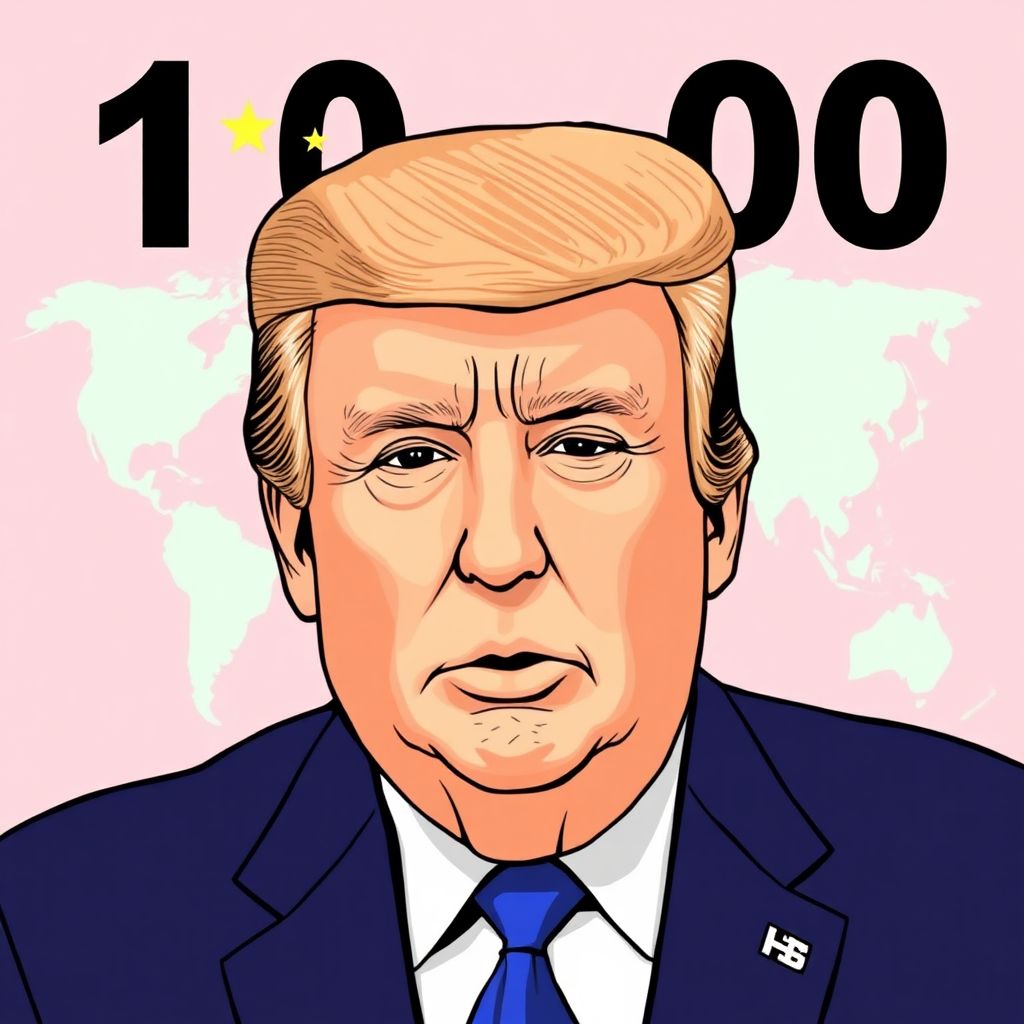
Trump Imposes 100% Tariffs on Chinese Imports, Triggering Bitcoin Drop Below $110,000
The cryptocurrency market was shaken on Friday following an unexpected announcement by former U.S. President Donald Trump, who declared a full-scale 100% tariff on all Chinese imports. The move, aimed at retaliating against China’s attempts to restrict exports of rare earth elements, sent Bitcoin (BTC) tumbling beneath the $110,000 mark, sparking renewed fears of a global trade conflict and widespread financial instability.
According to Trump, China’s actions to limit shipments of critical minerals—essential components in the manufacturing of semiconductors and high-tech electronics—posed a direct threat to U.S. technological and economic interests. He took to his social platform to justify the aggressive trade measure, stating that the United States had no choice but to respond decisively to what he called “predatory economic behavior.”
The announcement rattled investors across multiple asset classes. Crypto markets, already sensitive to macroeconomic shifts, reacted sharply. Bitcoin, which had maintained relative stability in previous weeks, saw an immediate sell-off, plunging from around $116,000 to under $110,000 in a matter of hours. The sharp decline erased billions in market capitalization, echoing the panic seen during earlier phases of the U.S.-China trade standoff.
This isn’t the first time the crypto sector has been hit by geopolitical tension. A similar market reaction occurred in April when Trump proposed broader tariff structures, leading to a temporary but significant pullback in digital assets. Analysts suggest that Bitcoin, often viewed as a hedge against inflation and fiat instability, becomes vulnerable during times of global uncertainty, when investors scramble for liquidity and shift toward traditional safe havens like the U.S. dollar or gold.
The news also renewed concerns about supply chain disruptions, particularly in the tech and automotive sectors, which rely heavily on rare earth materials. A prolonged trade rift could slow production and increase costs for consumer electronics, electric vehicles, and other goods that depend on advanced chip technologies.
Moreover, the imposition of full-scale tariffs could lead to retaliatory actions from Beijing, further escalating tensions between the world’s two largest economies. If China responds with its own set of trade barriers or capital controls, it could deepen the economic divide, potentially triggering a broader global slowdown—something that would inevitably weigh on risk assets, including cryptocurrencies.
Market strategists warn that this move could mark the beginning of a new phase in U.S.-China relations, one where economic confrontation replaces diplomatic engagement. Such a shift could have long-term implications for global trade, investment flows, and currency markets. In particular, the digital asset space may become a proxy battlefield for international economic contests, especially as both nations explore the development of central bank digital currencies (CBDCs) and blockchain-based trade infrastructure.
Investors are now closely monitoring both policy developments and market data for signs of stabilization. Key support levels for Bitcoin are being watched by technical analysts, many of whom believe that a sustained breach below $110,000 could trigger further downward pressure, possibly testing psychological levels around $100,000 or below.
Meanwhile, other cryptocurrencies have also followed Bitcoin’s decline. Ethereum (ETH), Solana (SOL), and Binance Coin (BNB) all posted losses in the wake of the announcement. DeFi protocols and NFT markets have seen reduced activity as traders reassess risk exposure amid rising uncertainty.
In the broader financial landscape, U.S. equity markets opened lower following the tariff news, with tech-heavy indices like the Nasdaq experiencing notable declines. Commodity prices, particularly industrial metals and oil, also saw increased volatility.
Economists have raised concerns that escalating tariffs could contribute to inflationary pressures in the U.S., as higher import costs are passed on to consumers. This, in turn, might influence the Federal Reserve’s monetary policy stance, possibly delaying interest rate cuts or prompting further tightening to combat price increases.
As the situation unfolds, both crypto investors and traditional market participants remain on edge. Future statements from Chinese officials, potential countermeasures, and further commentary from Trump or current U.S. policymakers will likely dictate the next moves in global markets.
In the meantime, the crypto community is bracing for continued turbulence. With heightened geopolitical risk, tightening monetary conditions, and growing regulatory scrutiny, digital assets may face a challenging path ahead. Still, some long-term investors view the current correction as a potential buying opportunity, anticipating that Bitcoin and other cryptocurrencies will ultimately benefit from broader macroeconomic instability and fiat currency debasement.
For now, however, the focus remains on the immediate fallout of Trump’s announcement and its ripple effects across global finance. Whether this marks a short-term correction or the beginning of a prolonged downturn for crypto remains to be seen. What is clear is that Bitcoin’s descent below $110,000 has rekindled fears of market contagion and raised fresh questions about the resilience of digital assets in a world increasingly shaped by geopolitical power plays.