
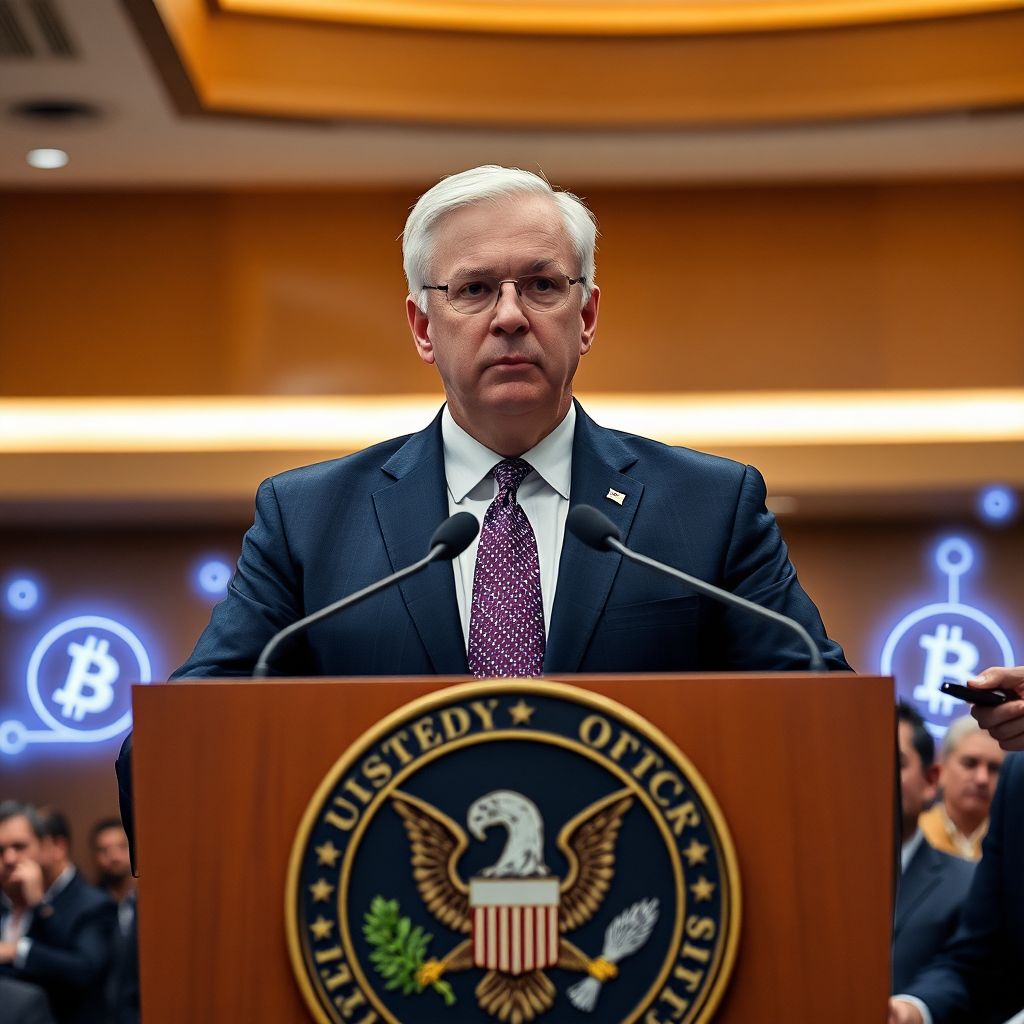
SEC Chair Atkins Signals Major Pivot Toward Rules-Based Crypto Oversight
US Securities and Exchange Commission (SEC) Chair Paul Atkins has outlined what could be the most significant strategic shift in the agency’s approach to digital assets in years, signaling a move away from a regime defined by enforcement cases and toward a clearer, rules‑driven framework designed to keep crypto innovation in the United States rather than pushing it abroad.
In a recent interview with CNBC, Atkins sharply criticized the SEC’s earlier posture, which, in his view, relied excessively on enforcement actions instead of establishing explicit regulatory standards. That approach, he argued, left companies guessing at the rules, chilled legitimate activity, and incentivized entrepreneurs to build outside US borders.
“Nowhere has the cost of failing to offer clear guidance been more obvious than in our handling of crypto assets,” Atkins said, adding that past messaging effectively came down to “adjust to our expectations-or face the consequences.” According to him, that mindset not only undermined regulatory credibility but also discouraged credible projects from engaging with US regulators at all.
Atkins pointed to newly issued interpretive guidance, prepared jointly with the Commodity Futures Trading Commission (CFTC), as the first tangible step in a more transparent and practical regulatory roadmap for the digital asset space. He framed the document as both a clarification of existing law and a signal that the SEC is increasingly open to engaging constructively with the industry.
The joint guidance, released earlier this week, sets out how federal securities laws should apply to a wide spectrum of digital tokens. In a notable departure from earlier uncertainty, the SEC and CFTC now state that, as a general matter, crypto assets are not to be presumed securities by default. Instead, classification hinges on the asset’s purpose, structure, and the economic realities surrounding its issuance and use.
The guidance also explains how specific token transactions, governance changes, or alterations in a token’s role within an ecosystem can cause it to move into or out of securities status. For example, a token that initially functions as an investment contract might, over time, evolve into a utility within a sufficiently decentralized network and therefore fall outside securities regulation, or vice versa if new profit‑sharing rights are introduced. This framework is meant to give market participants a clearer basis for evaluating when securities laws are triggered and what compliance obligations may follow.
As part of the new approach, regulators have identified four broad categories of crypto assets that the SEC no longer views as securities:
1. Digital commodities – tokens that function primarily as raw digital goods or settlement assets.
2. Digital tools – tokens whose main function is to provide access to a platform, service, or software feature.
3. Digital collectibles, including non‑fungible tokens (NFTs), where value is principally tied to uniqueness, creativity, or community appeal rather than profit expectations from an issuer’s efforts.
4. Stablecoins – assets designed to maintain a relatively stable value, often pegged to fiat currencies or other reference points.
The agencies emphasized that this position emerged from close cooperation between the SEC and CFTC and is consistent with several recent legislative proposals, particularly regarding the treatment of stablecoins under frameworks such as the GENIUS Act. At the same time, the guidance makes clear that tokenized securities-traditional securities represented on a blockchain-remain fully within the SEC’s jurisdiction and continue to be treated as securities regardless of the underlying technology.
Atkins also floated the idea of a “fit‑for‑purpose startup exemption” tailored to early‑stage crypto projects. Under this concept, fledgling crypto ventures could raise a limited amount of capital or operate for a specified time under a lighter regulatory regime, so long as they meet certain transparency and investor‑protection conditions. The aim would be to give innovators room to build and test products without immediately facing the full weight of securities regulation that was designed for mature public companies.
In parallel, the SEC is preparing to publish a formal proposal for crypto safe harbors, which Atkins expects to be opened for public comment in the near term. This proposal is slated to include the so‑called innovation exemption-a time‑bound carve‑out from certain securities rules that would allow companies to experiment with novel token models and business structures, provided they meet disclosure and anti‑fraud standards. Such a safe harbor could serve as a bridge between unregulated experimentation and long‑term regulatory compliance.
Atkins underscored that years of ambiguity have had concrete and damaging consequences. By relying on “regulation by enforcement,” he said, the SEC effectively forced companies to deduce the rules retroactively from settlement orders and court decisions. That uncertainty led some of the most promising firms to relocate their operations overseas, while those that stayed in the US had to navigate a patchwork of informal guidance, conflicting interpretations, and unpredictable enforcement risk.
The new interpretive guidance, in his view, represents a course correction: a deliberate effort to provide clearer signposts so that digital asset businesses can understand expectations before they act, rather than after they find themselves under investigation. The broader objective is to embed crypto innovation inside the US regulatory perimeter, where investor protections are robust and oversight mechanisms are mature, instead of allowing activity to migrate to less regulated markets.
For crypto entrepreneurs and investors, the implications of this shift are potentially far‑reaching. A more defined classification system can help projects decide how to structure their tokens from the outset, whether to seek registration, or whether to operate under a commodity, payments, or utility framework instead. This reduces legal guesswork, lowers compliance costs, and may make it easier for institutional players-who typically require clear regulatory status-to enter the market.
The recognition of distinct categories such as digital tools and collectibles also signals that regulators are beginning to differentiate between speculative investments and functional or creative assets. For developers of gaming tokens, loyalty points, or NFT‑based media, this separation could offer much‑needed reassurance that not every digital representation of value will automatically be swept into securities law. It also encourages more nuanced policy discussions that reflect the diversity of blockchain use cases beyond pure speculation.
The treatment of stablecoins is particularly important for the broader financial system. By aligning their stance with emerging legislative frameworks, regulators are acknowledging the growing role of stablecoins in payments, trading, and decentralized finance. Clearer rules around stablecoins could pave the way for wider adoption in remittances, on‑chain settlement, and merchant payments, while still addressing concerns around reserves, transparency, and systemic risk.
However, the reaffirmation that tokenized securities remain securities serves as a reminder that technology alone does not alter the legal character of an asset. For traditional financial institutions exploring tokenization of stocks, bonds, funds, or real‑world assets, the message is that blockchain can streamline settlement and broaden access, but it does not exempt them from disclosure, registration, or other investor‑protection requirements. Instead, tokenization will likely proceed under existing securities frameworks, potentially with updated rules to reflect the mechanics of on‑chain infrastructure.
The contemplated startup exemption and safe harbor regime, if ultimately adopted, could reshape the early stages of crypto project funding. Today, many teams face a stark choice: avoid US investors entirely, launch in regulatory gray areas, or incur heavy legal expenses to pre‑empt enforcement risk. A carefully designed safe harbor could offer a middle path-allowing teams to raise modest sums, build networks, and reach initial users while committing to progressive decentralization, periodic reporting, and eventual transition into full compliance if the token remains an investment product.
Still, the success of this new direction will depend on the details. The thresholds for fundraising, the length of any grace period, the specific disclosure requirements, and the metrics used to assess decentralization will determine whether the framework truly lowers barriers for innovators or simply adds another complex layer. Industry participants will be watching closely for concrete rule proposals and opportunities to provide input during the comment process.
Internationally, the SEC’s move toward clarity may also influence how other jurisdictions position themselves. Overly restrictive regimes risk driving businesses away, while overly permissive ones may invite fraud and instability. By signaling that the US is prepared to modernize its approach and coordinate between agencies such as the SEC and CFTC, Atkins is attempting to balance competitiveness with investor protection, offering a blueprint that other regulators may either emulate or react against.
For now, Atkins’ comments and the joint guidance mark an inflection point rather than a finished framework. Many unresolved questions remain-how to treat governance tokens in decentralized autonomous organizations, how to evaluate hybrid tokens that mix utility and profit rights, and how to supervise cross‑border platforms that serve US users. Nonetheless, the tone has clearly shifted from one of implicit threats to one of explicit rules and collaborative problem‑solving.
In sum, Atkins is charting a path that seeks to replace opacity with predictability in US crypto regulation. By moving beyond an enforcement‑first mentality, defining categories of non‑securities, reaffirming the status of tokenized securities, and sketching out exemptions and safe harbors, the SEC is signaling that it wants innovation to occur in the open, under accountable oversight, rather than on the regulatory margins. For an industry long accustomed to uncertainty, that alone marks a significant step toward long‑awaited regulatory clarity.