
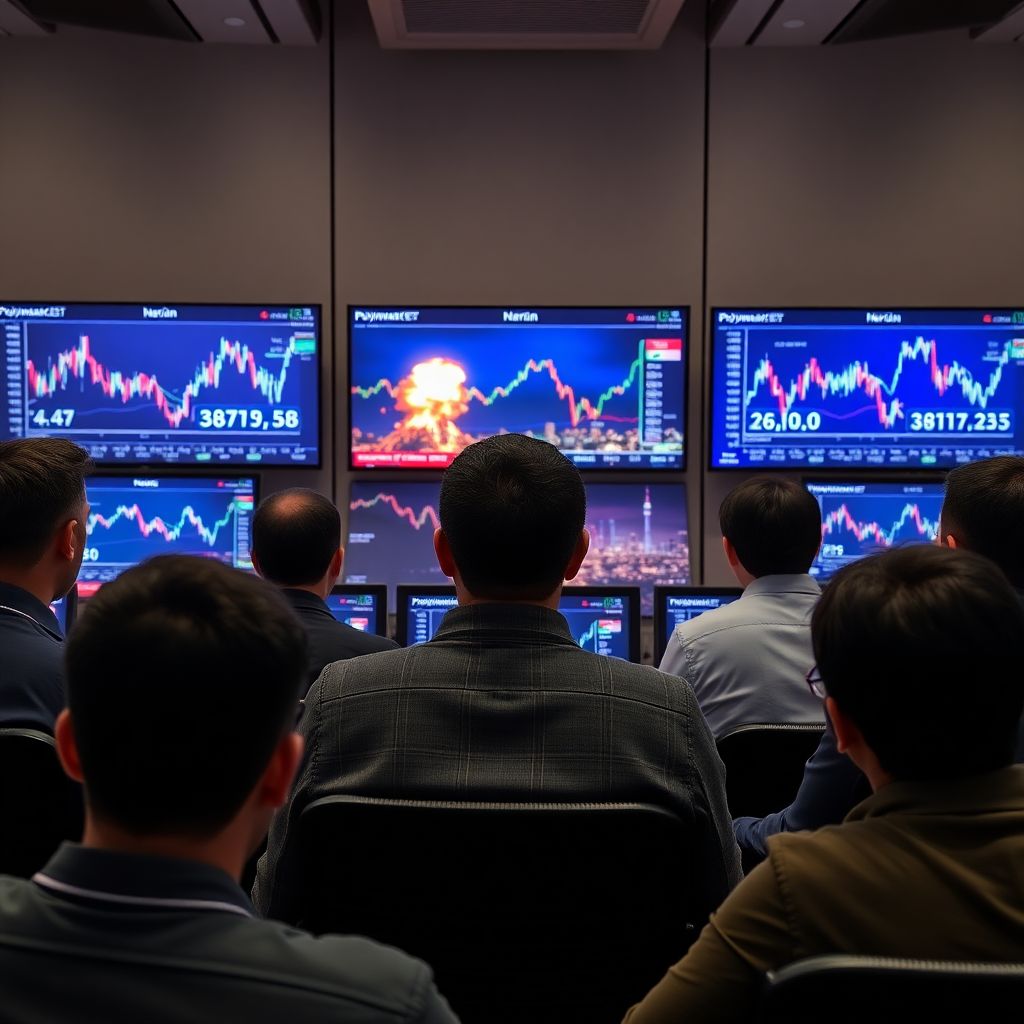
Six Polymarket Traders Score $1M on US-Iran Strike Bets, Stoking Insider Trading Fears
Six newly created trading wallets on Polymarket collectively earned around $1 million by correctly wagering that the United States would launch a military strike on Iran before the end of February, according to data analyzed by Bubblemaps SA and reported by Bloomberg.
The wallets were all set up in February and were used almost exclusively to trade contracts tied to the timing of a potential US attack on Iran. In several instances, these traders bought shares just hours before the first explosions were reported in Tehran, paying as little as $0.10 per share before the contracts later surged in value.
This pattern immediately caught the attention of onchain analysts and market observers. The clustering of wallets, their narrow focus on a single geopolitical event, and the last‑minute timing of the purchases resembled behavior that has previously raised red flags in other suspected insider trading cases on prediction platforms.
Nicolas Vaiman, chief executive of Bubblemaps, noted that in situations involving military conflict, sensitive information often circulates among a wider group of insiders long before it becomes public. When combined with the relative anonymity of platforms like Polymarket-where users typically need little more than a crypto wallet to trade-this information asymmetry can create powerful incentives for individuals with early knowledge to place highly targeted bets.
During the spike in geopolitical tensions, strike‑related contracts on Polymarket attracted more than $529 million in total trading volume. Among these, a contract speculating on a US strike by February 28 became the single most heavily traded, drawing about $90 million alone. Another key date, January 31, accounted for roughly $42 million in volume, underlining how strongly traders were positioning around specific timelines.
One of the wallets flagged by analysts had previously lost money on an earlier Iran‑related contract before doubling down with a larger position that ultimately generated more than $170,000 in profit. That history has been cited as a reminder that suspicious timing does not automatically prove wrongdoing; it could also reflect aggressive speculation based on widely available information and public warnings from Washington about potential retaliatory action.
Still, this is far from the first time Polymarket has been shadowed by allegations of insider‑driven trades. Recently, a small cluster of crypto wallets reportedly made over $1.2 million by betting on a contract linked to an onchain investigation into DeFi project Axiom. Those positions were taken shortly before blockchain investigator ZachXBT publicly alleged that an Axiom employee and associates had been engaged in insider trading since early 2025.
In another high‑profile case, a Polymarket account is believed to have turned about $32,000 into roughly $400,000 by wagering on the removal of Venezuelan President Nicolás Maduro shortly before news of his capture became public. The timing of that trade also triggered intense speculation about whether the trader had access to confidential or early‑stage information.
Growing concern over these types of incidents has begun to reach policymakers. In the United States, Representative Ritchie Torres is advancing draft legislation known as the Public Integrity in Financial Prediction Markets Act of 2026. The bill is designed to prevent insider trading on prediction platforms by prohibiting elected officials, political appointees, and executive‑branch staff from trading contracts linked to government policy or political outcomes if they hold nonpublic information that could influence those markets.
At the same time, Polymarket is facing mounting pressure from regulators around the world. Authorities in a range of countries, including several European states as well as Singapore, have restricted or outright banned access to the platform. In many of these jurisdictions, event‑based prediction contracts have been officially categorized as unlicensed online gambling products rather than regulated financial instruments, putting them in direct conflict with local laws.
Why Prediction Markets Are So Vulnerable to Insider Risks
Prediction markets are built on the idea that the crowd can collectively forecast future events more accurately than individual experts. Traders buy and sell shares in outcomes-such as elections, court decisions, regulatory moves, or even military strikes-with prices reflecting the probability that an event will occur.
However, this structure also makes them highly sensitive to information imbalances. Traders with early or privileged access to government decisions, corporate moves, or confidential investigations can exploit that knowledge ahead of the broader public. When those events involve national security or law enforcement, the ethical and legal implications deepen dramatically.
Unlike traditional financial markets, prediction platforms often operate in a gray regulatory area. Investor protections, disclosure rules, and surveillance systems-standard in stock and derivatives markets-are either minimal or completely absent. That lack of oversight gives insiders more room to maneuver and makes it more difficult for authorities to investigate suspicious patterns.
Anonymity, Crypto, and the Enforcement Challenge
Polymarket and similar protocols typically require users only to connect a crypto wallet to start trading. This wallet‑based model can preserve pseudonymity, complicating efforts to link suspicious trades to real‑world individuals. Even when patterns suggest nonpublic information may have been used, tracing those trades back to a specific official, contractor, or associate is technically and legally challenging.
Blockchain transparency cuts both ways. On one hand, every trade is publicly recorded, enabling analytics firms to detect clusters of wallets, timing anomalies, and repeated patterns that might indicate insider activity. On the other hand, without robust identity checks or regulatory authority, such findings rarely translate directly into enforcement actions. They instead fuel public debate and pressure for new regulations.
Where the Legal Line Is Being Drawn
Legally, the concept of insider trading is well established in securities law but much murkier in the realm of prediction markets. If a contract is not classified as a security or a regulated derivative, existing insider trading statutes may not obviously apply. That ambiguity leaves regulators and lawmakers scrambling to decide whether new rules are needed or if existing laws can be stretched to cover these platforms.
The Torres proposal highlights an emerging consensus that, at minimum, government officials and staff should not be allowed to monetize sensitive policy decisions through prediction markets. But the draft bill targets only a narrow class of potential insiders. It does not fully address scenarios involving contractors, military personnel, journalists with embargoed information, or individuals connected indirectly to confidential planning.
As prediction markets grow in size and visibility, there is likely to be a push for clearer categorizations: are these platforms gambling sites, innovative financial tools, or something entirely new that demands a bespoke regulatory framework? How lawmakers answer that question will determine what surveillance, licensing, and enforcement mechanisms can be applied.
The Fine Line Between Informed Speculation and Illicit Advantage
One of the central complexities in these controversies is distinguishing between savvy speculation based on public information and trading that relies on material nonpublic information. In the Iran strike case, US officials had issued repeated warnings that a response was likely, creating a rational basis for traders to price in the risk of imminent action. Those who watched diplomatic statements, troop movements, or open‑source intelligence closely could plausibly have reached similar conclusions without any secret briefing.
At the same time, the clustering of wallets, the narrow focus on one event, and the last‑minute purchases remain difficult to explain as mere coincidence. For regulators and market operators, the key question is not whether every successful trade is suspect, but how to design systems that discourage and detect abusive patterns without undermining the core value proposition of prediction markets as information‑aggregation tools.
Possible Safeguards and Industry Responses
Operators could introduce several safeguards to address insider risks. These might include:
– Stronger identity verification for high‑volume traders or sensitive markets
– Blacklists or trading restrictions for government officials and employees with access to classified information
– Real‑time monitoring of unusual trading patterns and the option to pause or review markets when anomalies emerge
– More detailed disclosures to users about the limits of regulatory protection and the potential for information asymmetries
None of these solutions is simple. Tighter controls may conflict with the open, permissionless ethos of decentralized finance and could drive some activity to even less regulated platforms. But as cases like the US-Iran strike contracts draw public and political scrutiny, prediction market operators may face a stark choice between self‑regulation and externally imposed rules.
The Future of Geopolitical Betting
The controversies around Polymarket’s war, investigation, and regime‑change contracts highlight a deeper ethical debate: should markets exist where people profit directly from armed conflict, political turmoil, or legal crackdowns? Supporters argue that such markets provide early warning signals, improve forecasting, and can even help policymakers gauge public expectations. Critics counter that they incentivize morally questionable bets, create opportunities for insiders to exploit crises, and risk undermining trust in public institutions.
As geopolitical events continue to play out in real time across social media and global markets, platforms like Polymarket sit at the intersection of finance, politics, and technology. The roughly $1 million scored by six wallets on US-Iran strike bets may be only a preview of the much larger battles over regulation, ethics, and market design that lie ahead.