
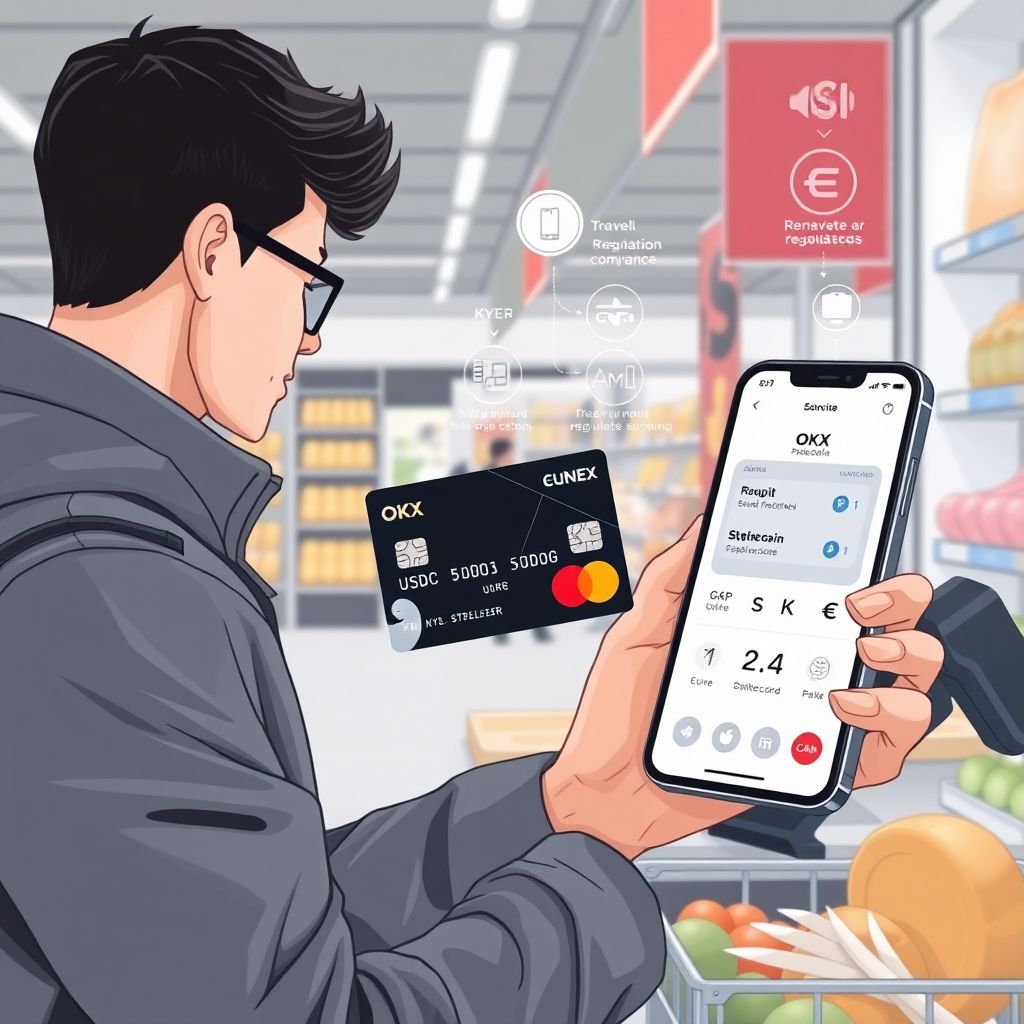
OKX Debuts European Crypto Card Enabling Everyday Stablecoin Spending
Cryptocurrency exchange OKX has introduced a new payment card for European users that allows them to pay with stablecoins anywhere Mastercard is accepted. The launch is aimed at turning digital assets into a practical tool for everyday transactions while remaining fully aligned with the European Union’s fast‑evolving regulatory framework.
How the OKX Card Works
The OKX Card lets users spend supported stablecoins — initially including Circle’s USD Coin (USDC) and the Paxos-issued Global Dollar (USDG) — at any merchant worldwide that accepts Mastercard payments. From the customer’s point of view, it works much like a regular payment card: they tap, swipe or pay online in euros or other fiat currencies, while the underlying balance is held in stablecoins.
The card is connected to OKX Pay, the exchange’s self-custodial wallet that lives inside the OKX app. Users can top up their OKX Pay wallet directly from their OKX exchange account, then use those balances to fund card spending. This design aims to bridge the gap between on-exchange balances, self-custody, and real-world payments in a single ecosystem.
According to OKX Europe CEO Erald Ghoos, the product is meant to make crypto “simple for anyone in Europe to use for real-world purchases,” addressing one of the key hurdles in broader adoption: actually being able to spend digital assets at familiar merchants without extra friction.
Regulated Issuance Via Monavate and Mastercard
The OKX Card itself is issued by Monavate, an Electronic Money Institution (EMI) headquartered in the United Kingdom and operating across the European Economic Area. Monavate is responsible for issuing and operating the card on Mastercard’s global payment network, giving the product a familiar, widely trusted infrastructure.
As an EMI, Monavate must comply with stringent European rules on Anti-Money Laundering (AML) and Know Your Customer (KYC) checks. This means the card is not just a technical bridge between crypto and fiat, but also a regulated financial instrument subject to the same type of scrutiny as other electronic money products in the region.
OKX, for its part, is registered as a crypto-asset service provider (CASP) under the EU’s Markets in Crypto-Assets Regulation (MiCA). That status brings it under a defined legal framework for custody, exchange, and related services, and sets the foundation for offering regulated payment products like the OKX Card within the bloc.
Strict KYC and AML: Who Can Use the Card
The card is only available to fully verified users in the European Union and European Economic Area. Prospective cardholders must complete robust KYC and AML checks that align with MiCA requirements and broader EU AML directives and regulations.
Only after these checks are passed can an OKX customer apply for and receive the card. The company emphasizes that this is not an anonymous crypto spending solution, but a compliant, transparent payment product meant to fit neatly within European regulatory expectations.
The card’s reliance on verified accounts also underscores OKX’s positioning: it is not targeting purely privacy-driven or unregulated use cases, but rather everyday spending, travel, online shopping, and business payments that require traceability and legal clarity.
Integration With Self-Custodial Wallets
A distinctive feature of the OKX Card is its connection to OKX Pay, a self-custodial wallet controlled by the user. While the card is only available to verified OKX account holders, the core wallet infrastructure is designed around user control over private keys and on-chain assets.
In practice, this means that users can move funds from the centralised exchange into their self-custody wallet and then decide how much to make available for card spending. It provides a hybrid model: users retain self-sovereignty over their crypto while still benefiting from a familiar card interface when spending in the traditional economy.
This hybrid approach responds to a growing demand in crypto: people want the security and control of self-custody without giving up the ability to transact easily in the fiat world. By anchoring the card to a self-custodial wallet, OKX is signaling that it sees long-term value in user-controlled infrastructure rather than purely custodial models.
Monavate’s Strategic Direction and Exodus Acquisition
Monavate’s role in the card program comes as the EMI itself is undergoing significant strategic changes. It is set to be acquired by self-custodial wallet provider Exodus under a definitive agreement announced in November 2025. The transaction involves Monavate’s parent company W3C Corp and affiliated firm Baanx.
For the broader ecosystem, that combination — a regulated EMI and a self-custodial wallet player — hints at a future where the line between traditional electronic money institutions and crypto-native wallets becomes increasingly blurred. Regulated card issuance and decentralized wallet technology may end up more tightly integrated, offering users both regulatory clarity and technical sovereignty.
This context is relevant for the OKX Card: its infrastructure partner is not just a standard payments company, but one that is already aligning with crypto-native businesses and self-custody philosophies.
Why Stablecoins Are Central to the Strategy
The choice to focus on stablecoins like USDC and USDG is deliberate. Volatile cryptocurrencies such as Bitcoin or Ether are less convenient for everyday spending due to price swings, tax complexity, and accounting challenges. Stablecoins, pegged to the US dollar, offer a more predictable unit of account and make pricing and spending easier for both consumers and merchants.
Stablecoin payments also fit neatly with card networks like Mastercard. Behind the scenes, balances in USDC or USDG can be converted to fiat at the point of sale, while the customer experiences a seamless card transaction. This makes merchants largely indifferent to whether the original funds were crypto or fiat, lowering the barrier to adoption.
In addition, MiCA introduces specific rules for stablecoins — termed “asset-referenced tokens” and “e-money tokens” — which gives regulated firms like OKX and Monavate a clearer regulatory roadmap for building long-term stablecoin products in Europe.
Positioning Within Europe’s Regulatory Shift
Europe has become one of the first major jurisdictions to roll out a comprehensive framework for digital assets through MiCA. For exchanges and service providers, this is both a challenge and an opportunity: compliance obligations are rising, but the rules are more predictable.
By launching a card explicitly under a MiCA-compliant structure, OKX is signalling that regulated, mainstream crypto products are now central to its European strategy. Rather than sidestepping regulations, the company is building within them — a move that can help attract institutional partners, payment networks, and more risk-averse users.
The OKX Card can be seen as a test case for how crypto-native firms can offer payment products that look and feel like traditional cards while remaining anchored in on-chain assets and self-custodial tools.
Meeting Core Financial Needs With Crypto
Erald Ghoos frames the OKX Card around three basic financial needs: making and receiving payments, growing wealth, and accessing credit. The card, he notes, is designed to address the first of these — everyday payments — by giving users a practical, regulated way to spend crypto.
From a strategic standpoint, this positions OKX’s card as a building block. Once the payment rail is in place and trusted, additional services could logically follow: loyalty programs, integrated DeFi yield funnels for card balances, installment-style credit features, or business cards for freelancers being paid in crypto.
For now, the emphasis is on reliability and familiarity: users should be able to tap their OKX Card at a supermarket or use it to book a flight just as they would with any other Mastercard-backed debit product, without having to manually convert crypto on an exchange first.
Growing Adoption of Crypto-Linked Payments
The rollout of the OKX Card adds to a broader trend: crypto-linked cards are becoming a common way to bridge digital assets and fiat spending. Previous launches by other major networks and issuers have already shown that consumers are willing to use such products at scale, with some card programs seeing several-fold increases in annual transaction volumes.
These cards serve as an important onramp for mainstream usage. Instead of waiting for every merchant to natively accept crypto, card programs allow people to spend digital assets instantly in the existing payments infrastructure, while gradually normalizing the idea of using crypto as money rather than just as an investment.
In that sense, the OKX Card is part of a second wave of crypto adoption: moving from speculation and trading toward utility, convenience, and real-world integration.
What This Means for Everyday Users in Europe
For an average EU-based user, the implications are straightforward:
– They can hold stablecoins like USDC or USDG and still spend them almost anywhere in the world that accepts Mastercard.
– They benefit from self-custody via OKX Pay while also having a physical or virtual card that fits into everyday habits.
– They gain a payment option that operates within the EU’s regulatory perimeter, potentially making tax reporting and compliance easier than unregulated alternatives.
At the same time, users must accept trade-offs: full verification, transparency to regulated intermediaries, and operation under strict AML and KYC rules. For those who prioritize legal clarity and ease of use over anonymity, this will be an acceptable compromise.
The Bigger Picture: Crypto as Part of Everyday Finance
The launch of the OKX Card in Europe underscores a broader shift in the role of crypto. Digital assets are increasingly moving from the periphery of finance — speculative trading, niche communities, experimental DeFi — into mainstream financial infrastructure.
By combining regulated issuance (Monavate), global card rails (Mastercard), self-custodial wallets (OKX Pay), and compliant exchange operations (MiCA CASP), the card illustrates how traditional and crypto-native systems can be layered together. Stablecoins act as the glue between these worlds.
If such products gain traction, they may help redefine what “holding money” looks like for European consumers: balances could be kept in transparent, programmable on-chain assets, while being instantly usable through familiar tools like debit cards, mobile wallets, and online checkouts.