
This new crypto coin could be the smartest move since Solana at $2
Mutuum Finance (MUTM) is rapidly emerging as one of the most compelling crypto narratives of the year. For many seasoned investors, it evokes memories of Solana’s early days, when SOL traded near $2 and only a small circle of believers recognized its long‑term potential. Those who moved early back then watched relatively modest positions transform into life‑changing gains. MUTM is now at a similarly formative stage, combining an innovative lending model, a revenue-sharing ecosystem, and growing market traction that together could set the foundation for significant upside.
Early-stage momentum and presale positioning
Right now, Mutuum Finance is in Phase 6 of its presale. MUTM tokens are priced at $0.035, with 170 million tokens allocated to this phase, and more than 90% of that allocation already sold. Demand at this stage is a strong signal of investor confidence, especially given the broader volatility in the crypto market. The total supply of MUTM is capped at 4 billion tokens, and the project has already raised approximately $18.8 million.
Across all presale stages, the holder base has expanded to over 18,100 participants, suggesting that interest is not limited to a small group of whales but is spreading across a broad retail and early-institutional investor audience. Once Phase 6 concludes, the token price is scheduled to rise to $0.040 in the next phase, representing a 15% increase from the current level. That makes Phase 6 the final deeply discounted entry point before the project moves closer to its launch valuations.
Each previous presale round has been absorbed quickly, reinforcing the impression that market participants are not only aware of the project but are actively competing for allocation. For presale investors, that behavior often acts as a validation signal: when each phase fills rapidly, it indicates that the project is capturing sustained attention rather than experiencing a one-off hype spike.
What early investors could have gained already
To understand the scale of opportunity for early entrants, consider a simple example. An investor who committed $1,000 worth of ETH during Phase 1, when MUTM was priced at $0.01, would now be sitting on tokens valued at $3,500 at the Phase 6 price of $0.035. That is a 250% gain before the token has even launched on major markets.
If that same position were later to be repriced at $0.06 per token, the holding would grow to $6,000, translating into a sixfold increase from the original investment. These numbers resemble the type of compounding effect that early Solana backers experienced, where multiple presale and early-exchange price legs multiplied initial stakes long before the coin reached its peak valuations.
This hypothetical is not a guarantee of future performance, but it does highlight how presale structuring and staged price increases can reward those who are willing to commit capital before a token becomes widely available.
Dual-lending engine: the core of MUTM’s value proposition
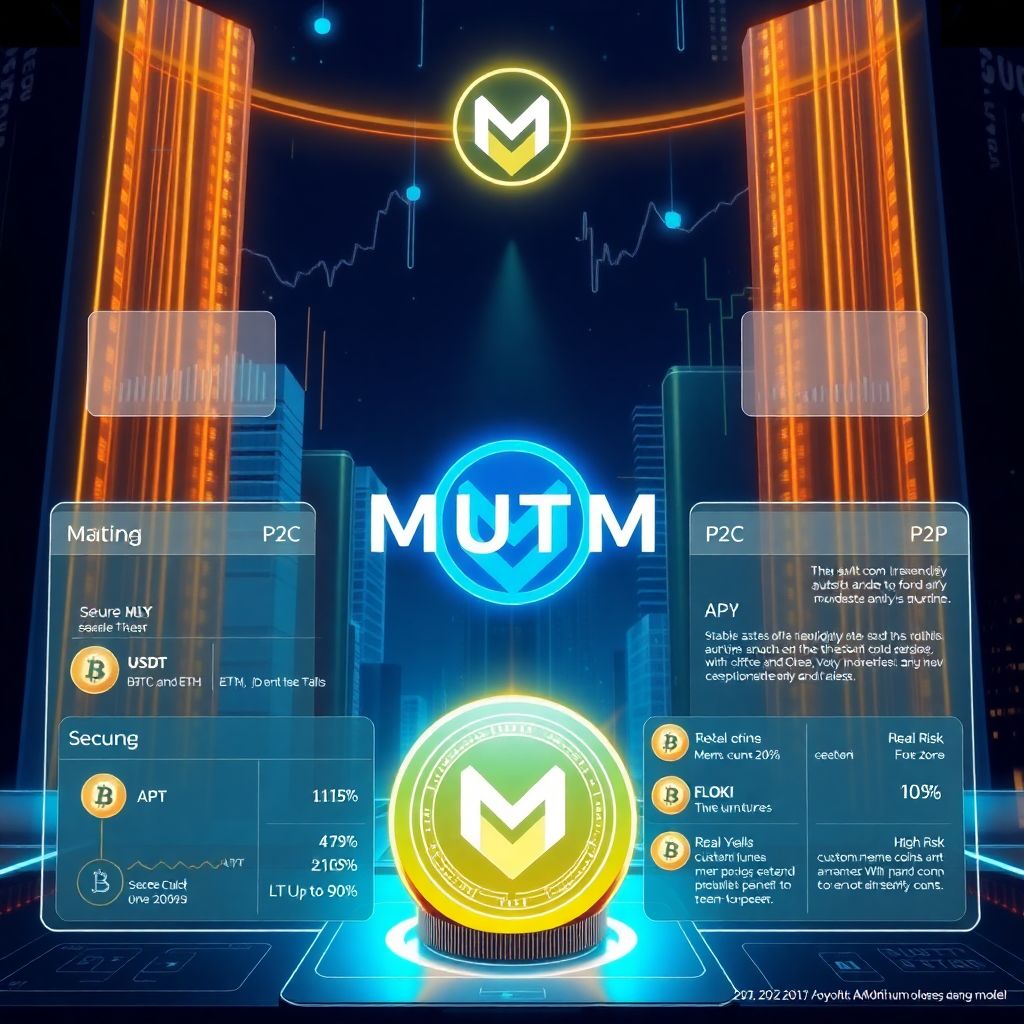
The backbone of Mutuum Finance’s economic model is a dual-lending ecosystem designed to generate real yield and persistent demand for the MUTM token. Instead of limiting itself to a single borrowing and lending structure, Mutuum splits its functionality between two distinct models: Peer‑to‑Contract (P2C) and Peer‑to‑Peer (P2P).
In the P2C model, users deposit assets like USDT or BTC into audited liquidity pools. These pools are governed by smart contracts that automatically adjust interest rates based on utilization. When demand for borrowing rises, rates move higher, increasing yields for liquidity providers. For example, a user depositing $15,000 in USDT receives mtUSDT at a 1:1 ratio and can potentially earn around 15% APY, translating to roughly $2,250 in passive income per year. Those returns are generated by borrowers, who deposit collateral such as ETH and can access up to 90% loan-to-value (LTV), enabling them to unlock liquidity without having to sell their underlying holdings.
The P2P system, on the other hand, targets riskier, more volatile assets such as DOGE or FLOKI. Here, lenders and borrowers negotiate terms directly with one another, including interest rates and loan duration. This peer-based framework segments high‑risk tokens away from the main liquidity pools, limiting systemic risk while still offering the potential for elevated yields to those willing to accept additional volatility.
Every borrowing, lending, or staking action within either model requires interaction with the MUTM token, whether through fees, collateralization mechanisms, or incentive structures. This constant on-chain activity translates into recurring demand for MUTM and underpins its potential to maintain a strong value floor over time.
Real yield via revenue recycling, not inflation
A major challenge for many DeFi protocols has been sustainability. Projects that rely heavily on minting new tokens to reward users often see their token price erode over time, as inflation overwhelms demand. Mutuum Finance seeks to sidestep that trap by focusing on real yield generated from platform activity.
Instead of endlessly printing new tokens, Mutuum intends to redirect a share of platform revenue toward buybacks of MUTM from the open market. These purchased tokens are then distributed to mtToken stakers—users who have locked their mtTokens within the ecosystem. This approach creates persistent buy pressure, while simultaneously recycling real, protocol-generated revenue back to participants.
Conceptually, this structure is similar to the way early centralized exchanges used trading fees to benefit token holders. Each interaction with the platform—whether lending, borrowing, or managing risk—becomes part of a feedback loop that supports both liquidity and token value. For long-term participants, that can make rewards significantly more robust than rewards based purely on emissions.
Testnet rollout and technical milestones
On the development front, Mutuum Finance has publicly outlined a clear roadmap. The team has announced that Version 1 (V1) of the protocol is scheduled to go live on the Sepolia Testnet in the fourth quarter of 2025. This early build is designed to introduce the essential building blocks of the ecosystem, including the primary liquidity pool, the architecture for mtTokens and debt tokens, and an automated liquidation bot to ensure that undercollateralized positions are handled promptly.
During the testnet phase, users will be able to lend, borrow, and lock ETH or USDT as collateral. This environment allows real-world behavior to be simulated without placing user funds at mainnet risk. It also gives the team the opportunity to fine-tune interest rate strategies, test liquidation logic, evaluate reserve parameters, and optimize user experience before any mainnet deployment.
Rolling out to a testnet first offers another clear advantage: it allows early supporters and prospective investors to interact with the platform’s core functionalities and evaluate whether the user experience and technical execution match the project’s ambitious narrative. Increased transparency and hands-on testing can help build trust and reduce uncertainty ahead of broader market exposure.
Risk management: LTV tiers and reserve factors
Any lending protocol is only as strong as its risk controls, and Mutuum Finance is placing emphasis on its safeguards. The platform will apply differentiated loan-to-value tiers depending on asset class and volatility profile. Stablecoins and ETH—generally considered low‑risk compared to many altcoins—can support up to 90% LTV with a 90% liquidation threshold. This means borrowers can unlock a significant portion of their asset value, but collateral will be liquidated if it falls below defined safety margins.
More volatile tokens will operate in a lower and more granular LTV range, between 35% and 90%, depending on risk characteristics and market behavior. On top of that, Mutuum plans to deploy varying reserve factors: around 10% for low-risk assets and up to 55% for high-risk tokens. These reserve buffers are held aside from the main lending pool to protect solvency, absorb market shocks, and keep the system functional even during periods of extreme volatility.
By tuning these parameters, Mutuum aims to strike a balance between capital efficiency—allowing users to borrow as much as safely possible—and long-term platform resilience. Properly calibrated, such mechanisms can help reduce the likelihood of cascading liquidations and sharp liquidity crunches that have plagued other DeFi platforms.
Incentives and gamification: daily leaderboard rewards
To encourage activity and accelerate growth, Mutuum Finance has also integrated a layer of gamified incentives. A 24‑hour leaderboard tracks trading and on‑platform interaction, and the top trader each day receives $500 worth of MUTM, provided they complete at least one qualifying transaction within that period. At 00:00 UTC, the leaderboard resets, giving users a fresh chance to compete for the daily reward.
This structure serves multiple purposes. It incentivizes larger participants to keep engaging with the protocol, amplifies transactional volume, and adds an element of excitement that can help draw attention to the platform, especially during its early lifecycle. As long as rewards are balanced against overall tokenomics and revenue, such mechanisms can help kickstart network effects without undermining long-term sustainability.
Why MUTM draws comparisons to Solana’s early days
The frequent comparison to Solana at $2 is not purely about price; it is about positioning and timing. Solana’s biggest winners were the investors who recognized the underlying technology, scalability, and network effects long before the majority of the market caught on. They bought into a narrative—high throughput, low fees, and a fast-growing ecosystem—at a stage when the risk‑reward balance was still heavily asymmetric in their favor.
Mutuum Finance appears to occupy a similar category of early-stage, high‑potential opportunity. Its thesis is not about becoming a general‑purpose layer‑1 chain, but about constructing a robust revenue-generating DeFi engine with dual lending, real yield, and a carefully designed token economy. If the project successfully executes its roadmap, maintains liquidity, and attracts both borrowers and lenders at scale, those who acquired MUTM during its discounted phases could see substantial upside.
At the same time, investors should recognize that high-reward opportunities come with commensurate risk. Execution failure, regulatory changes, market downturns, or technical vulnerabilities could all undermine the thesis. That is why many sophisticated participants treat such positions as part of a diversified portfolio rather than an all‑in bet.
How MUTM fits into a modern crypto portfolio
For investors building a diversified crypto allocation, MUTM can be seen as an early‑stage DeFi growth play, complementing more established holdings like BTC, ETH, or blue‑chip layer‑1s. In traditional portfolio terms, it sits in the higher‑risk, higher‑reward bucket, where position sizing and risk management become critical.
Some may choose to allocate a small percentage of their capital to promising presale projects like Mutuum Finance, accepting the possibility of drawdowns in exchange for the chance of outsized returns. Others may wait until the protocol has live mainnet metrics, such as total value locked (TVL), loan volume, and revenue, before entering. Both approaches are valid; the choice largely depends on individual risk tolerance and time horizon.
Key factors to watch going forward
For those tracking Mutuum Finance as a potential investment, several milestones and metrics may be useful:
– Successful deployment and stability of the V1 protocol on testnet
– Clarity and execution on mainnet launch timelines after testing
– Growth in user numbers, deposited liquidity, and borrowing volumes
– Transparency in how revenue is generated and used for buybacks
– Robustness of liquidation mechanisms during volatile markets
– Long-term sustainability of incentives such as the daily leaderboard
If the project can demonstrate real usage, consistent revenue, and secure operations, the narrative of MUTM as a “hidden gem” with Solana‑like upside will gain additional weight.
The bottom line
Mutuum Finance (MUTM) combines a discounted presale opportunity, a dual‑lending architecture, real‑yield mechanics, and a clear technical roadmap to present what many see as one of the more intriguing crypto plays in the current market. Phase 6 of the presale, with tokens at $0.035 and over 90% of the allocation already taken, is positioned as the final heavily discounted stage before prices climb further.
While no outcome is guaranteed, the blend of early‑stage pricing, strong investor interest, and a revenue-driven token model explains why MUTM is increasingly being discussed in the same breath as Solana’s formative years. For investors seeking asymmetric upside and willing to navigate the risk of emerging DeFi protocols, Mutuum Finance may be one of the more strategic moves to consider in the current cycle.