
Mt. Gox Hacker Moves Another 1,300 BTC While $360 Million in Bitcoin Still Sits on the Sidelines
Bitcoin associated with the long-running Mt. Gox saga continues to quietly move through the market, as wallets tied to alleged hacker and BTC‑e cofounder Aleksey Bilyuchenko send more coins to exchanges. The latest transfers extend a months‑long pattern of gradual selling rather than a single, dramatic liquidation of funds.
Another 1,300 BTC Hit Unknown Exchanges
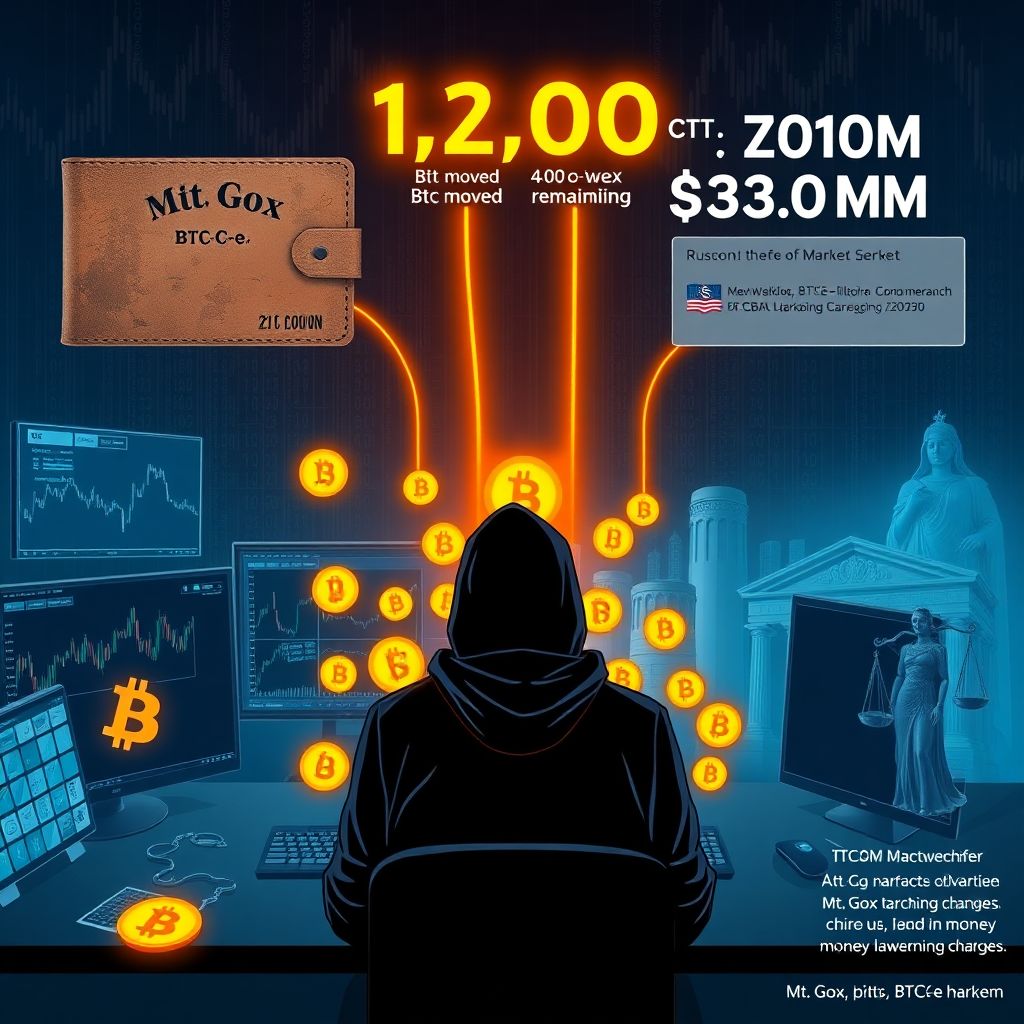
On-chain intelligence shows that entities linked to Bilyuchenko have deposited an additional 1,300 BTC, worth around 114 million dollars, to unidentified trading platforms over the last week. Despite these fresh outflows, the wallets in question still retain roughly 4,100 BTC, estimated at about 360 million dollars at current prices, and have already offloaded a total of 2,300 BTC.
According to publicly shared on-chain analysis dated December 23, the same entity has been systematically sending these coins to “unknown exchanges” in batches. The wording “unknown” here reflects that the destination wallets are not clearly labeled as belonging to major, widely recognized centralized exchanges in the data sets used by analysts.
Why “Unknown Exchanges” Matter for the Market
Transfers into exchange wallets are typically interpreted as a sign of potential selling pressure. When coins move from long‑dormant or historically significant addresses to trading venues, traders often brace for increased supply that could weigh on price.
However, in this case, the flows are harder to interpret. Because the receiving platforms are not definitively identified as top-tier exchanges, observers have less visibility into where and how the BTC might be sold. That uncertainty adds a layer of complexity: the market can see the coins are being positioned to move, but the precise route, timing, and liquidity venues remain opaque.
For derivatives traders and larger funds, such ambiguity complicates risk management. Known flows into major exchanges can be modeled, hedged, and compared to order book depth. Unknown clusters, by contrast, suggest either smaller venues, over‑the‑counter arrangements, or intermediaries, making it tougher to estimate the exact impact on price.
A Slow Unwind, Not a Flash Dump
The December transactions build on a pattern first highlighted publicly in mid‑October and November. Rather than a one‑time mass sale, on‑chain evidence points to a controlled unwind of a significant stash of legacy coins.
In early November, analysts noted that BTC “once belonging to BTC‑e cofounder Aleksey Bilyuchenko” were being sold off gradually, with an example of approximately 110 BTC deposited across two days. That initial trickle has since turned into a more regular flow, but still far from a panic‑inducing flood relative to global market volume.
From a market structure perspective, such a staggered selling strategy is rational. Offloading hundreds of millions of dollars’ worth of bitcoin in one move would likely crush local liquidity, draw attention from regulators and compliance teams, and trigger aggressive front‑running by other market participants. Spreading sales out over weeks or months reduces slippage, keeps average execution prices higher, and makes the activity harder to track in real time.
Who Controls the Coins Now?
One of the biggest open questions is who actually holds the keys to these wallets today. Some on-chain commentary has underscored the uncertainty around whether Bilyuchenko himself is directing the movements, especially in light of his legal troubles in Russia and the United States.
Analysts have pointed to local Russian reporting that Moscow courts have already seized many of his other assets. That has fueled speculation that state entities, intermediaries, or third parties could be managing at least part of the bitcoin trove, rather than Bilyuchenko acting alone. The absence of clarity on this front further muddies the waters about the motives and endgame behind the current sell‑off.
In a previous analysis, it was even alleged that close to 8,000 BTC tied to the broader WEX/BTC‑e case were under the control of Russian authorities, including a specific tranche of 6,500 BTC moved on a single day. That claim suggested that a particular department within Russia’s security services had effective control over these assets. If accurate, it would mean that at least some of the coins now hitting exchanges are no longer purely in private hands.
The Russian WEX Case and Prison Sentence
In Russia, Bilyuchenko has been entangled in a separate criminal case linked to WEX, the successor platform to BTC‑e. Local courts have already delivered a guilty verdict.
On March 18, 2024, the Moscow City Court confirmed an earlier conviction against Bilyuchenko, described domestically as a system administrator for the WEX exchange. He was accused of misappropriating approximately 3.1 billion rubles in WEX customer assets. The Meshchansky District Court had previously sentenced him in September 2023 to three and a half years in prison and imposed a 500,000‑ruble fine. The appellate court’s decision made that verdict legally binding.
This Russian case centers on fraud and embezzlement within a specific exchange ecosystem. It runs in parallel to, but is distinct from, the massive laundering allegations tied to the Mt. Gox hack and BTC‑e in Western jurisdictions.
US Charges: Mt. Gox and BTC‑e Under the Microscope
In the United States, Bilyuchenko faces a different set of accusations, with a strong focus on the Mt. Gox hack and subsequent laundering operations.
In June 2023, US prosecutors announced that charges against Bilyuchenko and associate Aleksandr Verner had been unsealed in the Southern District of New York. The indictment alleges that the pair conspired to launder roughly 647,000 bitcoin stolen in the 2011 breach of the Mt. Gox exchange, once the world’s largest bitcoin trading platform. Both men are charged with conspiracy to commit money laundering, a count that carries a potential maximum sentence of 20 years in prison.
Separately, in the Northern District of California, Bilyuchenko is also charged with conspiracy to commit money laundering and operating an unlicensed money services business. These counts are tied to claims that he worked with Alexander Vinnik and others to operate BTC‑e from 2011 until the exchange’s shutdown in July 2017. The maximum penalty associated with the California charges is listed at 25 years’ imprisonment.
Taken together, the Russian and US proceedings paint a picture of a central figure embedded in some of the most notorious episodes in early crypto‑exchange history: the collapse of Mt. Gox, the operations of BTC‑e, and the subsequent WEX scandal.
Why These Legacy Coins Still Matter for Bitcoin Today
Even though the Mt. Gox hack dates back more than a decade, the coins tied to that era still influence today’s market narrative. There are several reasons the ongoing movements attract so much attention:
1. Sheer Scale of Holdings
A stash of more than 4,000 BTC—worth hundreds of millions of dollars—can impact liquidity if sold too rapidly, especially during thinner trading periods or in times of heightened volatility.
2. Symbolic Weight
The Mt. Gox episode is synonymous with early‑stage chaos in crypto: weak security practices, opaque operations, and massive losses for users. Any movement of “Gox‑linked” coins inevitably revives concerns about old wounds and unresolved legal battles.
3. Regulatory and Enforcement Significance
The legal actions against figures like Bilyuchenko and Vinnik intersect with long‑running discussions about how states handle cross‑border cybercrime, sanctions, and illicit finance in digital assets. The fate of these coins is part of a broader regulatory story.
4. On‑Chain Forensics as a Tool
Modern blockchain analytics allow investigators and private firms to trace old coins with precision unthinkable in the early 2010s. The Bilyuchenko wallets have effectively become case studies in how transparent blockchain data can be when paired with investigative work.
Potential Market Impact: Overhang, But Not Necessarily Doom
For traders and investors, the key issue is whether this selling creates a sustained “overhang” that caps bitcoin’s upside, or whether the market can absorb it without major dislocation.
Several factors temper the immediate risk:
– Gradual Pace of Sales
The pattern so far suggests an intent to blend into market liquidity rather than shock it. Deposits of 100–1,300 BTC at a time are significant but manageable compared to daily trading volumes on global exchanges.
– High Liquidity at Current Price Levels
With bitcoin trading near historical highs—around 87,756 dollars at the time of writing—there is typically deep liquidity from both institutional and retail participants. That depth can cushion the effect of large sellers.
– Sophisticated Counterparties
If some of the flows are being routed through over‑the‑counter desks, brokers, or private counterparties, much of the impact may be absorbed off‑order‑book, never visibly hitting spot markets in a disruptive way.
However, there are still risks. If legal or political developments suddenly forced a rapid liquidation—for example, if a state authority decided to monetize seized assets quickly—that could create short‑term selling pressure. Market participants therefore continue to monitor these addresses closely, treating them as a barometer for potential supply shocks.
Legal and Political Dimensions Behind the Flows
The intersection of multiple jurisdictions—Russia, the United States, and potentially others—adds a geopolitical layer to this story. Coins linked to hacks, defunct exchanges, and alleged money laundering touch on sensitive issues:
– Control of Seized Digital Assets
Different countries have different rules on how seized crypto is stored, managed, and eventually sold. Some opt for auctions; others may hold assets for extended periods.
– Use of Crypto in Sanctions and Law Enforcement
Cases like this underscore how digital assets can be both a tool for illicit finance and a traceable, recoverable asset in law enforcement operations.
– Precedents for Future Seizures
How authorities handle these coins—speed of disposition, transparency of sale, and communication with markets—could set practical precedents for future large‑scale seizures.
These broader dynamics mean that the sale of Gox‑linked and BTC‑e‑linked coins is not just a market event but also a test of how institutions manage high‑profile digital asset cases.
What Investors Should Watch Going Forward
For those following bitcoin’s macro story, several indicators may be worth tracking:
– On‑Chain Movement of Legacy Wallets
Sudden spikes in activity from long‑dormant Gox‑related, BTC‑e, or WEX addresses can signal upcoming supply.
– Court Filings and Legal Milestones
New indictments, plea agreements, or rulings in US or Russian courts could change who has legal control over certain addresses, and therefore influence selling patterns.
– Behavioral Shifts in Deposits
A move from unknown exchanges to clearly identified major exchanges, or a sudden increase in deposit size and frequency, could foreshadow more aggressive distribution.
– Market Reaction to Known Sales
Historical reactions to similar liquidations—such as previous law‑enforcement auctions of seized bitcoin—suggest that while markets can be jittery, they often digest supply faster than feared.
Bitcoin Price Context
Despite the background noise from legacy coins entering the market, bitcoin’s spot price remains elevated. At the time referenced in the data, BTC is trading at about 87,756 dollars. That level implies that even partial liquidation of the 4,100 BTC still held by the Bilyuchenko‑linked wallets represents a significant potential cash realization for whoever ultimately controls the keys.
Looking ahead, the combination of high prices, growing institutional participation, and improving market infrastructure suggests that even historic overhangs like Mt. Gox and BTC‑e may be increasingly absorbable. Yet the psychological and symbolic impact of seeing “Gox coins” move after years of dormancy ensures that every new transaction from these addresses will remain under the microscope.
In the meantime, the slow drip of sales from the Bilyuchenko‑associated wallets serves as a reminder that bitcoin’s early history—complete with hacks, opaque exchanges, and complex legal battles—is still echoing through today’s market, even as the asset matures into a global financial instrument.