
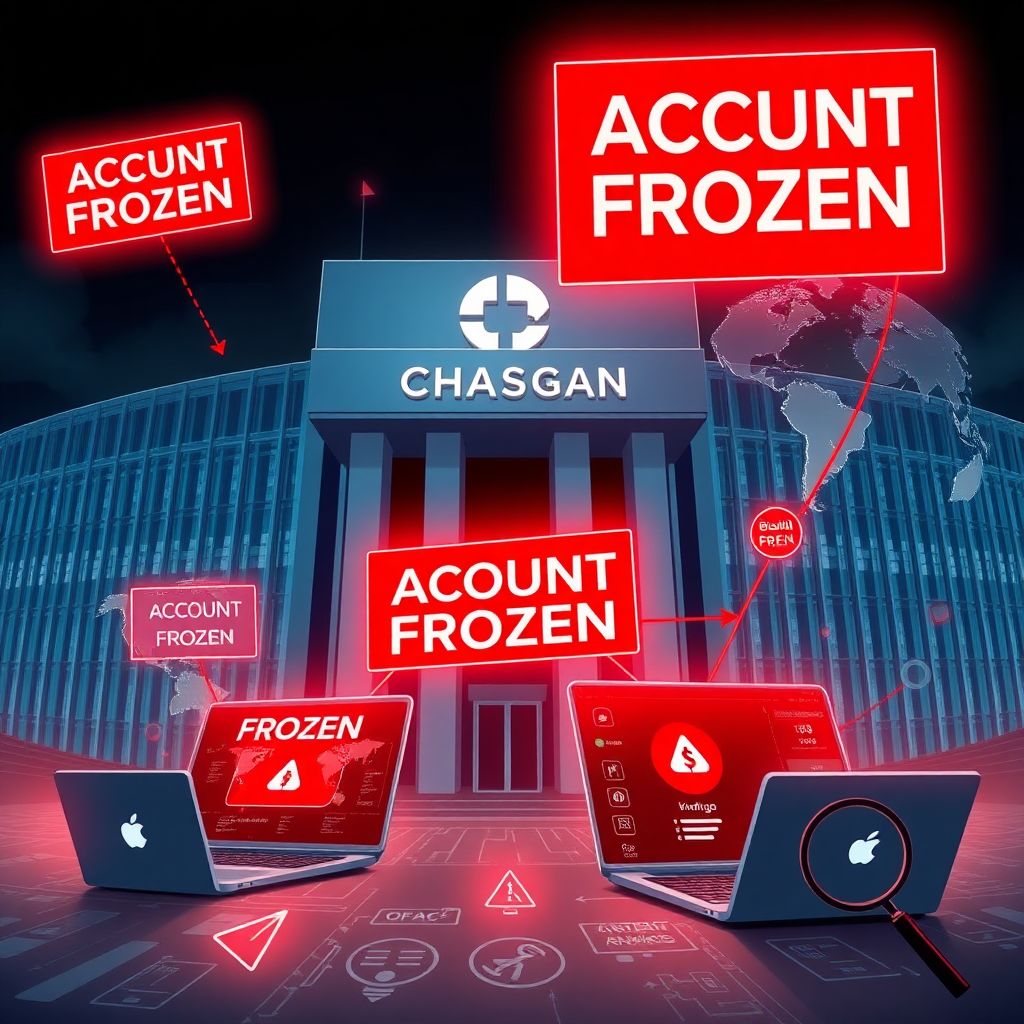
JPMorgan freezes accounts of Y Combinator–backed stablecoin firms over sanctions red flags
JPMorgan Chase has reportedly frozen bank accounts connected to two Latin America–focused stablecoin startups, BlindPay and Kontigo, after internal controls flagged their activity as potentially touching sanctioned and high‑risk jurisdictions, including Venezuela.
Both companies are backed by Y Combinator and have been using JPMorgan’s banking rails indirectly through Checkbook, a digital payments platform that integrates with major financial institutions. According to a report shared with industry media, the affected accounts were part of Checkbook’s relationship with the bank, which it leverages to serve a range of fintech and crypto-related clients.
The trigger for the freezes was JPMorgan’s compliance team identifying business flows tied to Venezuela and other regions under United States sanctions. That kind of exposure falls under strict regulatory scrutiny for any U.S. financial institution, particularly one as systemically important as JPMorgan, which is obligated to manage sanctions risk aggressively.
A spokesperson for JPMorgan stressed that the decision was not an attack on stablecoins as a technology or business model. The bank reportedly emphasized that it continues to serve both stablecoin issuers and companies building services around stablecoins. The spokesperson also noted that JPMorgan has recently helped take a stablecoin issuer public, underscoring that the institution remains active in crypto-adjacent capital markets.
Checkbook’s chief executive, PJ Gupta, said BlindPay and Kontigo were not the only firms affected. He described them as part of a broader group of clients swept up in account closures triggered by an unexpected spike in chargebacks. That surge, he suggested, was linked to hyper-fast onboarding of new customers. In his words, the platforms effectively “opened the floodgates,” onboarding large numbers of users over the internet in a short period, which in turn increased transaction disputes and reversals.
The account freezes land at a sensitive time for both JPMorgan and Checkbook, as the two deepen their strategic partnership. In late 2024, they announced that Checkbook would become part of the J.P. Morgan Payments Partner Network, a program that allows corporate clients to tap into digital check issuance and other next‑generation payment solutions through vetted third‑party providers. Earlier in 2024, Checkbook also expanded its business‑to‑business payments suite, focusing on verticals such as legal services, government agencies and banking institutions.
Venezuela’s prominence in the story reflects a broader macroeconomic reality. With the local currency battered by chronic inflation and capital controls, many Venezuelans have turned to cryptocurrencies and dollar‑linked stablecoins as a lifeline to preserve purchasing power and move money across borders. That organic adoption, however, intersects awkwardly with U.S. sanctions policy, which targets the Venezuelan state and related entities. The result is that any U.S.‑connected financial intermediary seeing volume tied to the country must carefully assess whether it is inadvertently facilitating prohibited activity.
For banks like JPMorgan, that tension creates a difficult balance. On one hand, digital assets and fintech platforms can serve genuine user needs in distressed economies. On the other, regulators expect rigorous enforcement of sanctions and anti‑money‑laundering rules, with little tolerance for error. When compliance teams detect exposure they view as ambiguous or high risk, shutting down accounts often becomes the most straightforward, legally defensible response.
The episode also fits into a pattern of friction between large incumbent banks and the crypto industry. In a separate case earlier in 2024, Gemini co‑founder Tyler Winklevoss publicly alleged that JPMorgan paused the exchange’s re‑onboarding in retaliation for his criticism of the bank’s data access policies. He accused the institution of engaging in behavior that could harm fintech and crypto competitors by limiting their ability to operate smoothly within the traditional financial system.
At the same time, JPMorgan is not stepping away from digital assets. The bank is reportedly exploring ways to offer institutional clients access to crypto trading, including both spot and derivatives instruments, as regulatory conditions in the United States grow more permissive and clearer. That dual stance — cautious on compliance, experimental on product — illustrates how big banks are trying to participate in the sector without running afoul of regulators.
From a regulatory perspective, the BlindPay and Kontigo case is a reminder that indirect banking access does not insulate crypto startups from bank compliance decisions. Even though these firms did not hold accounts directly at JPMorgan, their reliance on an intermediary like Checkbook means that a risk event at the bank level can cascade down and cut off their ability to process payments and settle funds in traditional currencies.
For stablecoin businesses operating in emerging markets, the incident underlines the importance of strict know‑your‑customer, anti‑money‑laundering and sanctions screening programs. Operating in or serving users from sanctioned or high‑risk regions requires not just robust internal controls, but also clear documentation and dialogue with partner banks to demonstrate that they are not facilitating prohibited transactions. Without that, any uptick in disputes, chargebacks or suspicious geography can lead to blanket de‑risking.
Chargebacks themselves are another critical angle. A surge in disputed payments not only signals potential fraud or poor customer screening, it also raises operational and financial risk for the bank and its partners. For early‑stage fintech and crypto firms, aggressive user growth often comes with looser onboarding standards. That may help capture market share quickly, but it also draws scrutiny from compliance teams who view high dispute rates as a red flag for scams, money mules or unsophisticated users being exploited.
The Venezuelan context adds an ethical dimension. Digital assets, and especially dollar‑pegged stablecoins, have become an informal parallel financial system for citizens caught between economic collapse and heavy‑handed state controls. Cutting off the platforms that serve them may reduce sanctions risk for U.S. banks, but it can also restrict access to tools ordinary people use to survive inflation, send remittances and escape domestic banking failures. Policymakers have yet to fully reconcile humanitarian considerations with the blunt force of sanctions compliance.
For founders and investors, the JPMorgan freezes highlight a strategic risk: dependency on a single banking gateway. When indirect access via one partner becomes a single point of failure, an account closure can instantly paralyze operations across markets. Diversifying banking relationships, building redundancies and considering regional banking partners — especially in jurisdictions more familiar with local risk dynamics — are becoming necessities rather than nice‑to‑haves.
The case also feeds into a broader debate over “debanking” in the crypto and fintech sectors. While banks often argue that closures are driven purely by risk and compliance obligations, affected firms frequently see them as disproportionate, opaque and sometimes politically or competitively motivated. The lack of clear, timely explanations from banks can deepen mistrust and reinforce the perception that traditional finance is selectively shutting out innovation under the cover of regulatory risk.
Looking ahead, stablecoin startups targeting high‑risk or sanctioned‑adjacent regions may need to redesign their models around compliance from day one: geofencing certain countries, implementing enhanced due diligence for users in sensitive areas, and investing in real‑time transaction monitoring designed to spot and block risky flows. Those measures can be costly for small teams, but they are increasingly the price of admission to the global banking system.
For large banks, the challenge will be finding a more nuanced approach than simply cutting ties whenever uncertainty arises. As digital assets and cross‑border fintech become central to financial inclusion in distressed economies, blanket de‑risking can have unintended social and geopolitical consequences. Clearer regulatory guidance, safe‑harbor regimes for humanitarian flows and better data‑sharing between banks and fintechs could help reduce those unintended side effects.
In the meantime, the freezes on BlindPay and Kontigo’s accounts serve as a stark warning: in the intersection of stablecoins, emerging markets and U.S. sanctions policy, even indirect exposure is enough to trigger decisive action from a major bank. For the broader crypto industry, it is another example of how regulatory and banking friction — not just technology or market demand — will shape which projects survive and scale in the years ahead.