
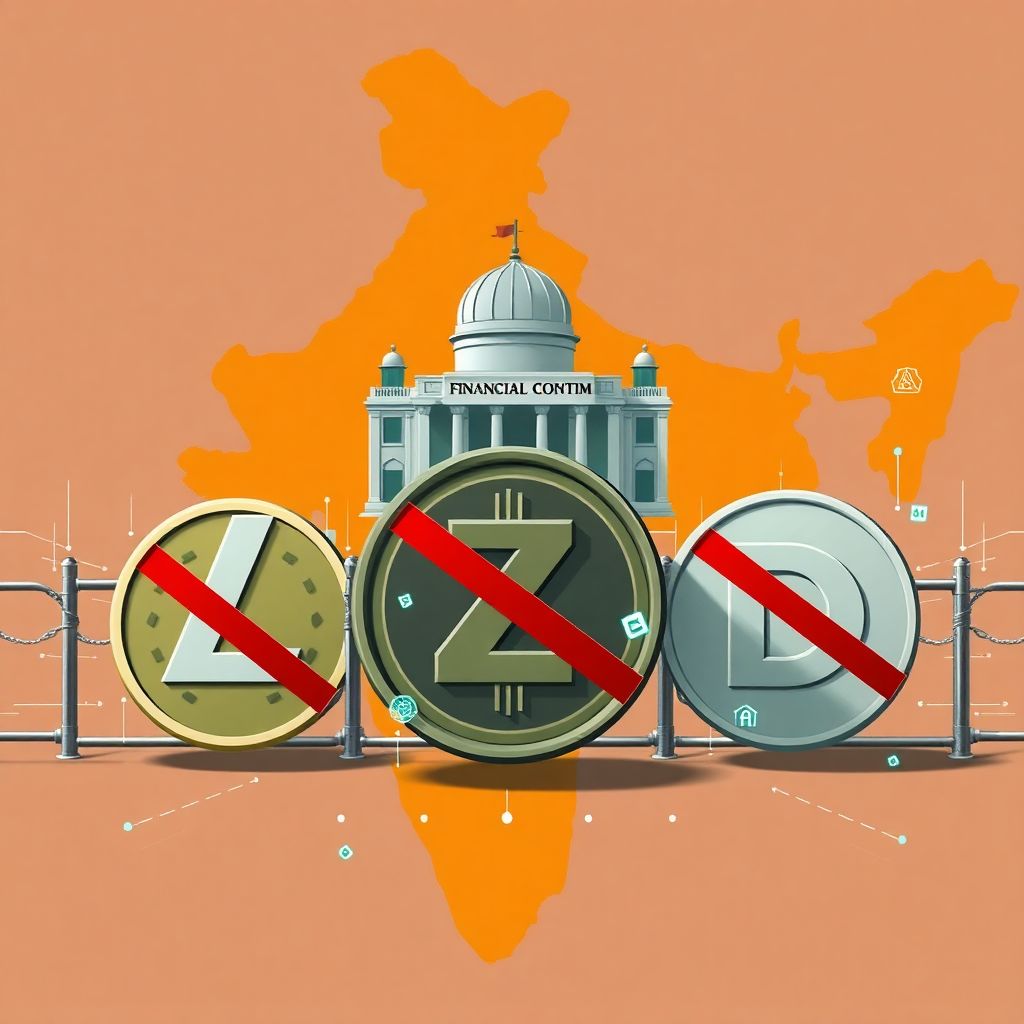
India Bans Monero, Zcash, and Dash as Authorities Escalate Anti–Money Laundering Campaign
India has moved to aggressively tighten its grip on privacy‑focused cryptocurrencies, ordering a complete halt to trading and custody of Monero (XMR), Zcash (ZEC), and Dash (DASH) on compliant domestic exchanges. The step marks one of the country’s most decisive actions yet in its ongoing effort to curb money laundering and other illicit financial activity in the digital asset sector.
The directive comes from India’s Financial Intelligence Unit (FIU‑IND), the key agency responsible for monitoring suspicious financial transactions and enforcing anti‑money‑laundering (AML) rules. According to information shared by market analyst MartyParty on X (formerly Twitter), the FIU has instructed all registered crypto platforms in India to suspend deposits, withdrawals, and trading for the three leading privacy coins with immediate effect.
Under the order, exchanges operating legally in India must fully de‑support Monero, Zcash, and Dash. That includes delisting the assets, freezing any associated wallets, blocking all incoming and outgoing transfers, and disabling every trading pair involving those tokens. In practice, this means the coins are effectively prohibited within the country’s regulated crypto ecosystem.
Why Privacy Coins Are in the Crosshairs
The FIU’s move is driven by long‑standing concerns over the design of privacy coins. Unlike transparent blockchains such as Bitcoin or Ethereum, where transactions and wallet balances can be publicly traced, privacy‑enhancing cryptocurrencies intentionally obscure key pieces of information.
Monero relies on technologies like ring signatures and stealth addresses to disguise both senders and receivers, making it extremely difficult to link transactions to specific users. Zcash offers “shielded” transactions using zero‑knowledge proofs, allowing users to hide transaction amounts and addresses entirely. Dash incorporates optional privacy tools that can mix funds and make tracing historical flows far more complex.
While proponents view these features as essential for financial privacy and protection against intrusive surveillance, regulators see the same tools as an obstacle to enforcing AML and counter‑terrorist‑financing (CTF) requirements. When transaction trails are effectively hidden, it becomes significantly harder for exchanges and authorities to perform know‑your‑customer (KYC) checks, monitor suspicious patterns, or trace the origin of funds tied to crime, sanctions evasion, or terrorism.
From the FIU’s perspective, this inherent opacity elevates the risk profile of privacy coins compared to more transparent digital assets. That heightened risk is now translating into outright exclusion from the country’s regulated marketplaces.
Part of a Broader Regulatory Crackdown
The clampdown on Monero, Zcash, and Dash does not come out of nowhere. It follows a steady escalation of regulatory measures aimed at bringing India’s crypto market under stricter oversight.
In October 2025, FIU‑IND ordered internet service providers to block access to 25 offshore cryptocurrency exchanges that were serving Indian users without registering with local authorities. That action effectively cut off a major channel through which residents accessed unregulated platforms and tokens, including many high‑risk assets.
Since then, the list of fully registered and compliant exchanges in India has shrunk to only a small number of major players. Platforms such as Binance, Mudrex, Coinbase, CoinSwitch (CoinSwitch Kuber), and ZebPay currently remain permitted to operate in the country’s regulated environment. These firms are now under clear instruction not to list or support the three targeted privacy coins in any form.
The latest directive signals that regulators are willing to go beyond registration and reporting requirements to impose content‑level restrictions on what assets can legally trade in India. Rather than merely demanding better data, the FIU is drawing a line around entire categories of coins considered incompatible with prevailing AML standards.
Market Reaction: Short‑Term Bounce, Long‑Term Pressure
Interestingly, the immediate market response from Monero, Zcash, and Dash did not reflect panic—at least not on a 24‑hour timescale. After suffering sharp declines earlier in the week, all three assets managed to rebound modestly following news of the Indian ban.
At the time of reporting, Monero was changing hands at around 524 dollars, up approximately 3.5% over the previous day. Zcash also staged a small recovery, climbing about 2.2% to roughly 372 dollars. Dash saw the strongest daily move among the trio, jumping 11.6% in the same period.
However, these short‑term gains sit against a much weaker broader trend. Data from market aggregators indicate that, on a weekly basis, the privacy coins remain deeply in the red. Over the last seven days, Monero has fallen roughly 21%, Zcash is down about 8%, and Dash has dropped close to 20%. The rebound looks more like a technical bounce or relief rally than a sustained recovery in investor confidence.
For global holders, India’s ban underscores a looming risk: regulatory isolation. If more major jurisdictions follow a similar path, privacy coins could find themselves confined to a shrinking set of unregulated or lightly regulated venues, putting long‑term liquidity and price stability under pressure.
What This Means for Indian Users and Exchanges
For users inside India who already hold Monero, Zcash, or Dash on compliant domestic exchanges, the directive introduces immediate practical challenges. With deposits, withdrawals, and trading disabled, many may be unable to move or liquidate their positions through regulated channels. Depending on how each platform implements the order, users could be forced into prolonged holding or complicated off‑ramp strategies.
Exchanges, meanwhile, must navigate a difficult balancing act. On one hand, they need to comply swiftly to avoid penalties, license issues, or outright shutdowns. On the other, they face reputational and customer‑relations risks if users perceive the delisting process as sudden, opaque, or unfair. Some platforms may opt for grace periods, forced conversions to stablecoins, or other transitional solutions, but the overall direction is clear: privacy coins are being pushed out of India’s formal crypto market.
There is also a broader strategic dimension. By banning these assets, regulators are sending a signal to global exchanges: if you want to serve Indian customers and remain on the right side of the law, you must be prepared to sacrifice parts of your token lineup, particularly where privacy features limit traceability.
The Ongoing Debate: Privacy vs. Compliance
The clash between privacy coins and regulators highlights a deeper philosophical and legal debate: how to balance financial privacy with the needs of law enforcement and financial integrity.
Supporters of Monero, Zcash, and Dash argue that privacy technologies are not inherently criminal. They contend that individuals and businesses have legitimate reasons to protect transaction data—from shielding commercial strategies and salaries to resisting mass surveillance and data harvesting. In their view, privacy coins are a natural extension of long‑standing rights to confidentiality in finance, similar to cash transactions or banking secrecy laws in certain jurisdictions.
Regulators and policymakers, however, tend to focus on the downside of complete opacity. They point to documented cases where privacy coins have been used on darknet markets, in ransomware schemes, or to bypass sanctions. From this perspective, when authorities cannot trace funds at all, enforcement becomes nearly impossible, undermining the entire AML/CTF framework built over decades in the traditional financial system.
India’s move situates the country firmly on the side of prioritizing traceability and surveillance capabilities over unrestrained financial anonymity. It also sets a precedent that other emerging markets may study as they craft their own digital asset rules.
Could This Spark a New Wave of Global Restrictions?
India is not the first jurisdiction to scrutinize or constrain privacy coins, but its status as one of the world’s largest potential crypto user bases makes its actions particularly significant. If regulators in other major economies interpret the Indian ban as a successful risk‑mitigation step, they may feel emboldened to adopt similar policies.
We could see more countries using licensing frameworks for exchanges to restrict access to coins that fail to meet certain transparency thresholds. In practice, that might mean that privacy coins exist primarily on decentralized or offshore venues, with limited fiat on‑ramps and reduced institutional participation. For institutional investors subject to strict compliance rules, holding such assets could become increasingly untenable.
On the other hand, this pressure might spur technical and policy innovations. Some projects may explore “regulated privacy” models, where selective disclosure to authorities is possible under legal process, or where compliance‑friendly layers are built on top of privacy‑preserving protocols. How regulators respond to such hybrid approaches will shape the next chapter of the privacy coin story.
Implications for the Future of Crypto Regulation in India
Domestically, the ban on Monero, Zcash, and Dash offers a window into how Indian regulators may handle the broader digital asset ecosystem going forward. The message is that India is not seeking to outlaw crypto entirely, but intends to set hard boundaries around what is considered acceptable.
Transparent or semi‑transparent blockchains, products with robust KYC/AML processes, and platforms that are willing to register and report can likely continue operating—albeit under close supervision. Assets and services that actively resist traceability or undermine monitoring obligations, however, may find themselves progressively excluded.
For Indian developers and entrepreneurs, this environment creates both constraints and opportunities. Projects focused on compliance‑compatible innovation—such as regulated tokenization, blockchain‑based payments, or DeFi protocols with identity layers—may find more room to grow. Those aiming to build or support full‑anonymity systems will likely face regulatory headwinds from the outset.
What Global Investors Should Watch Next
For investors and traders outside India, the immediate financial impact of the ban may be limited, but the policy trajectory is important. Key developments to monitor include:
– Whether other large jurisdictions announce similar restrictions on privacy coins.
– How global exchanges adjust their listings and geofencing practices in response.
– Any legal challenges or industry pushback within India that could test the scope of the FIU’s authority.
– Technical developments in privacy protocols aimed at addressing regulatory concerns, such as optional transparency or compliance tools.
In the medium to long term, the regulatory climate will be a decisive factor in determining whether privacy coins remain a niche segment of the crypto market or face a sustained contraction in liquidity and adoption.
A Turning Point for Privacy Coins
India’s prohibition of Monero, Zcash, and Dash on its registered exchanges is more than just another compliance update—it represents a clear inflection point in the global debate over financial privacy in the digital age. By explicitly naming and targeting privacy‑enhancing assets, Indian regulators have drawn a sharp line between what they deem compatible with modern AML/CTF regimes and what they consider unacceptable risk.
Whether this move marks the beginning of a broader international backlash against privacy coins, or simply one chapter in the ongoing tug‑of‑war between innovation and regulation, will depend on how other countries respond and how the projects themselves evolve. For now, holders and builders in the privacy‑coin space must contend with a reality in which one of the world’s most important emerging markets has shut its doors to their technology—at least within the bounds of the regulated financial system.