
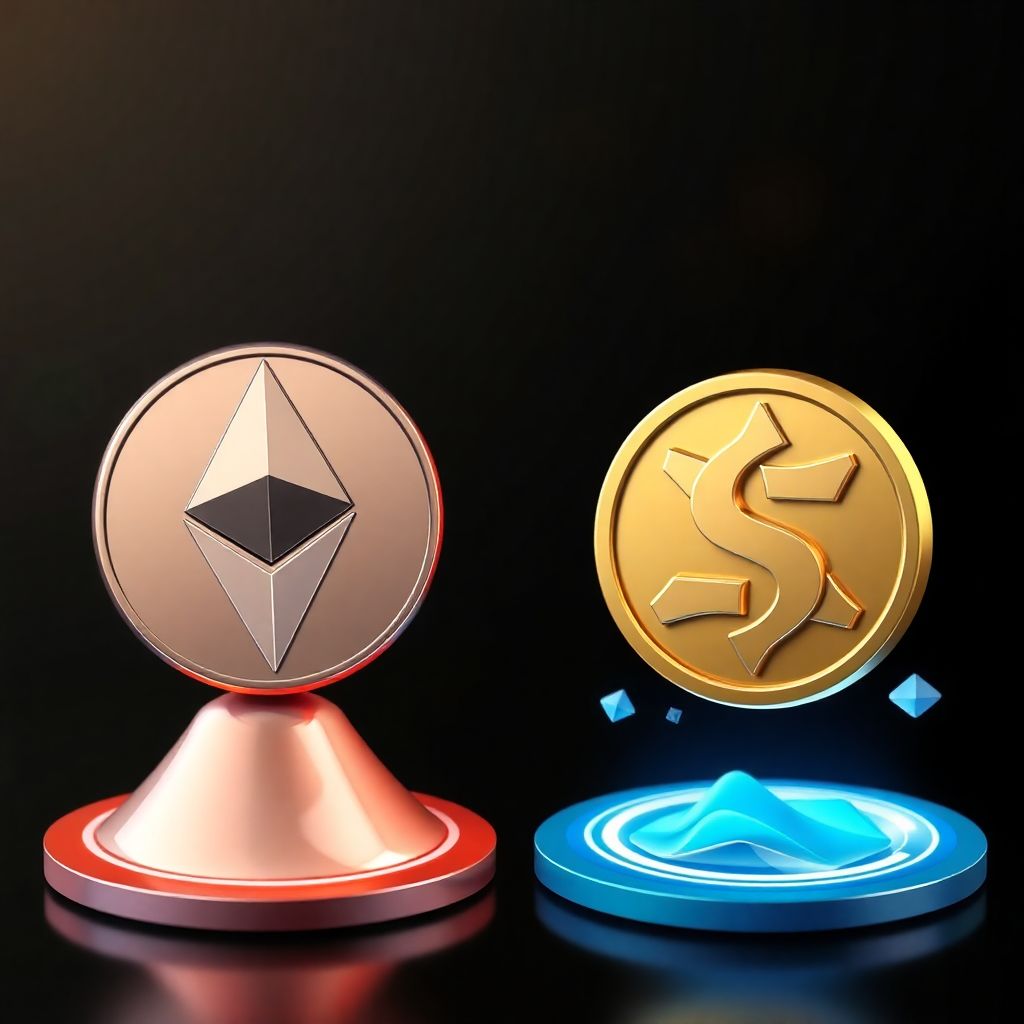
Ethereum vs. Solana: Which Altcoin Leads the Race as ETH Eyes $7.9K and SOL Gains Market Attention?
Since the beginning of October, Ethereum (ETH) and Solana (SOL) have demonstrated remarkable bullish momentum, reaffirming their positions among the top five cryptocurrencies by market capitalization, excluding stablecoins. With both assets registering gains exceeding 12% over the past week, market participants are closely watching whether this momentum can be sustained and if price targets of $7,900 for ETH and $400 for SOL are within reach.
Ethereum Approaches $7,900: Key Technical and On-Chain Drivers
Ethereum’s current trajectory points toward a significant price milestone—$7,900, just shy of the psychologically important $8,000 level. The altcoin has been consistently following a rising trendline since reversing from prior bearish conditions. To make this target a reality, ETH must first decisively break above the $5,000 resistance zone, which currently acts as the key obstacle.
Supporting this bullish outlook is Ethereum’s momentum indicator, which recently posted a reading of 537, well above the neutral threshold. This figure reflects strong upward movement, particularly after ETH successfully retested a critical support level. In parallel, Ethereum’s decentralized exchange (DEX) activity has surged, with DefiLlama reporting daily trading volumes reaching approximately $2.85 billion, highlighting robust on-chain engagement.
Moreover, traditional finance interest in Ethereum continues to grow. Asset manager VanEck recently noted that ETH is narrowing the treasury gap with Bitcoin (BTC), suggesting that institutional investors are gradually accumulating ETH as part of a broader diversification strategy.
Solana Targets $400: Speed, Scalability, and Institutional Intrigue Drive Demand
Solana, on the other hand, is also gathering momentum, with analysts and influencers predicting a price surge beyond $300, and possibly toward $400. This level is gaining increasing traction within the crypto community, further fueled by widespread discussions and social media engagement.
Solana’s core appeal lies in its high-speed transaction processing and low finality times, making it particularly attractive to institutional players. Unlike Bitcoin, which still feels somewhat theoretical to traditional finance, Solana offers practical use cases in the realm of stablecoins and asset tokenization—two features that resonate strongly with institutional workflows.
Matt Hougan, Chief Investment Officer at Bitwise, emphasized Solana’s growing relevance, describing it as “the new Wall Street” in a conversation with the Solana Foundation’s CMO. This statement was reinforced by a $1.2 billion inflow in stablecoins on the Solana network, signaling clear accumulation and rising confidence in its infrastructure.
NFTs, Social Buzz, and Ecosystem Revival
Beyond price charts and trading volumes, both Ethereum and Solana are experiencing a resurgence in community engagement and ecosystem development. On social platforms, discussions surrounding the similarities and competition between ETH and SOL have gained traction, with memes, debates, and analysis drawing thousands of interactions. One viral post mocking the ETH/SOL overlap at a crypto conference garnered more than 1,100 likes, underscoring the widespread interest.
The NFT segment on Solana is also seeing renewed activity. Collections listed on the Tensor marketplace have seen values rise by over 15% in most cases, indicating a rebound in digital collectibles on the network. Meanwhile, Ethereum’s daily Reddit threads on supply dynamics and the stablecoin market cap—now approaching $100 billion—are attracting growing attention, further reflecting the increased investor interest.
Comparing Fundamentals: Ethereum vs. Solana
From a fundamental perspective, Ethereum and Solana differ significantly in architecture, consensus mechanisms, and community support. Ethereum, with its mature ecosystem and dominance in DeFi and NFTs, benefits from broader developer activity and deeper institutional trust. The upcoming upgrades to Ethereum’s scalability—particularly through layer-2 solutions—promise to reduce transaction fees and further improve user experience.
Solana, by contrast, is designed for speed and throughput from the ground up. Its proof-of-history mechanism allows for thousands of transactions per second with minimal cost, making it suitable for consumer-facing applications such as gaming, social media, and microtransactions. This has enabled Solana to carve out a niche, especially among developers and startups looking for scalable blockchain infrastructure.
Institutional Adoption: Who’s Winning?
While Ethereum continues to dominate in terms of institutional adoption, Solana is rapidly gaining ground. Major financial players are beginning to explore Solana for tokenized assets, and several blockchain-native projects have migrated to Solana due to lower costs and faster execution.
Ethereum still maintains an edge due to its compatibility with existing financial frameworks and its integration with legacy systems. However, Solana’s aggressive push into real-world use cases, from decentralized finance to real estate tokenization, suggests that it could soon rival Ethereum in this domain.
Can the Rally Sustain?
The sustainability of the current rally for both ETH and SOL depends heavily on macroeconomic conditions, regulatory clarity, and continued innovation within each network. Technical indicators remain bullish for both altcoins, but resistance levels and market sentiment will play crucial roles in future price action.
Ethereum must maintain its upward trend and overcome psychological barriers around $5,000 and $8,000 to validate the bullish thesis. Solana, meanwhile, needs to maintain strong network performance and capitalize on growing institutional demand to push past the $300 level and test $400.
Staking and Yield Opportunities
Another factor influencing investor interest is the staking and yield potential of both networks. Ethereum’s shift to proof-of-stake has enabled users to earn rewards by locking up ETH, with many institutional-grade platforms offering ETH staking services. Solana also offers staking, though its shorter history and recent network outages have led some investors to approach with caution.
However, as network stability improves and more validators join Solana’s ecosystem, staking on SOL could become more attractive, especially given the higher yields it often provides compared to Ethereum.
Developer Ecosystem and Innovation
Ethereum has long been the preferred platform for developers, thanks to its rich documentation, established tooling, and widespread community support. Its ecosystem boasts thousands of dApps, spanning DeFi, NFTs, DAOs, and more.
Solana is catching up quickly, with a growing number of developer grants, hackathons, and community programs. Its lower fees and faster confirmation times make it a compelling choice for developers focused on user-centric applications.
Final Thoughts: Ethereum or Solana?
Choosing between Ethereum and Solana ultimately depends on an investor’s priorities. Ethereum offers stability, deep liquidity, and a proven track record, whereas Solana provides speed, innovation, and untapped potential. Both are well-positioned to benefit from broad crypto adoption, and both have price targets—$7,900 for ETH and $400 for SOL—that reflect growing confidence in their respective futures.
As the crypto market continues to mature, these two ecosystems may not necessarily compete, but rather coexist, each serving different segments of the blockchain economy. Investors and developers alike should watch closely as Ethereum and Solana pave their unique paths toward mass adoption.