
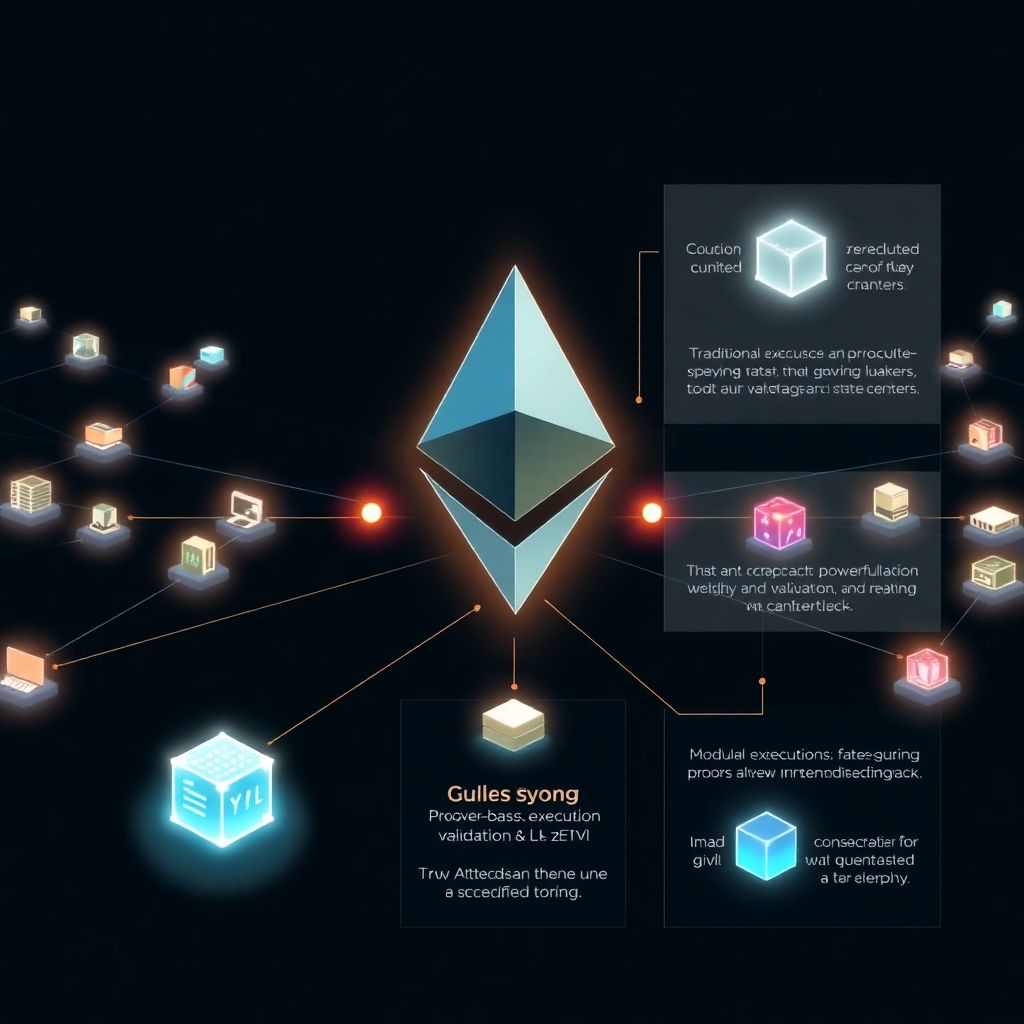
Ethereum’s 2026 pivot: How proof-based validation could reshape node participation
In 2026, Ethereum is preparing for one of its most significant architectural upgrades since the Merge – a transition toward proof-based block validation at the base layer. At the heart of this shift is the L1-zkEVM roadmap and, in particular, EIP‑8025, an upgrade that could fundamentally change how nodes verify the chain, without forcing anyone to change how they operate today.
Instead of every validator re-executing all transactions in each block, Ethereum may soon allow blocks to be validated using zero-knowledge proofs generated by specialized actors. If successful, this could dramatically lower the cost and complexity of running a fully validating node and increase decentralization in practice, not just in theory.
L1-zkEVM: setting the stage for a new validation model
On 11 February, Ethereum developers and researchers are convening for the first dedicated L1-zkEVM workshop. The focus is not just on theoretical cryptography, but on how to embed zero-knowledge technology directly into Ethereum’s base layer in a way that respects its existing security model and decentralization ethos.
The broader L1-zkEVM roadmap aims to make Ethereum’s execution layer “provable” at the protocol level. Instead of assuming every node must redo all computation, the protocol will gain the ability to accept succinct mathematical proofs of correctness. EIP‑8025, also known as Optional Execution Proofs, is the central piece of this vision.
The key word in the proposal’s name is “optional.” No validator, staker, or node operator will be forced to use proofs instead of re-execution. Nodes that prefer the current model can simply continue verifying blocks by executing every transaction themselves. The new pathway is an additional mechanism – not a replacement – which is essential for maintaining continuity and trust.
What EIP‑8025 actually changes
Right now, Ethereum’s validation pipeline is straightforward but demanding: for each block, every validating node executes each transaction, updates the state, and checks that the results match what the block claims. As network usage increases, and if gas limits rise over time, this process becomes increasingly resource-heavy. Hardware needs grow, and running a “true” full node edges further out of reach for average users.
EIP‑8025 introduces a parallel route. Instead of repeating all the computations, validators will be able to check a zero-knowledge proof that attests to the correctness of the entire block’s execution. This proof is generated off-chain by specialized entities, called zkAttesters.
A zkAttester runs the block’s transactions in a zkVM (zero-knowledge virtual machine) or similar system designed to produce a succinct proof. The output is a cryptographic object that can be verified quickly and cheaply. If the proof is valid, it mathematically guarantees that the claimed state transition is correct, without requiring every validator to redo the work.
Importantly, EIP‑8025 is not designed as a “trust me” shortcut. The design currently assumes that blocks are only accepted once multiple independent proofs have been verified. The current proposal uses a threshold such as three out of five separate proofs, ensuring that no single implementation or prover becomes a critical point of failure.
Why this matters for nodes and decentralization
The resource profile of a node is one of the quiet but powerful forces shaping a network’s decentralization. When validating the chain requires high-end hardware, constant upgrades, and expensive bandwidth, the number of people who can realistically participate shrinks. Over time, that can push validation into the hands of data centers and large operators.
By shifting validation from full re-execution to proof verification, Ethereum can significantly reduce the computational and storage burden on validators. Verifying a succinct proof is orders of magnitude lighter than running a full block’s worth of transactions, especially as blocks get denser.
In practical terms, this opens the door for fully validating nodes to run comfortably on consumer-grade laptops and modest home setups again, even if gas limits increase or the network handles far more activity. Lowering the hardware and bandwidth barrier could keep solo stakers and home validators competitive, preserving a broad and diverse validator set as the protocol scales.
This is particularly important in a future where rollups and L2s push more activity onto Ethereum. Rather than assuming that more usage must lead to heavier node requirements, proof-based validation suggests a path where the chain can grow without squeezing out smaller participants.
Security, client diversity, and architectural resilience
Security is not just about cryptography; it’s also about how many independent implementations and actors participate in securing the network. Ethereum has long emphasized client diversity – multiple execution and consensus clients written by different teams – so that a bug in one does not endanger the entire chain.
EIP‑8025’s approach to requiring multiple, independent proofs per block fits neatly into this philosophy. Instead of relying on a single zkVM or prover, the protocol can require proofs from different zkAttesters, potentially using distinct software stacks and proving systems. A block is only considered valid when a threshold, such as three out of five attestations, agrees on its correctness.
This multi-prover requirement reduces the chance that a single bug, misconfiguration, or malicious actor could slip a bad block into the chain. Furthermore, it means that the proof infrastructure itself becomes pluralistic and competitive, mirroring the diversity seen today in client implementations.
From an architectural standpoint, proof-based validation enables a more modular system. Execution, proving, validation, and consensus can be more cleanly separated into layers with well-defined interfaces. This modularity tends to improve resilience: upgrades can be rolled out in one part of the stack without overhauling everything at once.
The six sub-themes: building the proof-based stack
To make this vision concrete, work on the L1-zkEVM roadmap and EIP‑8025 is being divided into several technical streams. These sub-themes are critical for making the system interoperable, auditable, and robust:
1. Execution witness and guest program standardization
This covers how execution traces (the detailed “witness” of what happened during transaction processing) are represented, and how the guest programs inside zkVMs are specified. A consistent format is essential so that different zkAttesters can produce compatible proofs for the same block.
2. zkVM–guest API standardization
The interface between the zkVM and the code it runs must be unified. A standardized API makes it easier for multiple teams to implement zkVMs that can all generate valid proofs for Ethereum blocks, while still allowing for innovation in performance and design.
3. Consensus layer (CL) integration
For proofs to matter, they must be properly embedded in the consensus rules. This stream defines how proofs are propagated in the network, how they are checked by validators, and how proof-based validation interacts with existing fork choice and finality rules.
4. Prover infrastructure
Generating zk proofs at the scale of Ethereum mainnet is non-trivial. This area focuses on the hardware, software, and distributed systems required to produce proofs reliably and on time – including parallelization strategies and specialized hardware where appropriate.
5. Benchmarking and metrics
To choose viable parameters and evaluate trade-offs, the ecosystem needs standardized metrics. Benchmarking will compare prover implementations, measure verification costs, and help determine safe thresholds for proof requirements without compromising liveness.
6. Security and formal verification
Given the complexity and criticality of the system, formal methods and in-depth security analyses are essential. This includes verifying the correctness of zkVMs, the soundness of proofs, and the protocol logic that decides when proofs are accepted.
Each of these sub-themes contributes to turning the high-level idea of “optional execution proofs” into a credible, production-grade feature of the Ethereum protocol.
Beyond L1: benefits for rollups and the broader ecosystem
Although EIP‑8025 is focused on the L1, its impact is likely to ripple throughout the Ethereum ecosystem. Standardizing execution witnesses and zkVM interfaces can be a powerful catalyst for tooling that supports rollups, validity proofs, and third-party infrastructure.
Rollups already rely heavily on proofs – whether optimistic or zero-knowledge – to convince L1 of their correctness. If Ethereum standardizes how execution traces are expressed and how zkVMs plug into the protocol, rollup teams can align with these standards, reducing duplicated effort and easing interoperability.
Proof infrastructure providers, many of whom are already working on generating Ethereum block proofs for research or archival purposes, stand to gain from consistent formats and APIs. A unified approach can lower integration costs, encourage shared libraries, and ultimately accelerate innovation in proof systems and hardware acceleration.
In the long run, this standardization could make Ethereum the most natural “home base” for provable computation infrastructure, where the same tools serve both the main chain and its scaling layers.
Why the upgrade remains optional – and why that’s important
Making EIP‑8025 optional is not just a technical detail; it is a governance and trust decision. Ethereum’s culture prizes credible neutrality and backward compatibility. For many node operators, the ability to verify the chain by simply executing transactions is a foundational part of their trust model.
By keeping re-execution as a first-class verification path, the protocol allows conservative actors to stick with what they know works. Over time, as proof systems are battle-tested, audited, and refined, more participants may choose to rely on proofs for their day-to-day operations, while still having the fallback of full execution if needed.
This dual-path design also acts as a safety net. If a bug or vulnerability is discovered in a popular proving stack, validators can immediately revert to traditional re-execution, ensuring continuity of security. Optionality, in this sense, is a practical hedge against both technical and social uncertainty.
What this could mean for future gas limits and throughput
One of the practical implications of proof-based validation is its effect on the gas limit debate. Today, raising gas limits too aggressively risks pricing out smaller validators, because heavier blocks mean more work for every node. With proof-based validation, that relationship can change.
If verifying a block’s proof remains cheap even as the block gets computationally heavier, then the chain could process more complex workloads without proportionally increasing the burden on validators. The expensive part – generating the proof – is offloaded to zkAttesters who opt into that role and invest in specialized infrastructure.
This doesn’t mean Ethereum will suddenly increase gas limits arbitrarily. Network bandwidth, propagation delays, and other factors still matter. But it does open the door to scaling strategies that were previously constrained by the need for universal re-execution.
Implications for solo stakers and home validators
For individuals running nodes at home, the prospect of lighter validation is significant. Lower CPU usage, reduced memory pressure, and more modest disk requirements can make it feasible to run both consensus and execution clients on affordable machines.
This, in turn, supports the economic viability of solo staking. If an individual can validate the chain securely without investing in professional-grade hardware, the barrier to operating their own validator drops. In an ecosystem concerned about the dominance of large staking providers, this is a meaningful counterweight.
In scenarios where proof-based validation becomes the default for many, solo stakers could still choose to occasionally re-execute blocks, either for spot checks or as part of an audit routine. This hybrid behavior further strengthens the network’s assurances.
The bigger picture: Ethereum as a provable execution layer
EIP‑8025 and the L1-zkEVM roadmap are not just performance tweaks; they signal Ethereum’s evolution into a fully provable execution platform. In such a world, the correctness of state transitions is not only a social assumption backed by code, but a mathematically attested fact, available to anyone capable of verifying a proof.
This shift has philosophical as well as technical consequences. It tightens the link between what the protocol specifies, what nodes enforce, and what users can independently verify. Over time, provability could become a standard expectation for blockchain infrastructure, much like open-source clients or permissionless participation are today.
If Ethereum succeeds in integrating optional execution proofs while preserving its current security and decentralization guarantees, it will not only make node operation more accessible, but also set a new bar for what it means to validate a global, permissionless ledger.
Final thoughts
Ethereum’s move toward proof-based validation via EIP‑8025 is a bet on zero-knowledge technology as a core part of its long-term architecture. By introducing zkAttesters, multiple independent proofs per block, and standardized interfaces for zkVMs and execution witnesses, the network aims to reconcile high throughput with broad participation.
The upgrade’s optional nature respects existing trust models while creating a path for lighter, faster validation. If successful, it could make fully validating nodes viable on everyday hardware again, give solo stakers more staying power, and strengthen client diversity and protocol resilience.
As the L1-zkEVM workshop and subsequent development efforts unfold, the focus will be on turning this ambitious roadmap into a robust, secure reality – one where proof-based validation becomes a powerful complement to Ethereum’s existing consensus foundations.