
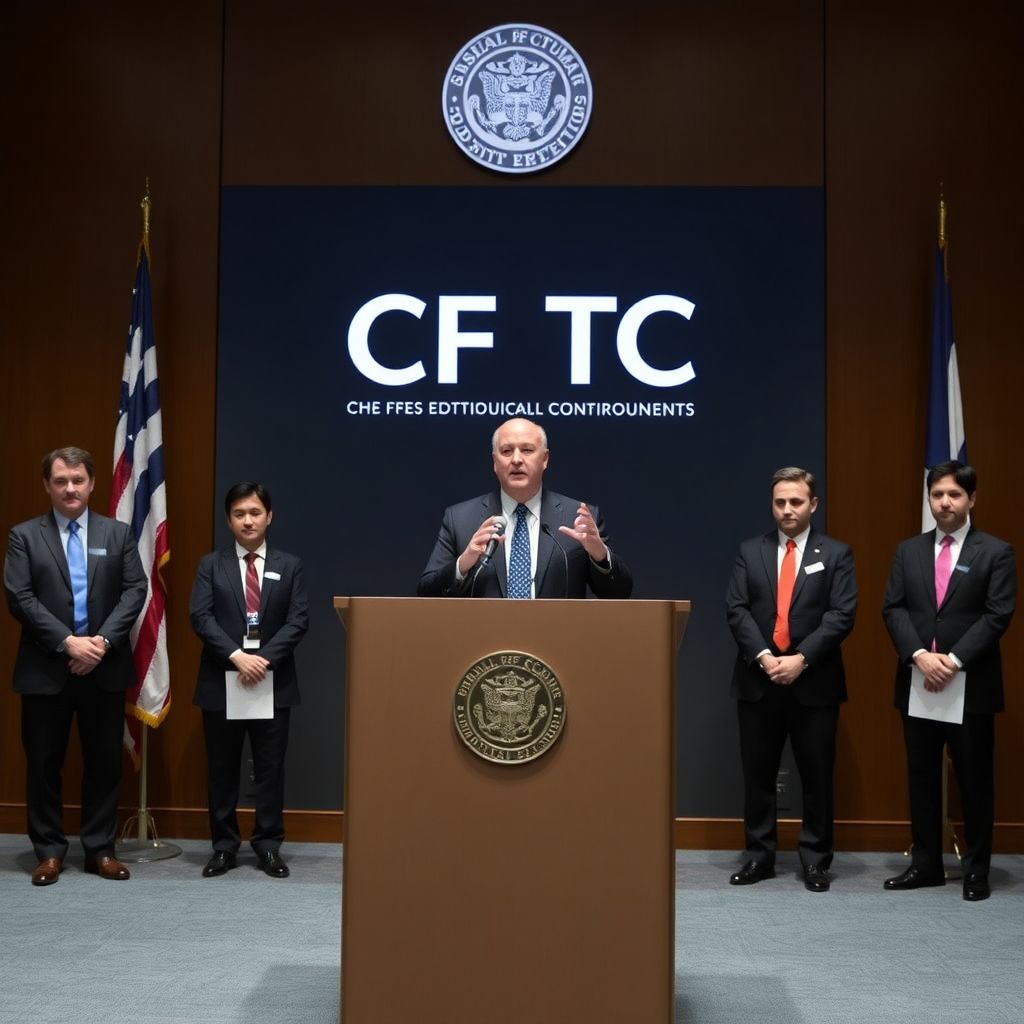
CFTC Launches Innovation Task Force To Tackle Crypto, Prediction Markets, And AI
The US Commodity Futures Trading Commission (CFTC) is stepping up its oversight of emerging financial technologies with a new initiative squarely aimed at crypto, blockchain, prediction markets, and artificial intelligence.
CFTC Chair Michael Selig announced the creation of an Innovation Task Force that will focus on providing clearer, practical regulatory guidance for companies building products in and around the US derivatives markets. The move signals a more structured approach to governing rapidly evolving digital finance, after years of regulatory uncertainty that pushed many firms to friendlier jurisdictions abroad.
A New Mandate For Emerging Tech
According to the agency, the Innovation Task Force has been given a broad but clearly defined mandate spanning three core areas:
– Crypto assets and blockchain-based technologies
– Artificial intelligence and autonomous systems
– Prediction markets and event contracts
Rather than functioning in isolation, the task force will operate alongside the CFTC’s existing Innovation Advisory Committee. It is also set to coordinate closely with other federal regulators, most notably the Securities and Exchange Commission (SEC) and its own Crypto Task Force, with the goal of aligning rules across agencies and reducing conflicting interpretations.
Selig framed the initiative as part of a wider “innovation agenda” inside the Commission, intended to balance market growth with appropriate oversight. In his announcement, he stressed that the objective is not to stifle experimentation, but to make sure it happens within clear and predictable boundaries.
By establishing a coherent regulatory framework for innovators “building on the new frontier of finance,” he argued, the US can support responsible development at home and avoid a scenario in which domestic firms and investors are “left on the sidelines” of global innovation.
Addressing The Cost Of Regulatory Ambiguity
Selig has recently been vocal about the damage caused by years of unclear rules in the digital asset space. In a social media post a day before the announcement, he emphasized that persistent ambiguity around how crypto assets are classified and regulated has driven many legitimate businesses offshore and left the industry “in limbo.”
That uncertainty has not only affected startups. Large financial institutions exploring tokenization, on‑chain derivatives, or AI‑driven trading systems have often complained that the lack of a stable rulebook makes it difficult to invest at scale. The new task force is explicitly designed to close that gap by engaging with innovators early and translating complex technology into workable regulatory categories.
Follow‑Up To Joint SEC-CFTC Crypto Guidance
The launch of the Innovation Task Force comes on the heels of a rare, high‑profile joint action by the SEC and the CFTC aimed at clarifying how US law treats different types of crypto assets.
That guidance, released while the CLARITY Act remains stalled in Congress, seeks to provide a practical roadmap for market participants who have spent more than a decade guessing where the line between commodities and securities might be drawn in the digital realm.
At the heart of the document is a structured taxonomy that divides digital assets into five main buckets:
– Digital commodities
– Digital collectibles
– Digital tools or utility tokens
– Stablecoins
– Digital securities
The agencies stress that these are functional categories designed to reflect how a token is used and what economic rights it conveys, rather than just its technical features.
A Dynamic View Of Token Status
One of the most consequential elements of the joint guidance is its explicit recognition that a token’s regulatory status can evolve over time.
A crypto asset that initially functions as a non‑security – for example, as a decentralized network commodity or as a purely functional tool – may later become subject to securities laws if its use changes or its economic characteristics begin to resemble an investment contract. Conversely, a token that launches as a security could, under certain conditions, cease to be treated as one if the underlying network becomes sufficiently decentralized and no longer relies on a central managerial effort.
This dynamic approach marks a break from the more rigid, case‑by‑case enforcement strategy that defined much of the previous decade, particularly under the Biden administration. Instead of leaving firms to infer regulatory standards from lawsuits and settlements, the agencies are attempting to provide a forward‑looking framework that can adapt as projects mature.
SEC Chair Atkins underscored the significance of this shift, stating that after more than ten years of confusion, the new interpretation is meant to give “market participants a clear understanding of how the Commission treats crypto assets under federal securities laws.”
From Enforcement‑First To Rules‑First
Both the CFTC and SEC have framed the recent developments as a deliberate pivot toward clarity and predictability. For years, regulators were criticized for relying heavily on enforcement actions to set de facto policy in crypto – a strategy that often left companies learning the rules only after investigations had begun.
The Innovation Task Force is presented as the next step in moving from an enforcement‑first stance to a rules‑first approach. Instead of waiting for problems to surface, the task force is expected to engage early with new technologies, identify potential risks, and help craft guardrails that are understandable and realistically enforceable.
For firms building in areas like on‑chain derivatives, algorithmic trading tools, or event‑based contracts, this could mean more structured dialogue with regulators and a clearer path to compliant product launches.
Why Prediction Markets And AI Are On The Agenda
The inclusion of prediction markets and AI in the task force’s mandate is notable. Prediction markets – platforms that allow users to trade contracts based on the outcome of future events – sit at the intersection of derivatives, betting, and information markets. Their legal status in the US has long been contentious, with only a handful of platforms operating under tailored exemptions or in regulatory grey zones.
By explicitly naming prediction markets and event contracts, the CFTC is signaling that it wants to draw more precise lines around what is permitted, what falls under its jurisdiction, and what may be considered prohibited gambling activity. That clarity could be particularly important as decentralized protocols and tokenized event contracts grow in popularity.
Artificial intelligence and autonomous systems, meanwhile, are increasingly used in everything from order routing and risk management to fully automated market‑making strategies. The task force will need to grapple with questions such as algorithmic accountability, model transparency, and how existing rules on market manipulation or fraud apply when decision‑making is delegated to AI systems.
Implications For US Crypto And DeFi Projects
For crypto and decentralized finance (DeFi) projects operating in or targeting the US, the new initiative has several immediate implications:
– Greater regulatory engagement will be expected. Firms will likely be encouraged – and in practice, pressured – to interact with the CFTC earlier in their product design process.
– Token design will face closer scrutiny. How a token is structured, marketed, and used will play a growing role in determining whether it falls into the “digital security” bucket or remains a commodity or utility.
– Hybrid products will need careful analysis. Derivative instruments built on top of tokens, especially those that touch both SEC and CFTC jurisdictions, will require nuanced, cross‑agency compliance strategies.
– On‑chain prediction products will be watched closely. Protocols that tokenize event outcomes will need to show how they fit within the evolving framework for event contracts.
At the same time, the promise of clearer ground rules may encourage more established financial institutions to move beyond small pilots and into larger‑scale deployments of blockchain and AI‑driven tools.
Market Reaction: Crypto Capitalization Slips
The regulatory developments arrived against a backdrop of short‑term market weakness. At the time of the announcement, the total cryptocurrency market capitalization had fallen to around 2.35 trillion dollars.
Leading assets were in the red:
– Bitcoin (BTC) was down approximately 2%
– Ethereum (ETH) slipped about 1.5%
– XRP declined around 3%
Although the price moves were relatively modest and part of broader market volatility, they underscore how regulatory headlines now sit alongside macroeconomic data and technological news as key drivers of sentiment in digital assets.
What Comes Next For The CFTC’s Innovation Agenda
The creation of the Innovation Task Force is likely only the first step in a broader regulatory reform process. In the coming months, market participants should watch for:
– Public consultations and requests for comment on specific topics such as event contracts, DeFi derivatives, or AI‑driven trading tools
– Staff guidance and no‑action letters that may clarify how the agency will treat certain business models in practice
– Joint statements with the SEC refining the digital asset taxonomy and addressing overlaps between commodities and securities regulation
– Pilot programs or sandboxes allowing limited testing of novel products under close supervisory conditions
How aggressively the task force moves – and how open it is to genuine two‑way dialogue – will be critical in determining whether the US becomes a more attractive base for crypto and AI‑driven financial innovation, or whether the trend of companies setting up abroad continues.
A Fragile Balance: Innovation Versus Protection
Ultimately, the CFTC’s new initiative reflects a broader dilemma facing regulators worldwide: how to encourage technological progress in financial markets without undermining investor protection, market integrity, or systemic stability.
Too little oversight can lead to frauds, bubbles, and systemic risks that damage trust for years. Too much, or the wrong kind, can suffocate experimentation and drive the most creative projects to more permissive jurisdictions. The explicit aim of the Innovation Task Force is to walk that tightrope more deliberately, instead of reacting piecemeal to crises as they emerge.
If it succeeds, market participants may finally get what many have long asked for: not special treatment for crypto or AI, but rules that are clear, consistent, and capable of evolving alongside the technology itself.