
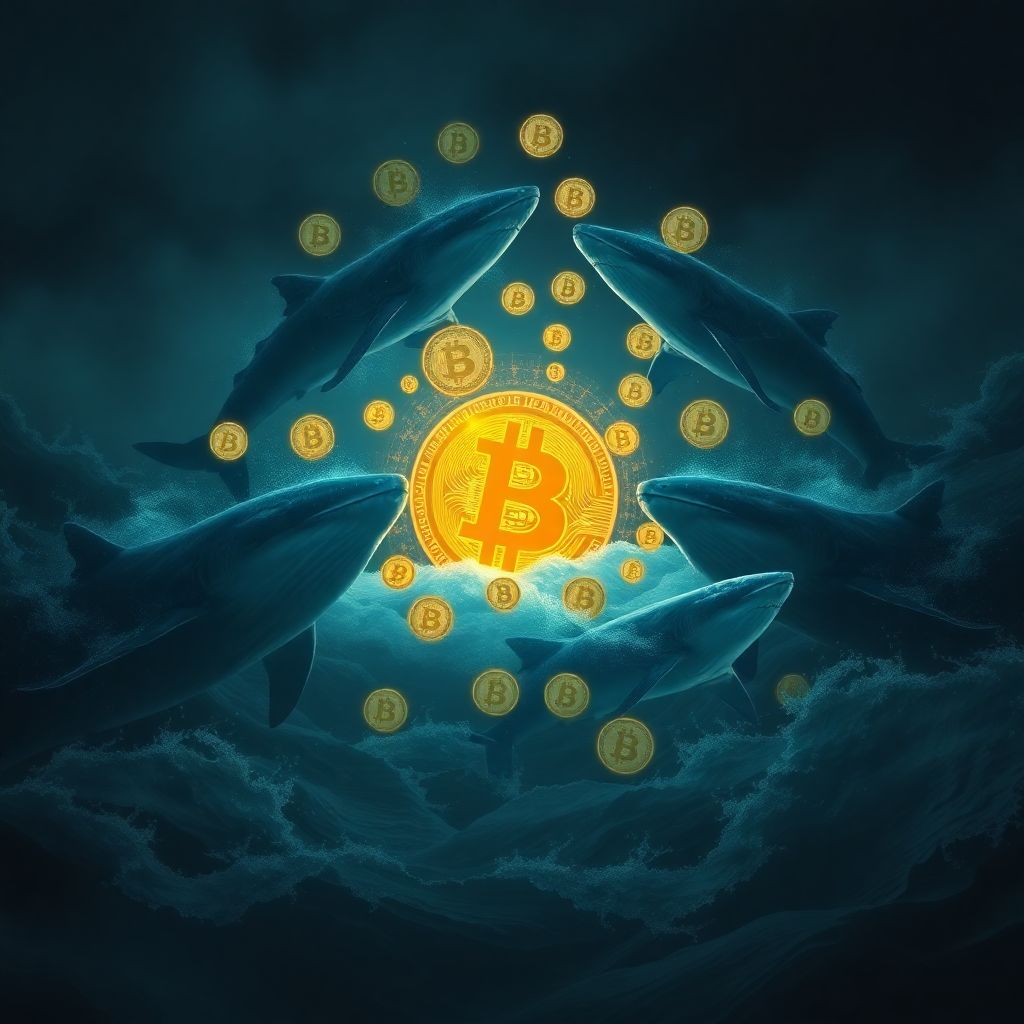
Whales and sharks quietly loaded up on more than 61,000 Bitcoin over the past month, building positions as geopolitical risks rise and markets remain gripped by fear. On-chain data suggests that large holders may be positioning for the next major move, while smaller investors are reacting emotionally to price swings.
According to analytics firm Santiment, wallets holding between 10 and 10,000 BTC – commonly labeled whales and sharks – increased their combined balances by 61,568 BTC in the last 30 days. That represents a roughly 0.45% rise in their total holdings. Over the same period, the smallest wallets, with less than 0.01 BTC each, added around 213 BTC, or 0.42% growth in that cohort.
This accumulation phase has unfolded against a backdrop of heightened macro uncertainty and escalating tensions in the Middle East. The conflict involving Iran, the United States and Israel intensified after strikes and retaliations spread across the region, including attacks on key energy infrastructure in the Gulf. At the same time, global markets have been grappling with volatile energy prices, inflation concerns and questions about central bank policy paths.
Despite this turbulent environment, the on-chain picture indicates that many Bitcoin holders are not rushing for the exits. Exchange outflows have remained elevated throughout March, a sign that coins are being withdrawn to self-custody or long-term storage rather than being sent to trading platforms to be sold. Historically, sustained exchange outflows have often coincided with accumulation phases by long-term, conviction-driven investors.
Santiment’s analysts argue that the pattern forming now could be constructive for Bitcoin’s next directional move. They note that strong accumulation by large wallets during a sideways price range has frequently preceded the start of new bull cycles. The ideal setup, they suggest, is when big players are quietly buying while a portion of retail investors either capitulate or lose interest, creating a supply and sentiment imbalance that can fuel a sharp move higher once demand returns.
However, not every large holder is following the same playbook. On March 19, as Bitcoin’s price dropped and energy prices spiked following renewed attacks on oil and gas facilities linked to the Iran conflict, two sizable whale wallets transferred tens of millions of dollars’ worth of BTC to exchanges. Such moves are often interpreted as preparation to sell or rebalance, showing that even within the whale category there are diverging strategies and time horizons.
Dominick John, an analyst at Zeus Research, believes that the whales accumulating in the background are laying the groundwork for a potential breakout once market conditions align. In his view, these entities are “positioning ahead of a potential breakout, quietly stacking during consolidation periods,” while smaller investors tend to chase upward price momentum out of fear of missing out on the next major rally.
John points out that whale behavior tends to unfold in “waves.” Accumulation often comes in clusters, interrupted by periods of distribution or profit-taking. If Bitcoin’s trading range remains intact and macroeconomic conditions do not sharply deteriorate, he argues that the current accumulation wave could extend. Conversely, if retail FOMO returns too aggressively and pushes prices up too quickly, a corrective phase or short-term sell-off might emerge before large buyers resume their slow accumulation.
While whales appear to be acting with a longer-term perspective, sentiment among the broader investor base is still dominated by anxiety. The widely followed Crypto Fear & Greed Index posted a reading of 13 on Friday, placing it firmly in the “extreme fear” zone. The previous day’s score was even lower at 10, and both the preceding week and the entire month of February saw average readings in the same deeply fearful range. Historically, such sentiment extremes have sometimes coincided with attractive accumulation windows for patient investors.
This divergence between on-chain behavior and crowd emotion is a key theme. On one side, long-term holders and large entities are adding to their positions, seemingly unfazed by headlines and short-term volatility. On the other, sentiment gauges, social chatter and retail flows suggest many smaller participants remain nervous, reactive and uncertain about Bitcoin’s near-term direction.
For market observers, the current environment raises an important question: are whales correctly front-running the next leg of the cycle, or are they misreading the depth of macro risk? Bitcoin has often been described as both a “risk asset” and a “digital safe haven,” but its behavior during geopolitically driven sell-offs has been mixed. Sometimes it trades in line with tech stocks and growth assets; at other times, it decouples and responds more to crypto-native factors like halving cycles and liquidity conditions within the digital asset space.
Another angle to consider is supply dynamics. As more coins move off exchanges and into longer-term storage, the amount of immediately available supply shrinks. If demand later returns with force – for example, due to a macro shift, new institutional inflows, or a narrative around Bitcoin as a hedge against inflation or geopolitical turmoil – a constrained supply backdrop can magnify price moves to the upside. Whales, by accumulating early, attempt to position ahead of such inflection points.
Yet whale accumulation is not a guarantee of imminent upside. Large holders can be wrong, or may simply have a far longer time horizon than traders watching intraday charts. They may be comfortable seeing prices fall further in the short term if they believe the long-term trend remains intact. For smaller investors, blindly copying whale behavior without understanding their own risk tolerance and time horizon can be dangerous.
In this context, the persistent “extreme fear” readings offer both a warning and an opportunity. Extreme fear can reflect real systemic risks – from war and energy shocks to tightening financial conditions – that could weigh on all risk assets, including Bitcoin. At the same time, episodes of panic and capitulation have historically laid the foundation for strong subsequent returns for those with patience and discipline.
For individuals navigating this landscape, several practical points emerge:
– On-chain signals like whale accumulation, exchange flows and wallet distribution can provide valuable context, but they should complement, not replace, a clear investment plan.
– Sentiment indicators, while useful for spotting extremes, are not timing tools on their own. Markets can stay fearful or euphoric longer than expected.
– Geopolitical shocks can create sharp, short-lived moves that test conviction. Understanding why you hold Bitcoin – speculation, long-term store of value, portfolio diversification – is crucial before volatility hits.
– Risk management, including position sizing and time horizon alignment, matters more than any single data point, no matter how compelling.
As the conflict in the Middle East continues and global markets absorb new macroeconomic data, Bitcoin remains at the intersection of fear, speculation and long-term conviction. Whales and sharks appear to be using this period of uncertainty to increase their exposure, while retail participants oscillate between FOMO and capitulation. Whether this sets the stage for the next major breakout or a prolonged consolidation will depend on how quickly the macro picture stabilizes – and how long large holders are willing to keep quietly stacking in the shadows.