
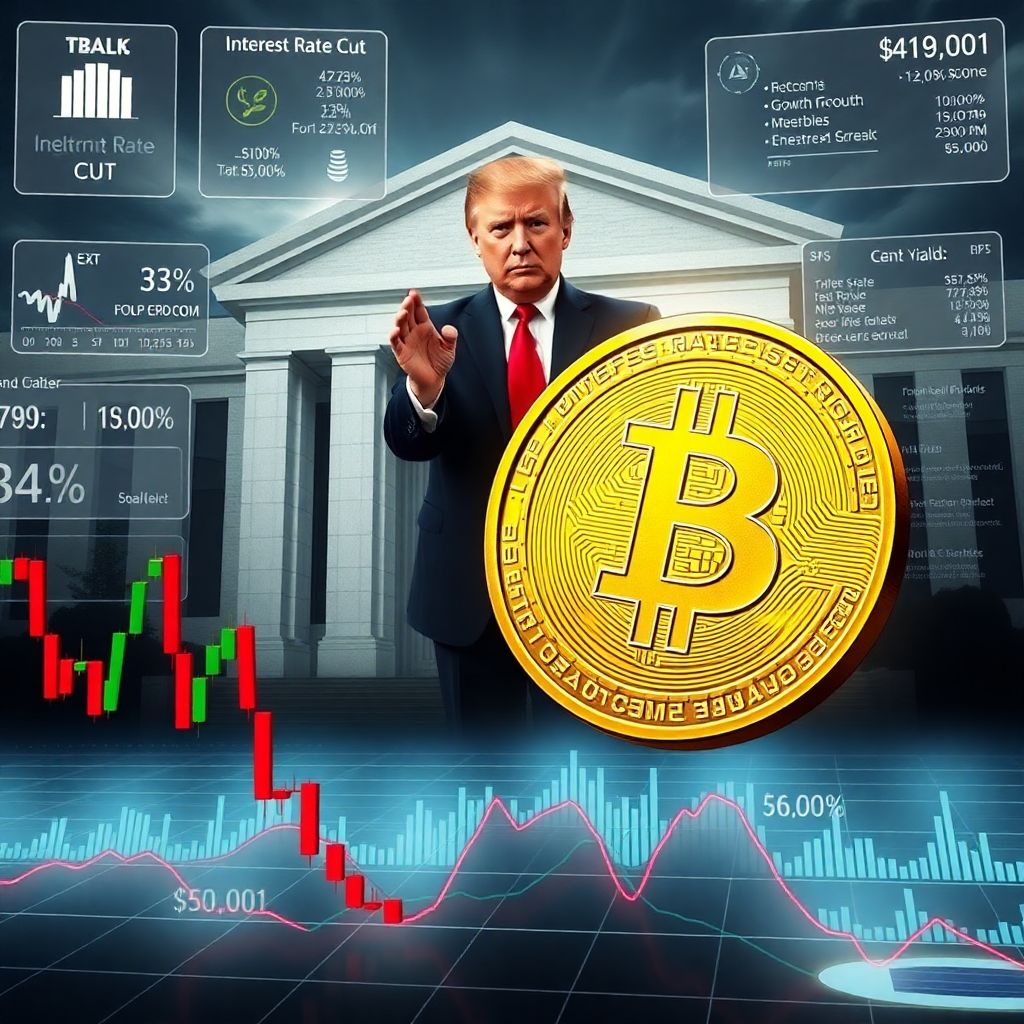
Bitcoin at a 2‑month low: can Trump’s rate‑cut agenda really rescue BTC?
Bitcoin has slipped back to a two‑month low around the $80,000 mark, just as President Donald Trump doubles down on his demand for deeper interest‑rate cuts and installs his preferred candidate as Federal Reserve Chair. On the surface, that combination should be rocket fuel for risk assets. In practice, the reaction in crypto has been muted – and in some corners, outright negative.
The disconnect between the political narrative and market behavior raises an uncomfortable question: are rate cuts still a bullish trump card for Bitcoin, or has the macro backdrop changed too much for the old playbook to work?
—
Liquidity, rate cuts and why they matter for Bitcoin
In every major market cycle of the past decade, one word has dominated investor discussions: liquidity. When central banks cut rates or expand their balance sheets, borrowing becomes cheaper and capital tends to flow more aggressively into risk-on assets like equities, tech stocks, and cryptocurrencies.
Trump has leaned heavily into this story. He has framed his choice for Fed Chair as a pro‑growth, pro‑liquidity move, openly calling for further rate reductions and stressing that they would arrive “without any pressure” on the central bank. That rhetoric is tailor‑made for a bullish Bitcoin narrative: easier policy, more dollars in the system, higher appetite for speculative assets.
Historically, Bitcoin has often thrived during or shortly after easing cycles. Against that backdrop, BTC’s retreat toward a two‑month low seems counterintuitive. If lower rates are coming, why isn’t the market bidding Bitcoin higher in anticipation?
—
The economic reality behind rate cuts
To understand the hesitation, it’s important to remember what rate cuts typically signal beneath the surface. Central banks do not ease policy in a vacuum. They usually cut because the economy is slowing:
– Consumer spending is cooling
– Unemployment is ticking up
– Business investment is softening
– Key macro indicators are coming in weaker than expected
In other words, easier monetary policy often arrives as a response to rising economic stress. For Bitcoin, that can be a double‑edged sword. Yes, cheaper money and more liquidity are supportive, but a deteriorating growth outlook can simultaneously undermine risk appetite. When investors start worrying about corporate earnings, job security, or credit risk, they sometimes sell volatile assets to raise cash rather than chase speculative upside.
—
Inflation data complicates the easing story
There is another problem: inflation is not yet cooperating with the “clean” easing narrative. Recent figures from the U.S. Bureau of Labor Statistics show the Producer Price Index for December at 3%, higher than the 2.7% that many economists had forecast.
That overshoot matters. If producer prices are still rising faster than expected, it suggests underlying inflationary pressure remains sticky. For the Fed, that reduces the room to cut aggressively. Any perception that the central bank might be easing into persistent inflation can trigger bond‑market volatility, push real yields higher, and actually tighten financial conditions rather than loosen them.
This is precisely the kind of macro ambiguity that crypto markets dislike. Instead of a clear, one‑directional “liquidity wave,” investors see a tug‑of‑war between slowing growth and stubborn inflation – a stagflation‑lite scenario that historically has not been consistently bullish for any risky asset, including Bitcoin.
—
Is Trump’s Fed pick a genuine Bitcoin catalyst?
Trump has made no secret of his desire to turn the U.S. into a global hub for digital assets, framing his administration as crypto‑friendly and positioning the Fed’s leadership as a critical piece of that vision. On paper, a central bank that leans dovish and tolerant of innovation should be good news for Bitcoin.
Yet markets appear unconvinced. The announcement of his Fed Chair pick and the renewed push for cuts have not reversed BTC’s drop to its recent low. Skepticism is growing that political promises alone can offset the structural forces now shaping the macro environment: elevated inflation risks, uncertain growth, and crowded positioning in risk assets after a long bull cycle.
There is also a credibility factor. When investors sense that rate‑cut rhetoric is driven by political incentives rather than data, they may discount its impact. If the market doubts that the Fed can or will deliver the cuts being advertised, Bitcoin’s price will reflect the reality of expectations, not the campaign speech.
—
Volatility still rules the crypto market
Bitcoin is often presented as a macro hedge – against inflation, currency debasement, or systemic risk. Regulatory gestures over the last fifteen months of Trump’s presidency have indeed nudged it in that direction, helping to normalize BTC in the eyes of mainstream investors and institutions.
But normalization is not the same as stabilization. Over this same period, volatility has remained the dominant driver of crypto pricing. Despite more regulatory clarity and political rhetoric, Bitcoin and its peers continue to trade with large intraday swings and deep drawdowns.
Market data over roughly the first two years of Trump’s term show that most large‑cap crypto assets endured sharp pullbacks, with some, like Aptos (APT), suffering losses in excess of 80% from local highs. Those moves underscore a key point: macro narratives can shift sentiment, but they do not erase the inherent risk profile of this asset class.
—
On‑chain signals: capitulation instead of conviction
The skepticism is visible not only in price charts but also on‑chain. Various cohorts of holders have been moving coins from long‑term storage to exchanges – a pattern historically associated with rising fear, forced liquidations, or a desire to sell into weakness before conditions potentially deteriorate further.
This behavior clashes with the idea that rate cuts are just around the corner and will deliver a near‑term boost to BTC. If participants truly believed a powerful liquidity wave was imminent, long‑term holders would more likely accumulate or sit tight, expecting higher prices ahead. Instead, their decision to transfer coins to trading venues suggests caution and a readiness to reduce exposure.
—
The widening gap between theory and practice
On a theoretical level, Bitcoin looks better positioned than ever:
– It is increasingly framed as a hedge against monetary debasement
– Regulatory structures are more defined, providing a clearer operating environment
– Institutional access and infrastructure have improved substantially
Yet, in practice, day‑to‑day price action is still heavily dictated by macro headlines, cross‑asset risk sentiment, and leverage flows within the crypto ecosystem. When volatility spikes in equities or yields jump in bond markets, Bitcoin is often pulled along, regardless of its “digital gold” pitch.
This divergence between narrative and reality is what has many investors puzzled. Rate cuts, a supportive Fed Chair, and a supposedly pro‑crypto administration should, in theory, underpin BTC. Instead, confidence remains fragile, and each bout of volatility appears to blunt the potential upside.
—
Could deeper rate cuts eventually lift Bitcoin?
Despite the current hesitation, it would be premature to dismiss the potential impact of a full‑blown easing cycle on Bitcoin. Historically, sustained declines in policy rates and a shift toward more accommodative financial conditions have coincided with renewed bull phases in crypto.
For that to happen this time, several conditions would likely need to align:
1. Clarity on the inflation path
Markets need more confidence that inflation is on a controllable trajectory. If price pressures ease while the Fed cuts, risk assets could re‑rate higher.
2. A controlled economic slowdown, not a crisis
A gentle cooling of growth tends to favor risk‑on behavior, whereas a sharp contraction or financial shock often pushes investors into cash, Treasuries, and defensive assets.
3. Stabilizing volatility in traditional markets
Bitcoin performs best when macro volatility is elevated but not chaotic – enough uncertainty to justify a hedge, but not so extreme that liquidity vanishes from speculative corners of the market.
If these pieces fall into place, Trump’s push for lower rates and his Fed Chair’s policy stance could yet provide tailwinds for BTC. That impact, however, is likely to play out over quarters and years, not in reaction to a single speech or announcement.
—
Why the market isn’t fully buying the “crypto capital” narrative
Trump’s vision of the U.S. as the world’s “crypto capital” hinges on three promises: supportive regulation, easier money, and political backing for digital assets. Each component faces real‑world constraints.
– Supportive regulation is helpful but can be offset by global crackdowns, shifting tax regimes, or enforcement actions elsewhere.
– Easier money is constrained by inflation and the Fed’s dual mandate, which forces it to weigh employment against price stability.
– Political backing can change with elections, congressional dynamics, and public opinion, making any policy direction less predictable.
This combination of uncertainty has led many investors to treat political pro‑crypto messaging as a second‑order factor. They pay attention, but they prioritize actual macro data, central‑bank minutes, and risk‑asset correlations when allocating capital.
—
What traders and investors can realistically watch for
Rather than assuming that Trump’s rate‑cut push will automatically reverse Bitcoin’s slump, market participants are more likely to focus on a handful of concrete signals:
– Fed guidance and meeting outcomes: How many cuts are projected, and under what conditions?
– Inflation trends: Do subsequent PPI and CPI readings confirm that December’s 3% producer inflation was a blip or the start of a re‑acceleration?
– On‑chain accumulation or distribution: Are long‑term holders returning to accumulation, or is the move to exchanges accelerating?
– Correlations with equities and bonds: Does Bitcoin decouple and trade more as a hedge, or remain tightly linked to broader risk sentiment?
These factors will likely determine whether BTC’s current two‑month low around $80,000 becomes a durable floor or just a waystation on the path to deeper corrections.
—
Bottom line: rate cuts vs. reality
Trump’s Fed strategy and his call for aggressive easing do create a potentially supportive backdrop for Bitcoin over the medium term. Liquidity still matters, and a genuine shift to lower rates can, over time, channel fresh capital into crypto.
For now, however, the market is signaling caution. Inflation surprises, a complex growth outlook, persistent volatility, and visible on‑chain capitulation all suggest that rate‑cut rhetoric alone is not enough to restore full confidence in Bitcoin or in the broader “crypto capital” vision.
BTC’s price action at its two‑month low reflects that tension: the theoretical bullishness of easier money colliding with the practical reality of an uncertain macro environment.
—
This text is for informational purposes only and should not be interpreted as financial or investment advice. Trading, buying, or selling cryptocurrencies involves significant risk, and each reader should conduct their own analysis and due diligence before making any financial decisions.