
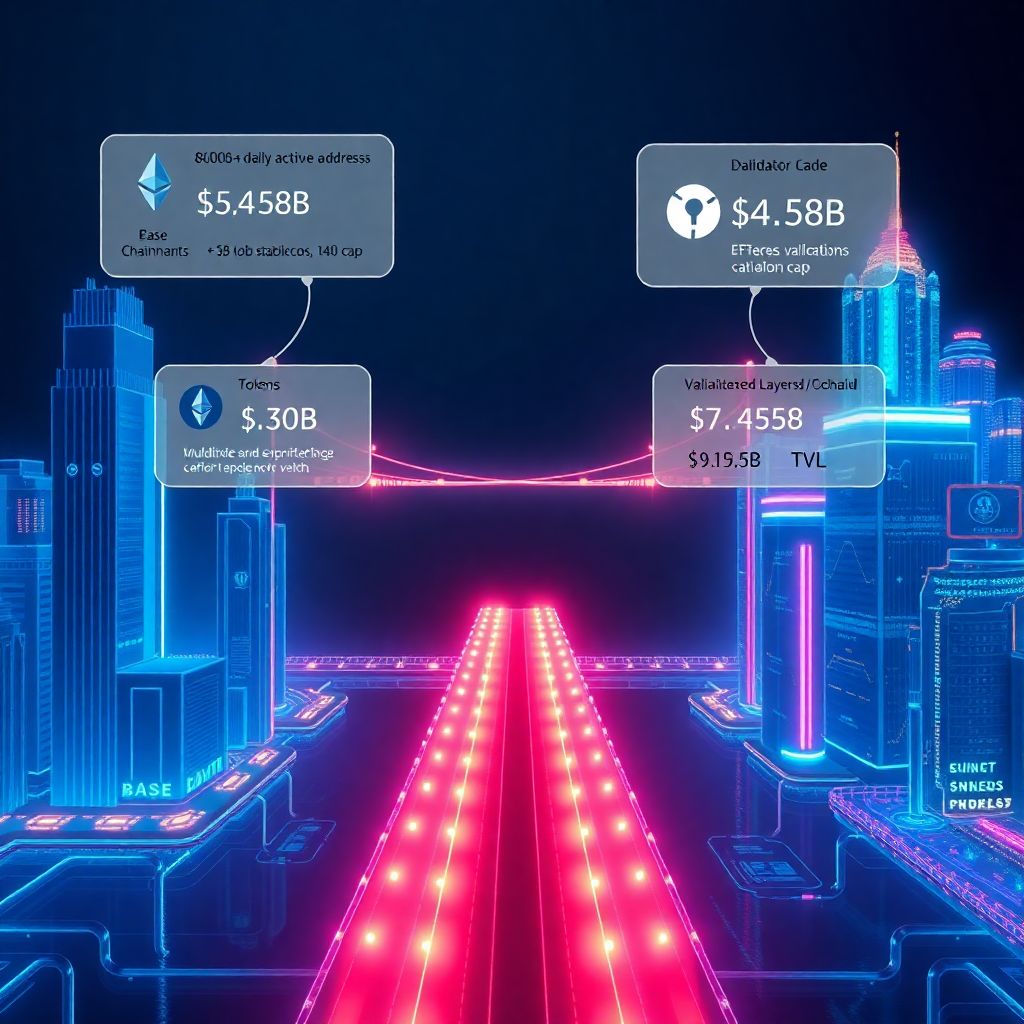
Base–Solana bridge launches: A new phase for a $9.15B on‑chain economy
Coinbase’s Layer‑2 network, Base, has taken a decisive step beyond the Ethereum ecosystem by going live with a native bridge to Solana. The new Base–Solana bridge, powered by Chainlink’s Cross‑Chain Interoperability Protocol (CCIP) and built on Coinbase infrastructure, allows users to transfer SOL and other Solana‑based assets directly and securely between the two networks.
With this launch, Base is positioning itself not just as an Ethereum‑centric L2, but as a cross‑chain liquidity hub connecting two of the most active blockchain ecosystems. For both users and developers, this dramatically lowers the friction of moving capital and building applications that span Base and Solana.
Base’s team framed the move as core to its long‑term mission, emphasizing that a truly global on‑chain economy cannot be siloed: the network aims to act as a “bridge, not an island,” enabling interoperable markets rather than isolated liquidity pools.
How the Base–Solana bridge works
At the heart of the integration is Chainlink CCIP, which serves as the cross‑chain messaging and security layer for the bridge. Instead of relying on a single set of validators or a monolithic bridge contract, the system uses multiple independent validator groups.
Coinbase and Chainlink CCIP node operators each function as separate validation layers. Every cross‑chain message related to token transfers between Base and Solana must be independently verified by these validator sets before it is finalized. This multi‑layered verification design is intended to reduce the chance of exploits and mis‑routing of assets, a crucial consideration given the history of high‑profile bridge hacks in the crypto sector.
Johann Eid, Chief Business Officer at Chainlink Labs, highlighted that by anchoring the Base–Solana bridge on CCIP, developers can create cross‑chain applications with a higher security baseline. In his view, this type of interoperability standard is a necessary foundation if on‑chain finance is to scale to the level of global markets and support “hundreds of trillions” in value over time.
Why this bridge matters for liquidity and users
Immediately after launch, several well‑known decentralized applications, including Zora, AerodromeFi, Virtuals, Flaunch, and RelayProtocol, began integrating the new bridge functionality. This early adoption means that users can already start to move assets and interact with cross‑chain features within familiar dApps, rather than waiting for new tooling to appear.
The bridge supports a wide set of Solana‑native tokens, from blue‑chip assets like SOL to more speculative memecoins such as CHILLHOUSE and TRENCHER. In practice, this means that traders, NFT platforms, and DeFi protocols on Base can now list, trade, or otherwise integrate Solana assets without forcing users to manually navigate centralized exchanges or complex multistep bridging routes.
For liquidity, the implications are significant. Capital that was previously split between EVM‑based chains and Solana can now be unified or at least made far more fluid. Builders on Base gain direct access to Solana liquidity and user communities, while Solana projects can tap into the growing on‑chain economy that has been forming around Base.
From Ethereum L2 to multi‑chain liquidity hub
Base’s evolution has been fast. Initially launched as a cost‑efficient Ethereum Layer‑2, it is now deliberately moving beyond a single‑ecosystem identity. Integrating Solana as its first external chain is more than a technical upgrade; it is a strategic signal that Base intends to become a central routing layer for value across multiple blockchains.
The team has open‑sourced the Base–Solana bridge implementation, allowing any project or protocol to integrate cross‑chain support directly into their own products. This openness is meant to encourage experimentation and to prevent the bridge from becoming a closed, proprietary choke point for inter‑network transfers.
Base has stated that Solana is only the first step. The longer‑term objective is to plug into additional chains over time, gradually building what it describes as an “everything economy” — an environment where any asset, regardless of its origin chain, can move seamlessly across networks and find liquidity, users, and utility.
Base’s current on‑chain footprint
The decision to invest heavily in cross‑chain infrastructure comes at a moment when Base’s own metrics already point to substantial traction. According to recent data, the network has:
– Over 880,000 daily active addresses
– A stablecoin market capitalization of approximately $4.488 billion
– Around 3.7 billion cumulative on‑chain transactions
– A peak throughput of 140 transactions per second (TPS)
– Roughly $9.156 billion in Total Value Locked (TVL)
These figures place Base among the leading Layer‑2 networks by both user activity and locked value. The new bridge is designed to leverage that momentum by making Base not only a fast and inexpensive execution layer, but also a key intersection point for assets moving between ecosystems.
What changes for developers?
For developers, the Base–Solana bridge opens several new design patterns:
1. Cross‑chain DeFi protocols
Projects can now design lending markets, DEXs, yield aggregators, and structured products that treat Solana and Base liquidity as one interconnected system. For example, collateral deposited on Solana could back leveraged positions or synthetic assets on Base, or vice versa.
2. Unified user experiences
Frontends can abstract away the complexity of chain boundaries. A user might interact with a single interface on Base while the application silently routes certain operations to Solana when it is cheaper, faster, or more liquid to do so.
3. Multi‑chain gaming and NFTs
Game developers and NFT creators can deploy logic on Base but use Solana’s ecosystem for specific features, or bring Solana collections into Base‑native marketplaces and social applications, expanding reach without fragmenting their communities.
4. Arbitrage and MEV strategies
Professional traders and MEV searchers gain new opportunities by monitoring price discrepancies between assets on Base and Solana. A secure, reliable bridge allows for more sophisticated cross‑chain arbitrage strategies that were previously too slow or risky.
By providing a standardized way to move both fungible and non‑fungible tokens between the two networks, the bridge reduces the need for ad‑hoc, project‑specific bridges that often come with uneven security practices.
What this means for everyday users
From a user’s perspective, the deeper impact of the Base–Solana bridge will unfold over time as interfaces improve. In the near term, users can expect:
– Simpler asset movement: Instead of using multiple custodial platforms or complicated bridge workflows, users can move SOL and Solana tokens directly to Base and back through integrated dApps.
– Broader asset choice on Base: More tokens, including Solana‑native memecoins and ecosystem tokens, can be traded, used as collateral, or incorporated into DeFi strategies on Base.
– Potentially lower costs and better execution: Having access to liquidity on both networks can help users find tighter spreads, deeper order books, or better yields, depending on where activity is strongest at a given time.
Over the longer term, if cross‑chain UX continues to improve, many users may no longer need to care which chain they are on at any moment — they will simply interact with applications that choose the optimal execution environment behind the scenes.
Security considerations and bridge risk
Bridge infrastructure has historically been one of the most vulnerable components in the crypto stack, with multiple incidents resulting in the loss of hundreds of millions of dollars. Against this backdrop, Base’s emphasis on a multi‑layered security model is not just a design preference but a necessity.
By relying on separate validator groups — Coinbase infrastructure and Chainlink CCIP node operators — the bridge reduces the risk that a single compromised system could unilaterally approve malicious transactions. Each message must pass independent checks before funds are released on the destination chain.
That said, users should understand that no bridge can be considered entirely risk‑free. Smart contract bugs, operational errors, or novel attack vectors remain possible. Prudent users and institutions will typically size their exposure accordingly, diversify across different infrastructures, and keep track of security audits and incident reports.
Impact on the broader on‑chain economy
Unifying liquidity between Base and Solana has implications that extend well beyond those two networks. If the model proves reliable and secure, it could accelerate a broader shift toward a genuinely multi‑chain on‑chain economy, where the focus is less on “which chain is winning” and more on “how well they interoperate.”
For institutional players, reliable interoperability can make it easier to deploy capital across multiple environments while maintaining compliance and risk controls. For retail users, the benefits show up in better access to assets, more competitive rates, and richer application experiences.
This bridge also strengthens the narrative of blockchains as modular components rather than monolithic silos. Execution, data availability, settlement, and liquidity can increasingly be treated as composable layers — and networks like Base aim to sit at the center of that modular stack.
What to watch next
Several developments will be key in determining how transformative the Base–Solana bridge ultimately becomes:
– Volume and adoption: The scale of assets actually moving through the bridge will indicate how much trust users and protocols place in it.
– Developer tooling: SDKs, APIs, and no‑code tools that simplify cross‑chain development will likely drive the next wave of applications.
– Additional chain integrations: As Base adds support for more networks, its role as a central hub will either strengthen or be tested by competition from other interoperability solutions.
– Regulatory and compliance frameworks: Institutions exploring on‑chain finance will pay close attention to how cross‑chain flows can be monitored, audited, and brought into existing financial reporting systems.
Final thoughts
Base’s launch of an open‑source, CCIP‑secured bridge to Solana marks a significant milestone in the evolution of on‑chain finance. With nearly $9.2 billion in TVL, strong user metrics, and a growing stablecoin base, the network is using its momentum to push toward a more interconnected, always‑on global market structure.
By stressing decentralization, interoperability, and security, Base is positioning itself as a unifying layer for the on‑chain economy — one where assets from different ecosystems can move with far less friction, and where developers can build applications that treat multiple chains as a single, cohesive environment.
—
This article is intended for informational purposes only and should not be taken as financial, investment, or trading advice. Cryptocurrency transactions and investments involve a high level of risk, and readers should conduct their own research and evaluate their risk tolerance before buying, selling, or holding any digital assets.