
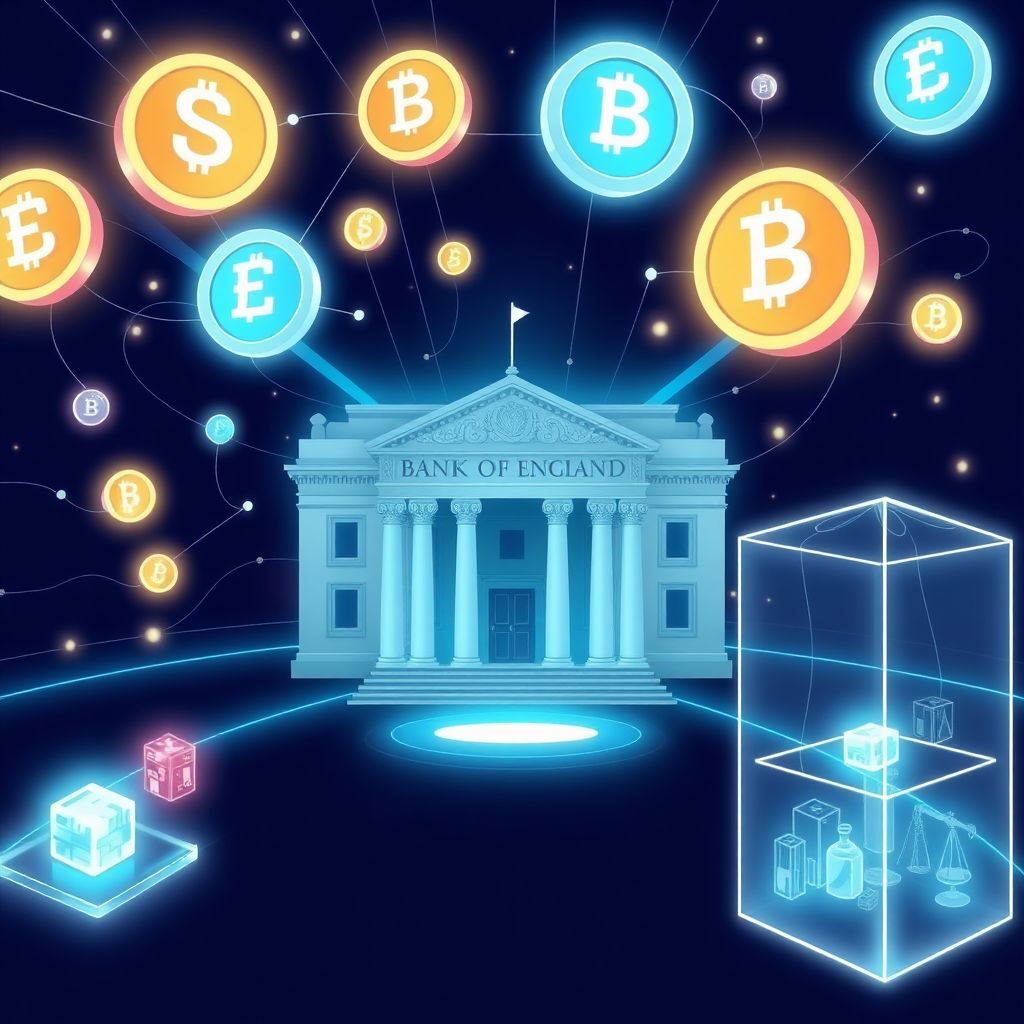
Bank of England Maps Out Stablecoin And Tokenization Push For UK’s Digital Finance Future
—————————————————————————————
The Bank of England is setting the stage for a major shift in the UK’s financial infrastructure, placing stablecoins and tokenization at the heart of its innovation agenda for 2026. In a recent speech in London, Sasha Mills, the Bank’s executive director for financial market infrastructure, outlined how these technologies are expected to reshape payments, collateral markets and securities trading, while remaining tightly anchored to financial stability.
A Vision For “Holistic” Digital Financial Markets
Speaking at the Tokenisation Summit, Mills argued that UK regulators now have a rare chance to design “truly holistic digital financial markets” that bring concrete benefits to the real economy. Rather than allowing technology to evolve in a regulatory vacuum, the Bank aims to guide its development so that new forms of money and assets can integrate safely into existing systems.
To do this, the Bank of England has singled out three priority areas:
1. Systemic stablecoins
2. Tokenized collateral
3. The Digital Securities Sandbox (DSS), including the role of stablecoins within it
These pillars are intended to support a broader transition toward a more automated, programmable and efficient financial system, without compromising resilience or trust.
Stablecoins: Modernizing Payments, Not Bypassing Rules
A central part of the plan is a comprehensive regime for “systemic” stablecoins – those that are large or interconnected enough to pose potential risks to the wider financial system. Mills stressed that such tokens could become an important part of both retail and wholesale payments in the UK.
According to her, stablecoins could:
– Speed up payments and settlement
– Reduce transaction costs for households and businesses
– Enable new programmable features, such as conditional payments or automated invoicing
– Provide additional choice to consumers and firms when making and receiving payments
However, she was equally clear that any stablecoin used widely in the real economy must be held to the same standards as existing forms of money. That means robust backing, operational resilience, strong governance and clear protections for users.
Joint Work With The FCA And A New Regulatory Regime
The Bank of England is working closely with the Financial Conduct Authority to finalize a detailed regulatory framework for sterling-denominated systemic stablecoins. The goal is to complete this regime by the end of the year, providing certainty to issuers, payment providers and market participants.
The framework under development addresses issues such as:
– The quality and composition of reserves backing stablecoins
– How those reserves must be held and segregated
– Redemption rights and timelines for holders
– Prudential and conduct requirements for issuers and wallet providers
– Limits on holdings to manage systemic risk
Earlier proposals from the Bank included caps on how much stablecoin individuals and firms can hold. The suggested bands were:
– Between £10,000 and £20,000 for individuals
– Up to £10 million for businesses
This mirrors the Bank’s thinking around a potential digital pound, where usage caps have also been floated as a way to prevent sudden outflows from bank deposits into digital money, and to contain financial stability risks during an initial rollout phase.
Tokenization: From Theory To Real-World Use In Collateral Markets
The second strategic focus is tokenization – the process of representing traditional financial assets, such as bonds, equities or cash-like instruments, as digital tokens on programmable infrastructure.
Mills noted that tokenization is no longer a distant, experimental concept. In the UK, real-world pilots are already taking place, especially in collateral markets. These projects are testing how tokenized collateral could:
– Be moved faster across institutions and borders
– Settle more quickly and with fewer manual steps
– Reduce operational and administrative costs
– Enhance overall market liquidity by unlocking assets that are currently harder to mobilize
Yet, as with stablecoins, the Bank’s message is that innovation cannot come at the expense of system-wide safety. Tokenized collateral, even when technologically novel, must still satisfy the same prudential and risk-management standards that apply to traditional collateral.
Technology-Neutral, But Standards-Driven
A recurring theme in Mills’ remarks was technology neutrality. The Bank of England does not want to dictate which specific platforms, blockchains or technical architectures firms must use. Instead, it aims to define clear regulatory outcomes and risk standards, and then allow the private sector to innovate within those boundaries.
In practical terms, this means:
– No blanket mandate to use a particular distributed ledger or network
– No outright bans on specific technologies purely because they are new
– A focus on how risks are managed, irrespective of the tech stack behind a product
However, the Bank acknowledged that firms need clarity on how tokenized assets fit within existing rules, particularly under the UK’s implementation of the European Market Infrastructure Regulation (EMIR). Without this, large-scale adoption will stall due to legal uncertainty.
Clarifying How Tokenized Collateral Fits Under EMIR
To address these concerns, the Bank intends to publish further policy guidance later this year explaining how tokenized collateral can operate under the current regulatory framework. This is expected to cover issues such as:
– Eligibility criteria for tokenized instruments as collateral
– How to treat settlement finality and legal ownership of tokenized assets
– Requirements around custody, segregation and operational resilience
– How existing margin, clearing and reporting obligations apply to tokenized arrangements
The Bank also emphasized that because collateral markets are inherently global, any national approach must be compatible with international standards. The upcoming policy work will therefore be informed by dialogue with overseas regulators and central banks, as well as with industry participants that operate cross-border.
Digital Securities Sandbox: A Testbed For Regulated Innovation
The third core priority is the Digital Securities Sandbox, a controlled environment where firms can trial new ways of issuing, trading, settling and recording securities using digital technologies, under the supervision of UK authorities.
Within this sandbox, the Bank is developing an assessment framework for stablecoins that could be used in wholesale financial market applications. The idea is to identify a set of regulated stablecoins that meet high enough benchmarks on:
– Resilience and reliability
– Quality and transparency of backing assets
– Governance and risk management
– Legal and regulatory compliance
Mills cautioned that, because regulatory regimes for stablecoin issuers are still emerging both in the UK and globally, the standards used in the sandbox may not line up perfectly with the eventual long-term rules for all wholesale applications. Instead, the framework is being designed as a practical, interim tool to allow real-world experimentation without undermining safety.
Why Stablecoins And Tokenization Matter For The UK Economy
Behind the technical language, the Bank’s agenda is closely tied to competitiveness and economic efficiency. If properly regulated, stablecoins and tokenized assets could:
– Lower transaction costs for UK businesses engaged in domestic and international trade
– Accelerate settlement times in capital markets, freeing up capital more quickly
– Reduce friction in cross-border payments and collateral movements
– Make financial services more accessible and flexible for smaller firms and fintechs
At the same time, the Bank is clearly aware of the risks: operational failures in large stablecoin systems, poor-quality reserves, cyberattacks, and the potential for runs if confidence suddenly evaporates. The strategy is to harness the benefits while making these new instruments as safe and predictable as existing payment rails and securities infrastructures.
Interaction With A Potential Digital Pound
Although the latest remarks focused on stablecoins and tokenization, they sit alongside the Bank’s ongoing exploration of a potential digital pound, sometimes called a central bank digital currency (CBDC). The proposed holding limits for both stablecoins and a digital pound suggest that policymakers are thinking about the interaction between private and public forms of digital money.
If a digital pound is eventually launched, the UK’s framework will need to:
– Prevent destabilizing flows between bank deposits, stablecoins and CBDC
– Ensure that private stablecoins complement, rather than undermine, central bank money
– Maintain competition and innovation among payment providers
– Safeguard consumer choice while keeping systemic risk in check
The current work on systemic stablecoins can be seen as a building block of that broader architecture, making sure that private digital money is not operating in a regulatory vacuum by the time any public digital currency is introduced.
What Market Participants Should Be Preparing For
For banks, fintechs, asset managers and infrastructure providers, the Bank’s 2026 roadmap is both a signal and a challenge. Firms that plan to issue stablecoins, tokenize assets or participate in the Digital Securities Sandbox will likely need to:
– Upgrade risk management and compliance capabilities for digital assets
– Rethink how they handle custody, settlement, and collateral in a tokenized environment
– Engage early with regulators to shape and understand the evolving frameworks
– Invest in technical infrastructure that can support programmable money and assets
Those that move early, within the guardrails set by regulators, may gain advantages in new markets for digital payments, securities issuance and collateral management.
A Carefully Managed Transition To Digital Finance
The Bank of England’s message is not one of unqualified enthusiasm for crypto-style innovation, nor of outright hostility to it. Instead, it is positioning itself as an active architect of the UK’s digital financial future: encouraging experimentation through tools like the Digital Securities Sandbox, while insisting that new forms of money and assets must be as robust, transparent and trustworthy as the systems they aim to improve.
By focusing on systemic stablecoins, tokenized collateral, and clear regulatory frameworks, the Bank is attempting to steer the transition toward a more digital financial system in a way that supports innovation, protects stability, and strengthens the UK’s position as a global financial centre.