
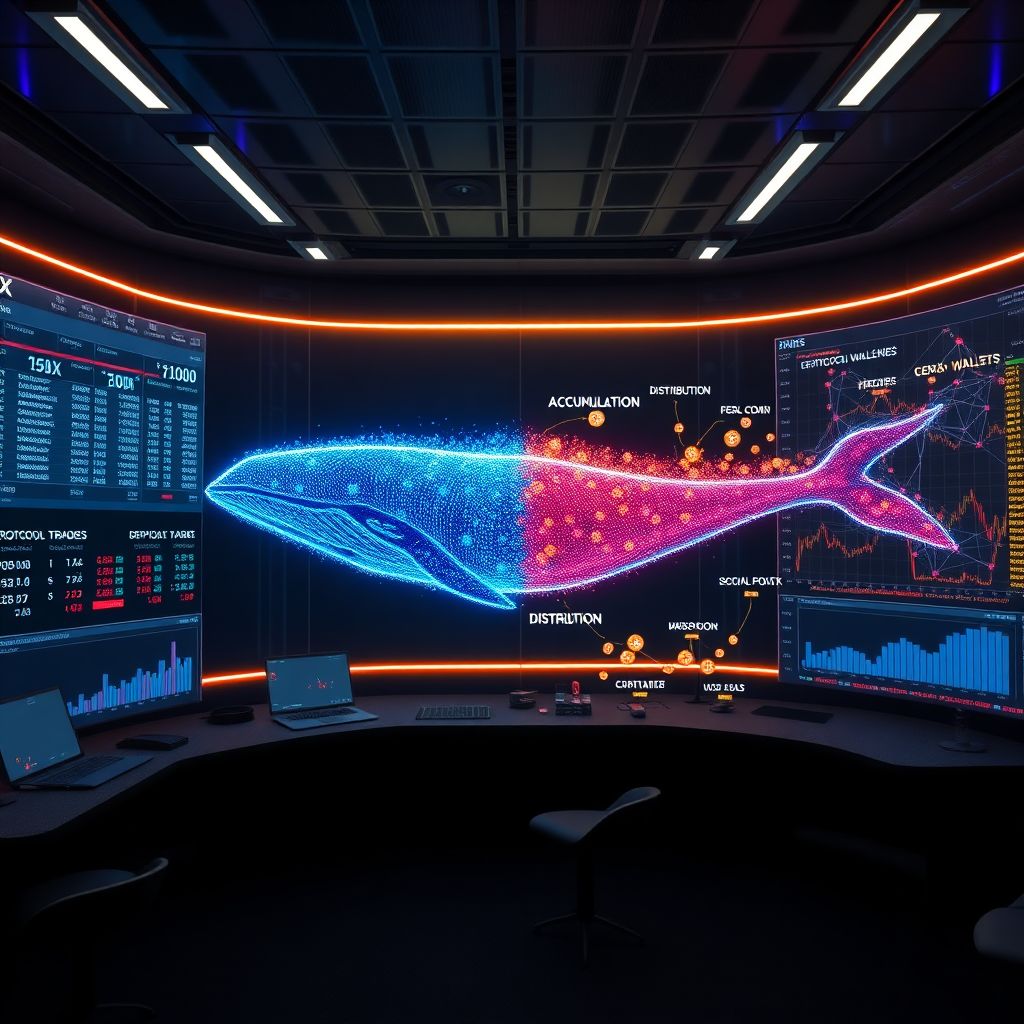
Why Whale Accumulation vs Distribution Matters More in 2025 Than Ever
Крипторынок повзрослел, а киты — нет
In 2025 the crypto market looks way less like a casino and way more like a weird hybrid of TradFi and social media. ETFs on majors are live, big banks quietly run liquidity desks, and yet price still jumps 15% in a day because a couple of whales decide to move coins. That’s why understanding whale accumulation vs distribution isn’t some nerdy side quest, it’s your early‑warning system. When you learn how to read on-chain data signals for whale buying and selling, you stop reacting to candles and start anticipating them, especially around narratives like AI tokens, RWAs and restaking that can pump purely on capital rotation from a handful of big players.
Accumulation vs распределение по-простому
Think of whale accumulation as “smart money quietly loading the truck,” while distribution is “the same guys unloading on everyone who’s late to the party.” Accumulation usually shows up as large addresses adding to their stack over weeks while price chops sideways or even drifts down, often when retail is bored or scared. Distribution is the opposite: price is euphoric, social media screams “new paradigm,” but big wallets start sending coins to exchanges and OTC desks. If you can reliably spot that flip from net inflows to net outflows on key whale cohorts, you don’t need to nail tops and bottoms; you just need to stop buying into distribution and stop panic‑selling into heavy accumulation.
Modern On-Chain Whale Accumulation Indicators That Actually Work
Как сейчас реально смотрят накопление китов
Back in 2020 people stared at single whale addresses like they were celebrity wallets. In 2025, on-chain whale accumulation indicators are way more nuanced. Analysts group wallets into cohorts: centralized exchanges, market makers, protocols, funds, “old money” self‑custody whales and even tagged airdrop farmers. Instead of asking “is one big wallet buying,” you look at whether the top 1% of non-exchange addresses are steadily growing their balance while retail flows to CEX hot wallets. When that cohort adds during low volatility, especially after a washout event, it’s often the cleanest clue that risk‑reward has flipped in your favor, even if the chart still looks depressing.
Real case: как киты выкупали дно после регуляторного шторма
A very real pattern showed up after the 2024 U.S. regulatory scare that nuked mid-cap alts. On the surface, prices kept bleeding, funding stayed negative, and Twitter was full of doomsday threads. But if you dug into on-chain data, you saw long‑dormant whale wallets steadily absorbing coins from panicked sellers, mostly via DEX routes that never briefly touched centralized exchange wallets. This quiet build-up went on for weeks. By the time headlines finally turned from “crypto crackdown” to “crypto resilience,” those whales had already locked in dirt‑cheap entries. Anyone watching those flows instead of just charts had the confidence to buy when it felt emotionally wrong but structurally right.
How to Detect Whale Accumulation in Crypto Markets Without Fooling Yourself
Три условия, без которых сигналы не стоят ничего
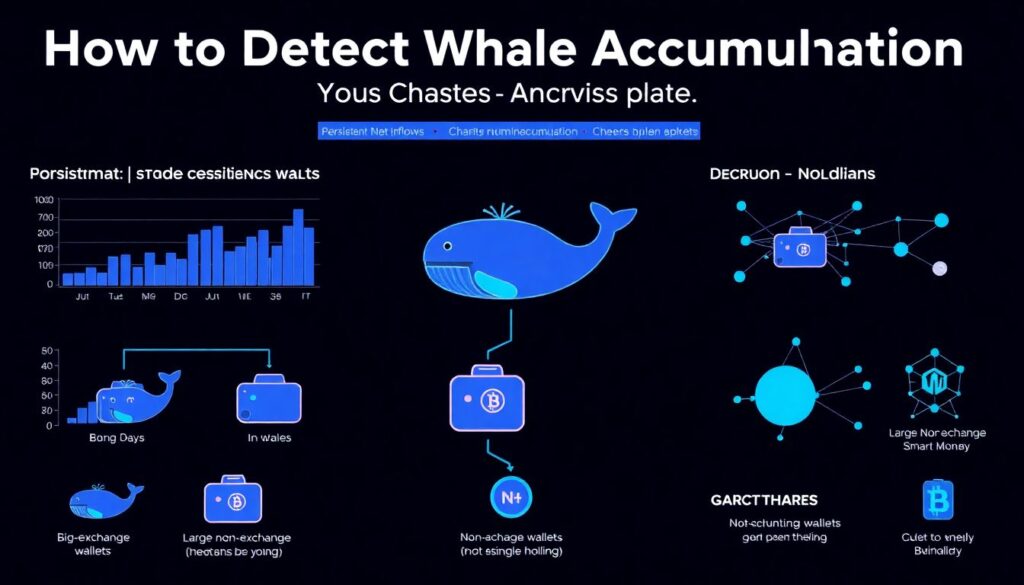
If you want to know how to detect whale accumulation in crypto markets without chasing every random spike, you need three conditions lining up. First, persistent net inflows to large non-exchange wallets over multiple days or weeks, not just a single huge transaction. Second, decreasing balances on exchanges for that asset, ideally alongside low perpetual funding, telling you coins are leaving the trading arena instead of just rotating. Third, muted hype: social interest flat or even declining while those flows build. When these pieces align, the odds are good you’re seeing genuine positioning, not a whale playing games with their own addresses to create noise.
Неочевидное решение: игнорировать “слишком красивые” сигналы
One counterintuitive trick in 2025 is learning to ignore signals that look perfect at first glance. Some sophisticated desks now intentionally fragment flows across hundreds of fresh wallets to confuse basic dashboards that brag about on-chain whale accumulation indicators but don’t have strong clustering logic. If you see sudden “accumulation” scattered across many brand‑new wallets with no interaction history, be skeptical. Real accumulation tends to cluster in wallets with some track record: previous participation in governance, staking, or DeFi strategies. The non‑obvious move is to focus on cohorts with a verifiable on-chain identity, even if that means watching fewer addresses but trusting the signal more.
Whale Distribution: Reading Exit Patterns Before the Rug
Как выглядит продуманная раздача на ончейне
When whales distribute in 2025, it rarely looks like a single mega‑deposit to Binance followed by an instant crash. More often it’s a slow bleed: steady streams of mid‑sized deposits into CEX hot wallets, combined with DEX selling into deep liquidity pools that rebalance through aggregators. Good crypto whale distribution on-chain analysis tools highlight rising exchange inflows from older wallets exactly when social metrics and price both spike. The trick is to note when long‑term holders, not short‑term traders, become net sellers. That change in holder composition often precedes a local or even macro top, especially in thin‑float tokens where a few whales control most circulating supply.
Real case: как киты вышли из модного AI-токена
Take a fictional but very plausible AI token that pumped hard in early 2025 off the back of another LLM narrative wave. Retail piled in, TikTok clips promised “passive AI income,” and price ripped 6x in a month. On-chain, though, large early wallets that had barely moved for a year started doing something subtle: routing tokens into a mix of DEX pools and multiple CEXs in 5–10% chunks. Price still climbed because aggressive buyers kept absorbing. But supply was quietly changing hands. A week later, the narrative cooled, CEX order books were stuffed with fresh whale inventory, and downside liquidity vanished. Holders who watched those slow distribution flows weren’t surprised by the sharp 50% drawdown.
Alternative Methods: Beyond the Usual Dashboards
Кластеризация и поведение вместо тупого подсчёта адресов
A lot of people still treat whale tracking like counting big addresses and calling it a day. In 2025 that’s outdated. Serious analysts lean on behavioral clustering: grouping wallets by habits rather than just size. For example, a cluster that always provides liquidity to the same DEX pair, stakes in certain validators, and joins specific governance votes is likely a fund or sophisticated desk. Watching whether that cluster flips from LPing to withdrawing and parking stablecoins can be more telling than simple balances. This approach turns your toolkit of crypto whale distribution on-chain analysis tools into a way to map entire strategies instead of chasing single “mystery whales.”
Комбинируем ончейн с деривативами и соцсигналами
Another underrated alternative method is mixing on-chain with derivatives and social data instead of treating each dataset in isolation. If you see strong on-chain accumulation but perps open interest exploding with high positive funding, that can mean whales are hedging their spot buys, not betting on immediate upside. Conversely, if on-chain distribution is mild but open interest collapses and social buzz dies, a lot of selling may already be done. In 2025, data vendors give you cross‑stack dashboards, so your on-chain data signals for whale buying and selling should always be read next to funding, options skew, and even Telegram or X sentiment, otherwise you’re only seeing half the story.
What’s the Best On-Chain Analytics Platform for Whale Tracking in 2025?
Выбираем не бренд, а глубину ончейн‑модели
Everyone wants the best on-chain analytics platform for whale tracking, but the answer depends less on brand names and more on how they handle address labeling, entity clustering, and coverage of L2s and appchains. In 2025, ignoring L2 activity is a big blind spot, because many whales now prefer cheap execution and more privacy by operating on rollups, then bridging only when necessary. A truly good platform lets you follow whale flows across L1, major L2s, and even restaking layers, with clear tags for CEXs, funds, market makers, and protocol treasuries. The platform that wins for you is the one that lets you test your own hypotheses rather than forcing you into canned metrics.
Неочевидный критерий: насколько удобно копать руками
One surprisingly important factor is how easy it is to do manual digging when the default dashboards don’t fully explain a move. Sometimes the best on-chain analytics platform for whale tracking is the one that lets you pivot fast: click from a big transaction into its counterparties, check historical behavior of that wallet cluster, and export raw data if you need custom queries. In a heated market, you don’t have time to fight UI friction. Tools that surface anomalies automatically but also let you investigate them deeply are the ones that will still be useful in three years, when today’s flashy indicators become tomorrow’s background noise.
Pro Lifehacks: How Professionals Use Whale Data in 2025
Смотрим не только “что делают киты”, а “кто именно это делает”
Professionals in 2025 don’t stop at “whales are buying” or “whales are selling.” They care which whales. A long‑only crypto fund accumulating a position into weakness means something very different from a high‑frequency market maker rotating inventory. One of the best practical lifehacks is to build your own internal “rolodex” of whale entities: tag clusters as long‑term believers, mercenary liquidity, airdrop farmers, or protocol treasuries. Then, when on-chain whale accumulation indicators fire, you can quickly see whether it’s the kind of whale whose track record you actually want to follow, not just raw size that might be hedged or arbitrage‑driven.
Снижаем шум: фильтруем по контексту и таймфрейму
Another pro tip is aggressive noise filtering. Not every big move is a signal, especially in an era of cross‑chain bridges, wrapper tokens and protocol migrations. Before reacting, pros check context: is there a big unlock, a governance decision, or a token migration that explains the flow? They also pick clear timeframes: zooming into the 5‑minute chart of flows is a fantastic way to get chopped. Instead, many desks focus on daily or even weekly net change in whale balances and exchange holdings. That slower lens lines up better with how big players actually build or unwind positions, giving you cleaner conviction instead of intraday paranoia.
Как киты помогают с риск‑менеджментом, а не только с входами
The last advanced lifehack is using whale data for risk management, not just entries. If your thesis is bullish but you see sustained distribution from early investors and protocol treasuries while price grinds up, you might still play the trend but size down, tighten invalidation, or avoid chasing leverage. Likewise, if you’re nervous about macro but whales keep soaking up supply on every dip and exchange balances trend down, you might stay allocated rather than fully derisking. In 2025, the edge isn’t only “front‑running whales,” it’s aligning your exposure with the flow of capital those whales represent.
Заключение: on-chain паттерны как язык поведения капитала
Чему нас научил рынок к 2025 году
By 2025, serious traders treat on-chain like a language for reading capital behavior, not a magic oracle. Whale accumulation vs distribution is just grammar: who is building risk, who is unloading it, and how that lines up with narratives, liquidity and macro conditions. When you combine solid tools, an understanding of crypto whale distribution on-chain analysis tools, and a healthy dose of skepticism, you stop being the exit liquidity for better‑informed players. You won’t catch every move, but you can dramatically cut the number of times you’re buying right into their distribution or selling the exact coins they’ve been patiently accumulating for weeks.