
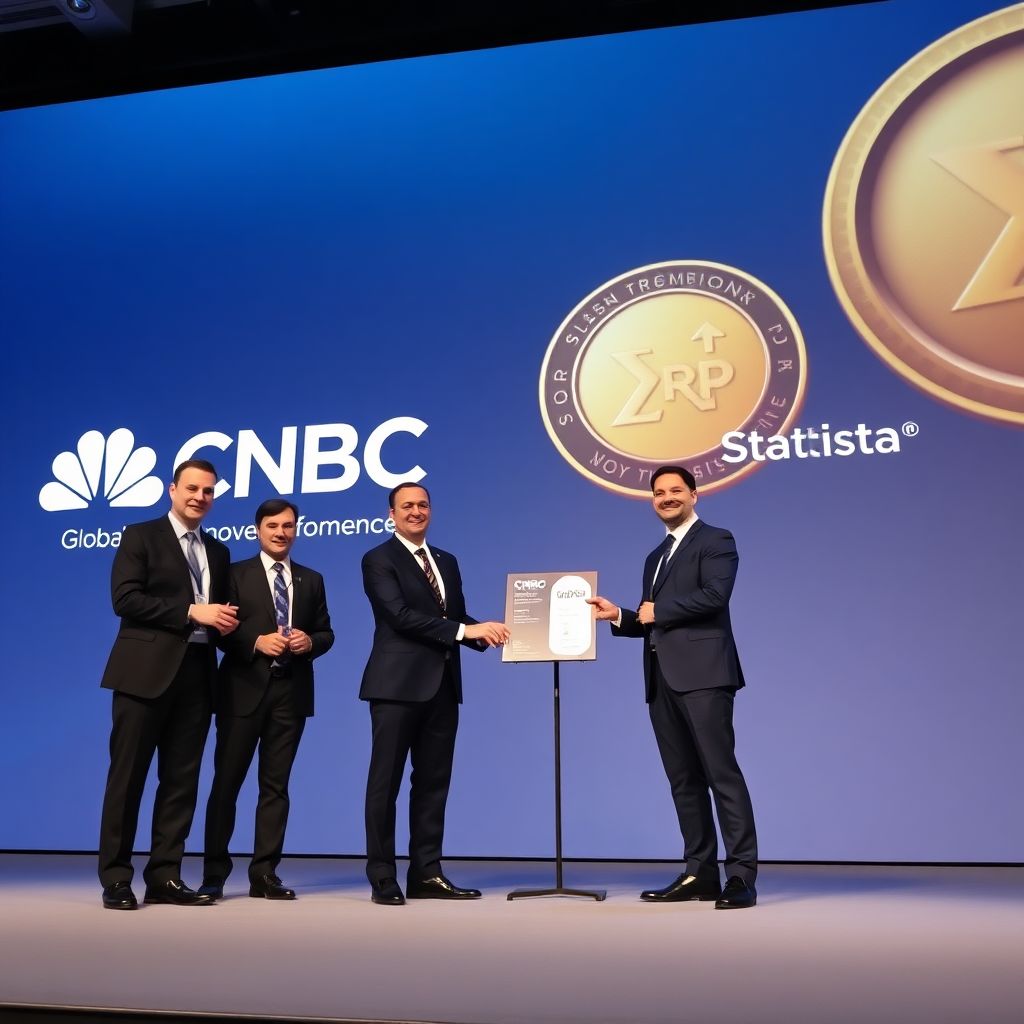
Ripple has secured a spot on CNBC and Statista’s “World’s Top Fintech Companies” list for the fourth year in a row, underscoring its position as one of the more established players in the digital asset and financial infrastructure space. The accolade highlights Ripple’s work across payments, custody, tokenization, and broader digital asset infrastructure – but it is essential to separate this corporate recognition from any direct endorsement or adoption of the XRP token.
This acknowledgment is explicitly about Ripple as a company, not about the market performance or institutional use of XRP. That distinction is often blurred in crypto discussions, yet it is crucial for understanding what this news actually means. CNBC and Statista assess fintech companies on a range of business-related criteria, and Ripple appears in the “Digital Assets” category, reflecting its enterprise-grade blockchain solutions rather than token speculation.
For XRP holders, the news is certainly helpful from a brand visibility and legitimacy standpoint. Ripple’s ongoing appearance in a respected fintech ranking reinforces that it is a serious player in the financial technology arena. However, it does not equate to a bank integrating XRP, a new cross-border payment corridor going live, or a formal endorsement of the token by mainstream media or research firms. It is, fundamentally, a corporate recognition story – and while that is meaningful, it should not be overstated.
Crypto-native audiences often evaluate companies primarily through token lenses: price charts, on-chain activity, exchange listings, regulatory battles, developer ecosystems, and liquidity. In contrast, the traditional fintech world looks at an entirely different set of indicators: revenue growth, client base, product maturity, risk management, compliance frameworks, and market positioning. Ripple has long straddled both of these worlds.
On one side, Ripple is deeply tied to the XRP Ledger and supported by a substantial token community. On the other, it functions as a B2B infrastructure provider offering cross-border payments solutions, institutional custody, and tokenization tools. This dual identity means that gaining recognition in mainstream fintech circles can influence how banks, payment processors, institutional investors, and enterprise clients perceive the company’s credibility and stability.
Being listed by CNBC and Statista does not alter Ripple’s financials or product capabilities overnight, but it contributes to a narrative that the firm is more than a speculative crypto play. For institutions that must justify their vendor choices to regulators, boards, and auditors, the fact that a partner appears consistently in global fintech rankings can be a subtle but important trust signal.
Ripple is often reduced to a single narrative depending on who is speaking. For some observers, it is “the XRP company.” For others, it is a cross-border payments specialist. To regulators, it has become a case study in how digital asset firms navigate securities law and compliance. In recent years, Ripple has been deliberately broadening that story, expanding into institutional custody, stablecoins, tokenization services for real-world assets, and prime-brokerage-like offerings for digital assets.
This strategic diversification is likely one of the reasons Ripple continues to surface in fintech rankings. Enterprise customers are not interested in social media hype or token tribalism; they are focused on operational reliability, regulatory alignment, security standards, and the ability to support complex cross-border settlement. Maintaining a presence in mainstream industry lists signals that Ripple is playing a long-term infrastructure game rather than chasing short-term token pumps.
At the same time, it is important to keep the XRP angle in perspective. Corporate prestige may open doors, but sustained demand for XRP as an asset will still depend on fundamentals: real usage of the XRP Ledger in payment and liquidity flows, the design and adoption of Ripple’s products that make use of XRP, how liquid and accessible the token is across markets, and the broader macro environment for digital assets. A fintech ranking, by itself, does not translate into higher on-chain volumes or guaranteed price appreciation.
The existence of a dedicated “Digital Assets” category in the CNBC and Statista rankings is significant in its own right. It shows that crypto and blockchain firms are increasingly being treated as a defined segment within the broader fintech universe, rather than as a fringe or purely speculative niche. Companies in this category are being evaluated alongside established infrastructure providers, which implies higher expectations around governance, resilience, and product viability.
Competition within this digital assets segment is intensifying. Exchanges, on-chain infrastructure providers, custodians, tokenization platforms, and payments networks all vie for enterprise relationships. To stay on such a list for four consecutive years suggests that Ripple has managed to maintain relevance and operational continuity in a volatile sector where many players rise rapidly and disappear just as quickly. In an industry littered with failed exchanges, distressed lenders, and abandoned token projects, multi-year recognition is non-trivial.
For Ripple, this continuity supports the view that it has evolved into one of the more durable firms in the digital asset landscape. Longevity matters to institutions that are wary of counterparty risk; a bank or payment company does not want to integrate with a provider that may be gone in two years. Repeated appearances in top fintech rankings strengthen the perception that Ripple is planning for the next decade, not just the next market cycle.
It is equally important to clarify what this recognition does not represent. Being named to the list does not mean CNBC or Statista recommend buying XRP. It does not imply that major financial institutions are using the token at scale or that regulatory questions around it have vanished. Nor does it confirm that Ripple’s technology is superior to every other blockchain or payment rail. The ranking is an acknowledgment of business performance and positioning, not a verdict on investment merit.
From a strategic standpoint, mainstream recognition can still deliver tangible benefits for Ripple’s institutional ambitions. It can make it easier to initiate conversations with conservative financial institutions that might otherwise hesitate to engage with a company associated with crypto. It may also enhance Ripple’s ability to attract senior talent, particularly executives and engineers who want to work for firms that are seen as leaders, not experiments.
For investors and observers trying to interpret this development, the most balanced view is to treat it as one piece of a larger puzzle. Ripple’s place on a top fintech list signals that the company continues to build and maintain relationships in the traditional financial sector, expand its product footprint, and pass external benchmarks of relevance. That is positive, but it is not a shortcut around the hard work required to drive genuine adoption of its technology stack and, where applicable, its associated token.
In a broader sense, Ripple’s repeated appearance in such rankings also illustrates the maturation of the digital asset industry. The line between “crypto company” and “fintech infrastructure provider” is blurring as firms build regulated products, enterprise-grade tooling, and long-term partnerships with existing financial institutions. Recognition from established evaluators helps normalize this transition and accelerates the integration of blockchain-based systems into mainstream finance.
For anyone following Ripple, the key takeaway is twofold: the company continues to be viewed as a serious fintech infrastructure player, and it continues to operate in a space where perception and reality must be carefully separated. Brand recognition can support growth and credibility, but only sustained product execution, real-world usage, and regulatory clarity will determine the long-term trajectory of both Ripple the company and XRP as a digital asset.