
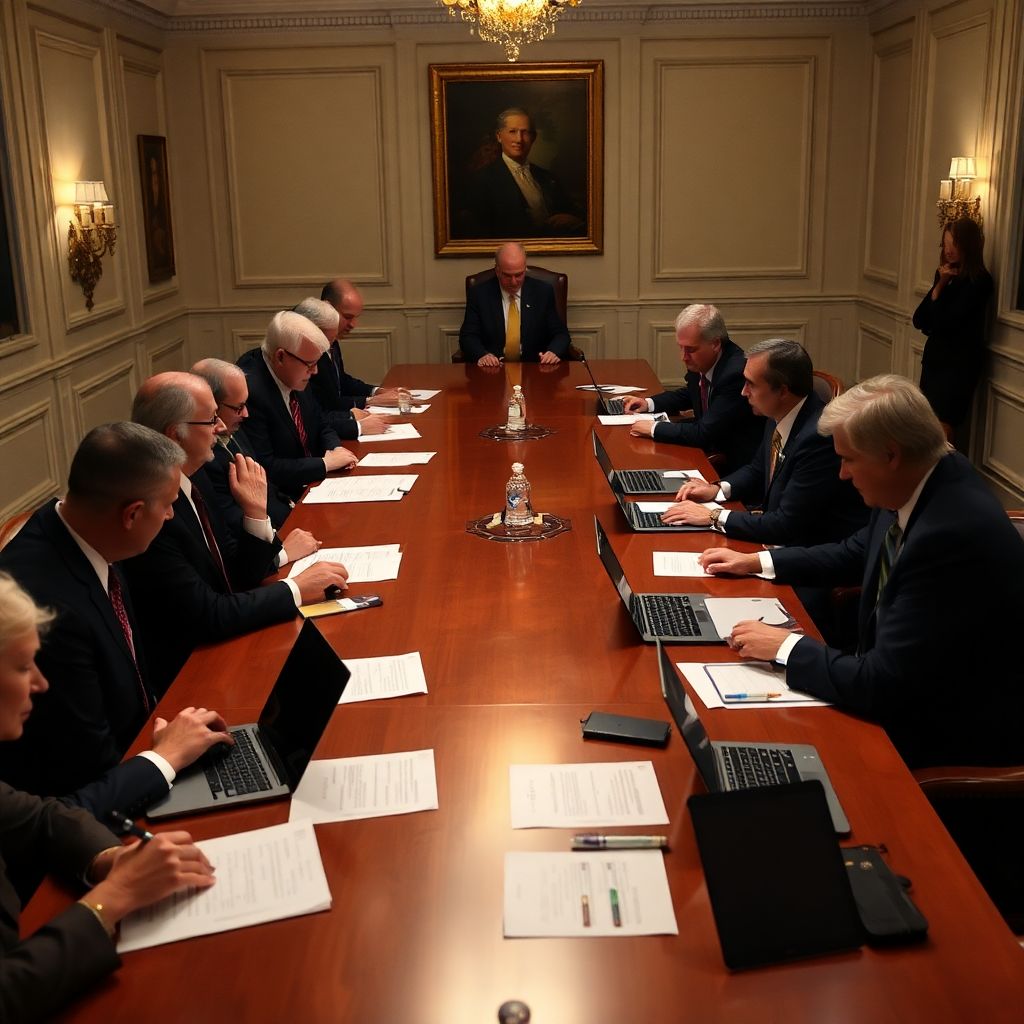
“Laughable” ethics deal? Inside the White House-Democrats showdown over the CLARITY Act
Negotiations over the crypto-focused CLARITY Act have run into a major obstacle, and it has nothing to do with technical definitions of digital assets. The fight is now centered on ethics: who enforces the rules, and whether President Donald Trump’s past crypto activity can be brought under scrutiny.
According to people close to the talks, the White House and Senate Democrats are deadlocked on two central issues.
First, Senate Democrats are insisting that state Attorneys General (AGs) play a direct role in enforcing the bill’s ethics provisions. They argue that giving only federal authorities the power to act could weaken oversight and politicize enforcement. The White House, however, wants the Department of Justice to have sole authority in handling ethics-related violations under the bill, effectively sidelining state-level enforcers.
Second, several Democrats want the legislation to include provisions that could hold President Trump accountable for his previous crypto dealings. Trump is reported to have made over 1.4 billion dollars in crypto-related profits in 2025, even as many investors in his associated memecoins and tokens suffered sharp losses. That imbalance has fueled Democratic demands for stronger, retroactive-style ethics language that would explicitly address these activities.
The White House has firmly rejected that approach. Chief Crypto Advisor Patrick Witt has publicly dismissed the idea of targeting Trump’s past crypto behavior as legally untenable, branding it “blatantly unconstitutional.” In essence, the administration’s position is that any ethics regime must apply prospectively, not reach back to punish actions taken before the rules were in place. Witt has argued that if Democrats insist on retroactive punishment, there is “literally nothing that can be done” to satisfy them within constitutional bounds.
Not all legal and policy experts are impressed by the compromise text that the White House is currently backing. Amanda Fischer, a former Chief of Staff at the SEC and a prominent voice among pro-Democrat policy analysts, has derided the proposal as “laughable.” Her criticism goes beyond the retroactivity question and focuses on what she sees as weak structural safeguards.
Under the current draft, the president would have a one-year grace period to place crypto-related business interests into a blind trust. During that time, there would be no requirement to sell or fully divest. Even after the assets are moved, the proposal does not prohibit earning interest income from those holdings. For critics like Fischer, this leaves enormous room for conflicts of interest to persist in practice.
The penalties envisioned in the ethics language are another flashpoint. Even if a president or senior official is found to have violated the rules, the maximum fine would be capped at 500,000 dollars. Fischer and others argue that, in the context of billion-dollar portfolios and potentially massive gains from regulatory decisions, such a cap is too low to serve as a real deterrent. In her view, the framework barely inconveniences existing arrangements and does little to halt what she calls Trump’s “crypto grift.”
Critics are particularly troubled by enforcement design. The draft reportedly leans heavily on the president’s own legal team to help police compliance, with Trump’s personal attorney Todd Blanche expected to play a central role in ensuring the rules are followed. That self-policing model, opponents say, invites abuse: the same team with a direct interest in preserving the president’s financial position is being asked to enforce restrictions on it.
Another controversial feature is what some have described as an effective amnesty. Once a new president is inaugurated, prior potential violations under the crypto ethics regime would be wiped clean. That sunset mechanism could encourage officeholders to push the limits early in their term while counting on eventual immunity.
Equally contentious is who the rules cover-and who they do not. The proposal aims its restrictions squarely at the president, senior administration officials, and members of Congress. However, it notably exempts their adult children and other immediate family members. That carve-out could create a wide-open channel for influence and profiteering, critics warn, allowing political families to profit from decisions they help shape while staying technically within the law.
These concerns have united a group of Senate Democrats against the ethics language as currently drafted. Senators Angela Alsobrooks, Ruben Gallego, and at least five of their colleagues have signaled that they cannot support the CLARITY Act in its present form. Their objections reach beyond ethics alone; they argue the entire bill needs stronger guardrails.
In a joint posture, they have asserted that the Republican-authored text falls short in several core areas: ethics rules for elected officials, consumer protections for crypto users, measures to curb illicit finance, conflict-of-interest safeguards, and basic market integrity. The message is that the bill, in its current incarnation, is too friendly to industry players and too lenient toward those in power who could benefit from regulatory decisions.
This stance is all the more striking because Alsobrooks and Gallego had previously broken with much of their party by voting for the bill at the committee stage. Their early support helped move the CLARITY Act out of markup and was widely interpreted as a sign that bipartisan agreement was within reach. Their subsequent resistance underscores how the ethics fight has changed the political calculus.
For Republicans, this creates a serious arithmetic problem. To overcome a filibuster and clear the 60-vote hurdle in the Senate, GOP leaders will need roughly 7 to 10 Democratic votes at the final floor stage. The same Democrats who once seemed open to compromise have now become pivotal holdouts. Without them, the bill’s path to passage narrows dramatically.
The impasse is playing out in parallel with a highly sensitive market backdrop. Bitcoin, which had surged close to 67,000 dollars earlier in the week, slipped back to around 65,700 dollars as news of the ethics dispute emerged. Although short-term price moves are driven by a mix of technical and macroeconomic factors, traders are closely watching the CLARITY Act as a signal of Washington’s regulatory direction. Delays or signs of legislative collapse tend to inject uncertainty, which can cool bullish sentiment in the near term.
Behind all this maneuvering lies a deeper clash over how to regulate the intersection of political power and digital assets. Supporters of stricter rules argue that crypto markets, with their speed, opacity, and global reach, are uniquely vulnerable to conflicts of interest when top officials hold large stakes. They warn that a president with extensive crypto holdings could benefit enormously-directly or indirectly-from decisions about enforcement priorities, token classifications, or access to banking services.
Republicans and the White House, meanwhile, are walking a tightrope between ethics optics and their broader pro-innovation message. They insist the administration is not against transparency or guardrails, but they reject anything that looks like retroactive punishment or what they see as an attempt to weaponize ethics law against Trump personally. From their perspective, the bill should set forward-looking standards without singling out any one officeholder.
At the same time, industry stakeholders are watching the debate with mixed feelings. On one hand, the CLARITY Act promises a more predictable regulatory environment, which many companies have long requested. On the other, an aggressive ethics regime that targets political figures’ holdings could shift attention toward more stringent oversight of large crypto positions held by corporate insiders and major market players. The final shape of the ethics chapter could signal how far lawmakers are willing to go in policing conflicts of interest throughout the ecosystem.
Democrats pushing for tougher language argue that anything less than meaningful divestment requirements risks public trust. They point to traditional ethics standards that have demanded presidents and cabinet officials reduce or blind their exposure to sectors they regulate. In their view, crypto-because of its volatility and the ease with which prices can react to a single policy signal-demands even stricter separation than conventional asset classes.
There is also a strategic angle: some Democrats believe that making ethics the centerpiece of their critique puts Republicans on the defensive without forcing them to argue against crypto itself. Rather than framing the fight as pro- or anti-innovation, they are casting it as a question of whether political leaders should be allowed to profit from the digital asset boom they are supposed to supervise.
For now, negotiators are exploring possible off-ramps. One option under discussion is to expand the list of covered individuals to include adult children and immediate family members, closing a glaring loophole without touching Trump’s past activities directly. Another potential compromise could raise the maximum penalties and remove any suggestion of automatic amnesty, making the enforcement regime more credible in the eyes of critics.
A third line of compromise could involve a more independent enforcement mechanism. Instead of leaving compliance largely in the hands of the Department of Justice or the president’s personal legal team, some proposals have floated the idea of a dedicated ethics monitor or a specialized office within an existing agency. That body could be tasked specifically with overseeing digital asset-related conflicts of interest among top officeholders.
Whether any of these ideas can bridge the current divide remains uncertain. For Democrats who view Trump’s prior 1.4 billion in crypto profits as emblematic of a broader problem, forward-only rules may feel like too little, too late. For the White House, however, conceding anything that appears to retroactively target the president would likely be a red line.
What is clear is that the CLARITY Act is no longer just a dry piece of crypto legislation. It has become a litmus test for how Washington intends to handle the explosive mix of political power, personal wealth, and digital assets. The outcome will shape not only the regulatory environment for cryptocurrencies, but also the expectations voters have for how their leaders conduct themselves in an era where a single token listing-or a single presidential tweet-can move billions.