
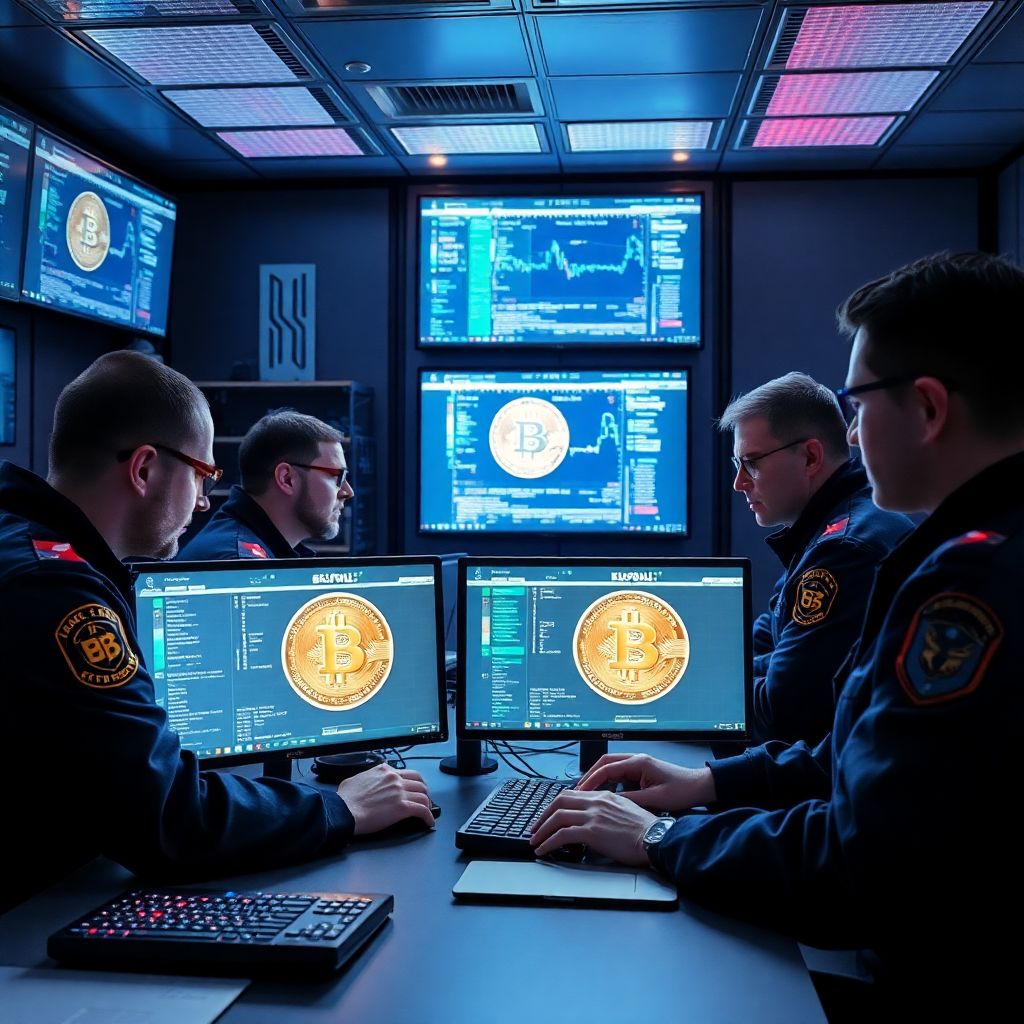
Irish law enforcement has confiscated another 500 Bitcoin tied to criminal activity, pushing the Criminal Assets Bureau’s (CAB) total Bitcoin seizures in 2026 to 1,500 BTC. At current market prices, that haul is valued at roughly 92.4 million dollars, underscoring how central cryptocurrencies have become in major criminal investigations.
According to CAB, the latest operation was carried out in close cooperation with Europol’s European Cybercrime Centre. Europol provided key operational coordination, technical expertise and decryption support, helping investigators gain access to the funds and secure them. The newly seized 500 BTC are estimated to be worth about 27 million euros, or just over 30 million dollars.
Officials have declined to reveal the identity of the wallet owner or provide any further specifics about the ongoing investigation. CAB stated that it would not comment beyond confirming the seizure, a common stance when operations are still active or when revealing more could compromise techniques and future cases.
This is the second large Bitcoin confiscation announced by CAB this year, following a previous recovery of 500 BTC in March. That earlier seizure drew widespread attention after Irish media linked it to Clifton Collins, a convicted drug trafficker whose case has become something of a cautionary tale in crypto circles.
Reports at the time indicated that the wallet accessed in March was one of a dozen Bitcoin wallets once controlled by Collins. In the early 2010s, he is believed to have amassed around 6,000 BTC, distributing them across 12 separate addresses as a rudimentary security measure. He allegedly recorded all the private keys on a single sheet of A4 paper, which he then hid in the aluminum cap of a fishing rod case at his rented home.
After Collins’ 2017 arrest, which followed the discovery of cannabis in his car, his landlord reportedly cleared out his belongings from the property. Collins later claimed the fishing rod case – and therefore the piece of paper storing his private keys – had been stolen before the landlord entered the premises. For years, the story circulated as an example of how a fortune in Bitcoin could be effectively lost forever due to poor key management and bad luck.
Although CAB has not confirmed whether the latest 500-BTC seizure is directly connected to Collins, blockchain activity suggests a possible link. On Thursday, an address associated by analysts with the Collins stash moved 500 Bitcoin to an unknown wallet. Data from a blockchain analytics provider shows that wallets tied to Collins still hold around 4,500 BTC, valued at roughly 277 million dollars as of Friday.
The reactivation of a long-dormant, Collins-linked wallet is particularly striking. For years, those coins appeared to be inert, reinforcing the narrative that they were permanently inaccessible. The recent on-chain movements now raise questions: were the keys never truly lost, did law enforcement finally crack the wallets, or is a third party involved? With authorities keeping details under wraps, much of this remains speculative, but the renewed activity alone has been enough to capture the attention of both investigators and market watchers.
From a legal and policy standpoint, the Irish Bitcoin seizures highlight how rapidly financial crime enforcement has adapted to the reality of digital assets. Just a few years ago, large-scale confiscations of cryptocurrency were relatively rare and technically challenging. Today, specialized cybercrime units, international intelligence sharing and advanced blockchain analytics make it increasingly difficult for criminals to hide behind pseudonymous addresses.
The partnership with Europol’s European Cybercrime Centre is a key part of that evolution. Rather than working in isolation, national agencies now tap into shared technical resources, decryption capabilities and cross-border intelligence. This is crucial in the crypto space, where funds can move across jurisdictions in seconds, and where servers, suspects and service providers often span multiple countries.
The Irish case also illustrates a nuanced reality about Bitcoin and criminal use. While Bitcoin is sometimes portrayed as a tool for anonymous illicit finance, its public blockchain can actually make it easier for skilled investigators to follow the money compared with traditional cash. Once law enforcement links an identity to an address, a complete transaction history becomes visible, often stretching back years. This transparency has turned old cases, previously thought to be dead ends, into live investigations once law enforcement gains new clues or improved tools.
For criminals, the Collins story carries a double warning: not only can a lifetime’s illicit earnings be seized by authorities, they can also be lost forever through basic operational errors like failing to back up private keys properly. In that sense, crypto combines the most unforgiving elements of both cash (irreversible once lost or stolen) and digital finance (permanently traceable on-chain).
For regulators and policymakers, high-profile seizures like Ireland’s are becoming a reference point in ongoing debates about how to handle digital assets. Many jurisdictions are tightening requirements around crypto exchanges, custodians and wallet providers, pushing them to implement rigorous know-your-customer and anti-money-laundering controls. The more law enforcement demonstrates the ability to trace and recover illegal funds, the stronger the argument that crypto can coexist with traditional financial oversight rather than sit outside it.
On the technology side, these cases showcase the growing sophistication of blockchain forensics. Investigators now routinely cluster addresses, identify patterns of mixing and obfuscation, and follow funds through complex transaction chains that may include decentralized services and cross-chain bridges. In some instances, authorities can even exert pressure on centralized exchanges or service providers where illicit coins eventually surface, freezing assets and obtaining user data through legal channels.
There are also practical questions around what happens to seized cryptocurrency. Different countries have experimented with strategies ranging from holding coins in government-controlled wallets to auctioning them off to the public. Volatility adds another layer of complexity: an asset worth tens of millions at the time of seizure could double or halve in value before any court case concludes. Whether Irish authorities will hold or liquidate the 1,500 BTC remains to be seen and could become a topic of domestic discussion as the cases progress.
From a broader market perspective, the Irish seizures fit into a year already dense with crypto-related regulatory and enforcement developments globally. While 1,500 BTC is a relatively small fraction of daily Bitcoin trading volume, the symbolic impact is significant. Each successful operation signals to both legitimate institutions and bad actors that digital assets are firmly within the reach of modern law enforcement.
For everyday crypto users, the unfolding situation in Ireland is a reminder of some core principles. Proper self-custody requires redundant, secure backups of private keys and recovery phrases, stored in multiple, well-protected locations. Relying on a single physical copy – as Collins allegedly did with his A4 sheet of paper – invites disaster, whether from loss, theft, or accidental destruction. At the same time, choosing compliant platforms and keeping clear transaction records can help demonstrate legitimate ownership if funds ever become entangled in investigations or disputes.
Looking ahead, experts expect more complex interactions between digital-asset markets, criminal investigations and evolving regulations. As blockchain technology continues to mature and new use cases emerge, the tools and legal frameworks used to police it will also advance. Ireland’s growing track record in large-scale Bitcoin seizures suggests that national agencies that invest early in cybercrime capabilities may be better positioned to protect their financial systems and recover illicit gains.
For now, what is clear is that 2026 has marked a turning point for Irish authorities in the crypto arena. With 1,500 BTC already seized this year and more questions than answers surrounding the remaining 4,500 BTC believed to be tied to Collins-linked wallets, the story of Ireland’s most famous lost-and-found Bitcoin fortune is still unfolding. Whether more of those coins will be recovered by the state, remain frozen on-chain, or move again in unexpected ways will likely shape future enforcement strategies and public perceptions of cryptocurrency for years to come.