
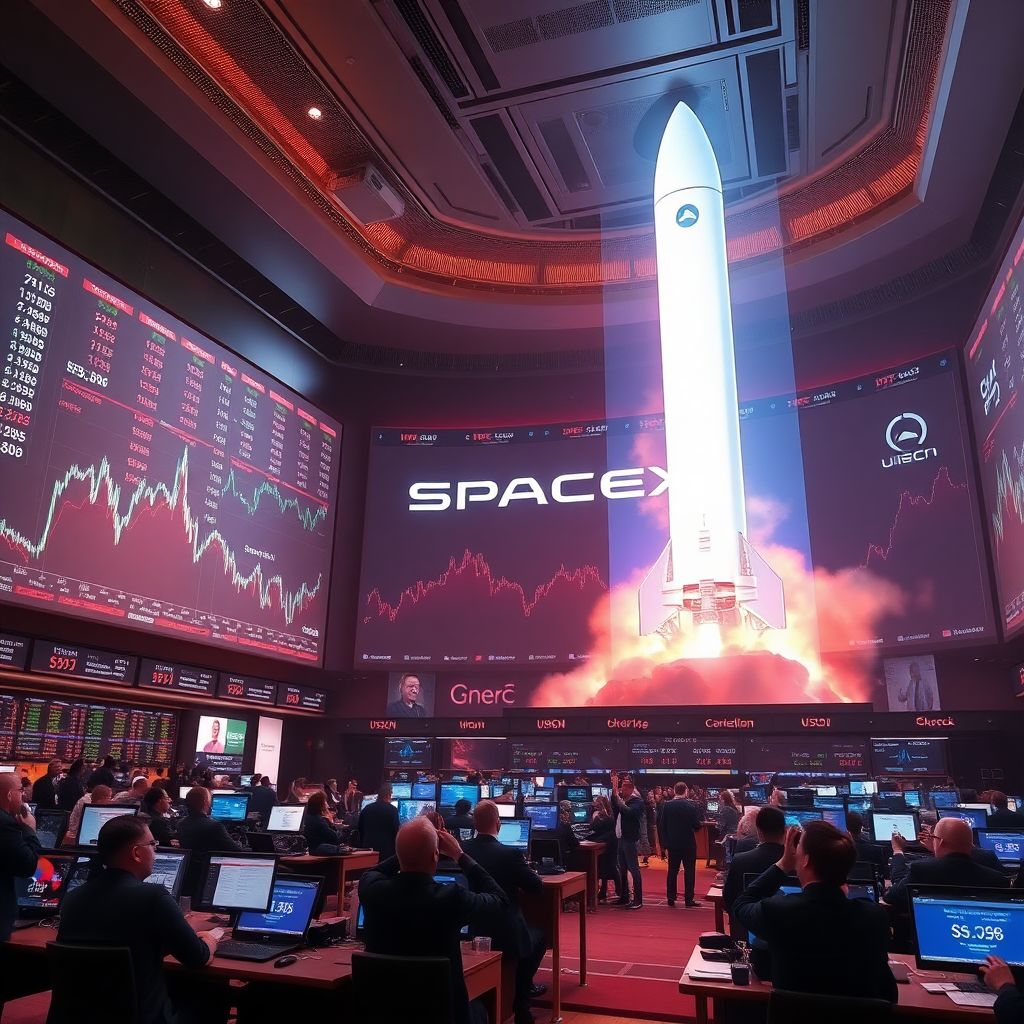
SpaceX’s long‑anticipated market debut is turning into a capital magnet of historic scale. According to reports, the offering has already pulled in more than $250 billion in investor demand-nearly four times the amount the company aims to raise. SpaceX is said to be seeking roughly $75 billion, a figure that-if finalized-would make it the largest IPO on record, alongside an implied valuation near $1.8 trillion.
Deal participants describe the order book as unusually aggressive, driven in part by long-only asset managers placing large allocations early. Even so, the final demand picture may keep shifting until the last moment, because some of the biggest institutional checks typically arrive late in the process. Pricing is expected Thursday, with the stock expected to begin trading Friday, based on the timeline circulating among market watchers.
A liquidity squeeze hits both tech and crypto
The fundraising wave is landing in an already tense environment. Markets have been choppy, and the timing is notable: US tech shares have slid, while crypto markets have shed more than $180 billion in total value over the past week. Analysts tracking cross‑asset flows say the synchronized dip looks less like a sudden loss of faith and more like a familiar pattern around blockbuster offerings-investors sell liquid positions to free cash for the new deal.
One research view frames the move as a “pre‑mega‑IPO liquidity squeeze,” where the market effectively pays an “IPO tax” ahead of a high‑profile listing. In that interpretation, the pullback is a temporary rotation, not necessarily the start of a broader downturn: capital is being reallocated from assets that can be sold instantly (large‑cap tech and major crypto tokens) into an IPO allocation that many funds don’t want to miss.
Why SpaceX demand is so extreme
SpaceX’s equity story isn’t built on hype alone. A major pillar is Starlink, its satellite internet business, widely seen as an increasingly meaningful engine of revenue and profitability. The company has also pointed investors to what it calls a $23 trillion market opportunity tied to its artificial intelligence offerings, further widening the narrative beyond launches and rockets.
Those elements help explain why the deal is drawing attention from both traditional institutions and a new class of traders seeking early exposure-sometimes through instruments that mimic a pre‑IPO market.
Exchanges race to offer “pre‑IPO” exposure
Crypto trading venues have moved quickly to capitalize on the frenzy. Several major exchanges-including Binance, Coinbase, Kraken and Bybit-have rolled out pre‑IPO perpetual futures tied to SpaceX (often labeled SPCX) in recent weeks. The pitch is straightforward: provide traders with market-style exposure to a famous private company before public trading begins.
Binance executives have characterized early activity as evidence of growing demand for “regulated‑style” exposure delivered through a native exchange product. On Binance alone, these pre‑IPO derivatives reportedly generated $2.1 billion in cumulative trading volume in 18 days, with participation spread across more than 130 countries.
Activity is also heavy on decentralized venues. On Hyperliquid, synthetic pre‑IPO SpaceX perpetuals recorded about $70 million in trading volume over 24 hours. Pricing has been volatile: the synthetic contract traded around $157, down from roughly $210 when the derivatives first launched. Despite the drop, interest remains elevated, with open interest exceeding $115 million on Hyperliquid alone-implying a still‑aggressive appetite for leveraged positioning. The pricing there has been read by traders as pointing to an implied valuation near $1.97 trillion, highlighting how quickly expectations can stretch when leverage enters the picture.
What this means for everyday investors and traders
The current setup is a classic example of how a single enormous listing can affect markets well beyond equities. When funds try to secure allocations, they often raise cash by trimming what’s easiest to sell-highly liquid tech names and large crypto positions. That can amplify downside moves and make unrelated charts look suddenly correlated.
For retail participants, the “pre‑IPO” derivatives trend adds another layer of complexity. These products can move on sentiment, implied valuations, and positioning-sometimes more than on fundamentals. The spread between synthetic prices and eventual IPO pricing can be wide, and leverage can turn small mispricings into large losses.
Additional context: why volatility may persist even after pricing
Even once the IPO is priced, the liquidity effect doesn’t always vanish overnight. Funds that receive smaller-than-requested allocations may rotate back into sold positions, while others may keep trimming risk to manage volatility around the first trading sessions. In other words, the squeeze can come in waves: pre‑pricing cash raising, post‑pricing repositioning, and then the first-week volatility as the market searches for a stable clearing price.
How to think about the “IPO tax” in crypto
Crypto often acts as a global, 24/7 liquidity pool. When large players need cash quickly, digital assets can be a convenient source of funds-especially during US market off-hours. That doesn’t mean crypto is uniquely weak; it means crypto is liquid. In a mega‑deal week, liquidity can become a feature that works against holders in the short term.
Derivatives are turning IPOs into tradable narratives
The rush to list pre‑IPO perps reflects a bigger shift: major events in traditional finance are increasingly becoming tradable stories in crypto markets before they fully unfold in equities. This can pull more attention-and more speculative capital-into the same headline, reinforcing a feedback loop: more hype, more volume, wider swings, and stronger spillovers into spot markets.
Bottom line
As reported, SpaceX’s IPO has amassed around $250 billion in demand against a planned $75 billion raise, approaching four-times oversubscription with a valuation discussed near $1.8 trillion. The timing coincides with a sharp dip in tech stocks and a $180 billion pullback in crypto, a pattern some analysts attribute to a liquidity squeeze as investors sell liquid holdings to fund IPO allocations. Meanwhile, both centralized and decentralized crypto venues are pushing pre‑IPO perpetual futures, with large volumes and high open interest showing how aggressively traders are trying to front‑run one of the biggest listings the market has ever seen.