
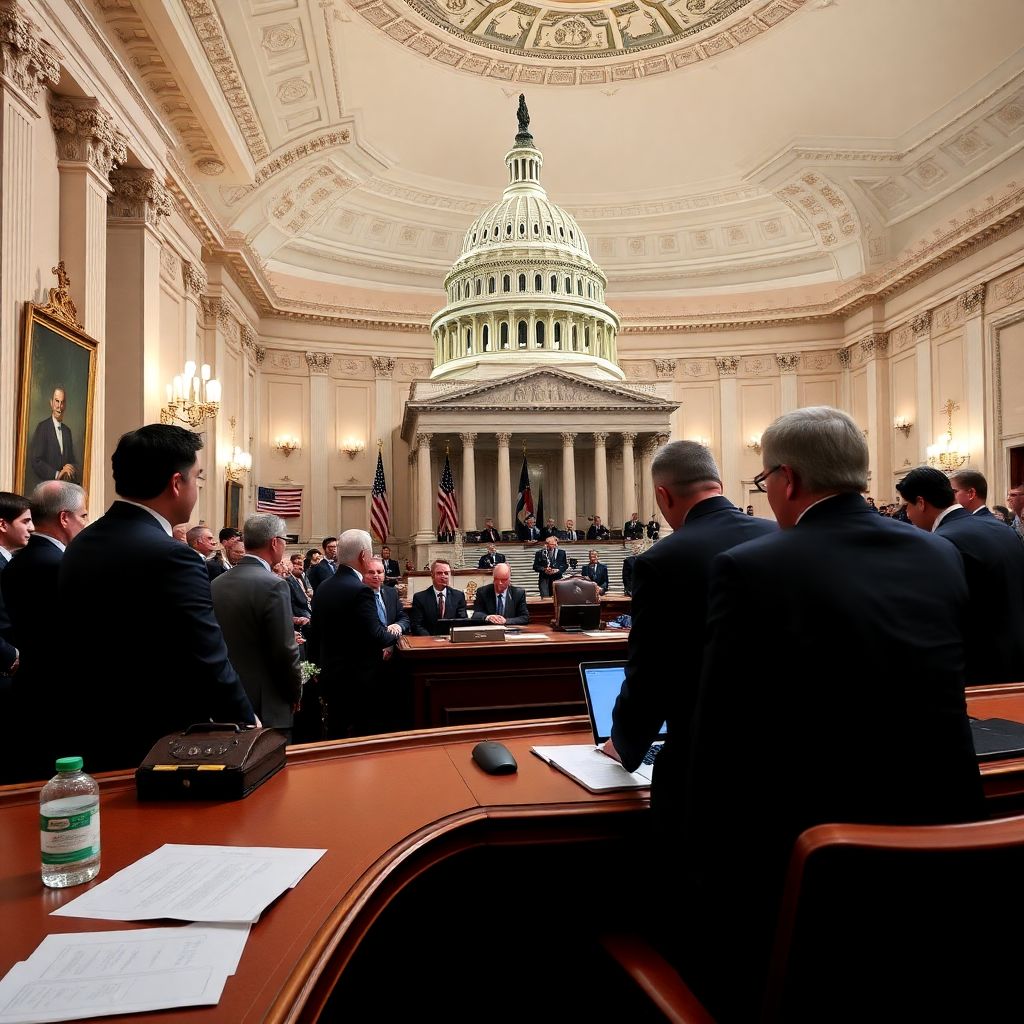
Senate Edges CLARITY Act Forward As August Target Still Within Reach
After clearing two major committee hurdles in the US Senate, the Digital Asset Market Clarity Act (often shortened to the CLARITY Act) has moved into its most fragile phase yet. The bill has momentum, but the window to get it to the President’s desk this year is narrow and crowded with both procedural and political obstacles.
The legislation advanced thanks to successful markups in the Senate Agriculture Committee and the Senate Banking Committee. Staff from both panels are now racing to merge their competing drafts into a single, unified version that can withstand scrutiny on the Senate floor. Until that reconciliation is complete, the CLARITY Act’s path forward remains uncertain.
Patrick Witt, executive director of the President’s Council of Advisors for Digital Assets, has indicated that the White House is still targeting early July for House passage, with July 4 flagged as a key milestone. That ambitious timetable underscores how aggressively the administration wants to push for regulatory clarity around digital assets before the political environment becomes even more volatile.
However, the calendar is only one part of the challenge. As reporter Eleanor Terrett has highlighted, unresolved substantive differences between the Agriculture Committee’s version and other Senate drafts are still being negotiated behind the scenes. Those negotiations will determine how much support the bill can attract across party lines, especially from key Democrats who are skeptical of loosening constraints on the cryptocurrency industry.
One of the central political tests is whether Senate Agriculture Committee Democrats can be brought on board. Because the CLARITY Act would almost certainly face a filibuster attempt, proponents need at least 60 votes to advance it, making bipartisan cooperation non‑negotiable. Without a cluster of Democratic votes from Agriculture and Banking, the bill is unlikely to survive a floor vote.
Inside the Banking Committee, Democrats Ruben Gallego and Angela Alsobrooks voted to move the bill out of committee, a significant win for supporters. Yet both lawmakers have made it clear their continued backing hinges on a separate, delicate negotiation: robust ethics rules for government officials who interact with or invest in digital assets. Gallego has suggested those discussions are close to wrapped up, but the political sensitivity around conflicts of interest means the exact language is still being fine‑tuned.
Senator Kirsten Gillibrand, one of the principal Democratic architects of the CLARITY Act, has repeatedly insisted that ethics safeguards are “non‑negotiable” if the bill is to retain Democratic support. That stance shapes every other compromise on the table. Tougher ethics language may reassure skeptics who fear regulatory capture, but pushback from some industry players signals concern that overbroad rules could deter knowledgeable public servants from engaging with the sector at all.
Beyond ethics, several Democrats want stronger enforcement‑related guarantees. Senators Mark Warner, Catherine Cortez Masto, and Raphael Warnock have pressed for clarity that law enforcement will retain sufficient tools to go after fraud, money laundering, and other abuses in decentralized finance (DeFi). They want to ensure the bill does not unintentionally erode existing powers to investigate and prosecute bad actors who exploit pseudonymous or non‑custodial crypto systems.
Industry representatives, however, warn that poorly drafted enforcement provisions could have unintended collateral damage. Some fear that efforts to tighten law‑enforcement powers around DeFi could erode protections for open‑source software developers, node operators, or protocol contributors who are not directly involved in illicit activity. According to these critics, conflating code writers with service providers could chill innovation and push development outside the United States.
The looming August congressional recess is widely viewed as an informal deadline. Once lawmakers leave Washington and pivot fully into campaign mode, floor time becomes scarce and leadership tends to shelve anything that is not absolutely essential or politically urgent. For crypto advocates, that means the CLARITY Act needs at least a Senate vote-or equally strong signs of forward movement-before the recess if it is to remain a priority.
Not everyone believes August is a hard stop, though. Some policy veterans argue that the political investment already sunk into the CLARITY Act gives it staying power beyond a single session’s calendar crunch. They contend that, unlike more obscure regulatory clean‑ups, this bill carries symbolic weight in the broader debate over whether the United States intends to compete seriously in digital asset innovation.
Adam Minehardt, chief policy officer at the Hyperliquid Policy Center and a former congressional staffer, has offered one of the more optimistic readings of the timeline. In his view, Washington often exaggerates the importance of specific dates. He notes that leadership on both sides has already spent considerable political capital debating and shaping the bill, making it unlikely they would abandon it abruptly unless the political environment changes dramatically.
Still, Minehardt concedes that slipping into next year would introduce new risks. The midterm elections could reshape the balance of power in both chambers, and any change in committee leadership or priorities could force back‑to‑square‑one negotiations. Crypto has gradually become a more visible political issue, but it is not yet entrenched enough to be fully insulated from sudden shifts in party agendas or leadership fights.
The broader stakes of the CLARITY Act go far beyond insider negotiations. For years, digital asset companies have complained about a “regulation by enforcement” approach in which agencies apply decades‑old securities and commodities laws to new technologies, often in contradictory ways. The bill is intended to draw clearer lines-especially between assets that should fall under securities regulators and those that are better treated as commodities or digital property.
Such clarity matters for investors, exchanges, DeFi platforms, and traditional financial institutions considering entering the space. Without a predictable framework, many firms hesitate to launch new products or list certain tokens, fearing retroactive enforcement actions. Stablecoin issuers, liquidity providers, and cross‑chain infrastructure developers are particularly sensitive to how the law will define custody, registration obligations, and liability for protocol‑level design choices.
The politics around DeFi add an extra layer of complexity. Lawmakers supportive of innovation argue that decentralized protocols can improve financial access, lower transaction costs, and reduce single points of failure in the financial system. Their opponents warn that the same features that reduce reliance on intermediaries can create blind spots for regulators and compliance teams, enabling money laundering, sanctions evasion, and consumer scams at scale.
The CLARITY Act negotiations are, in part, an attempt to thread this needle: to recognize the structural differences between decentralized protocols and traditional financial intermediaries while ensuring there are enforceable guardrails against abuse. This is why debates over how to categorize front‑end interfaces, liquidity providers, and governance token holders are so contentious: each definition can shift responsibility and legal risk for entire segments of the crypto ecosystem.
The bill also has a geopolitical dimension. Several jurisdictions have already rolled out comprehensive digital asset regimes, signaling to global companies that they are open for business under defined rules. If the US continues to rely on patchwork enforcement instead of statute, critics fear a slow but steady outflow of talent, capital, and infrastructure to friendlier environments. Supporters of the CLARITY Act argue that a clear federal framework would help anchor high‑value crypto and DeFi activity domestically, preserving tax revenue and high‑skilled jobs.
For everyday crypto users and retail investors, the immediate impact of the legislation may be less visible than the headlines suggest, but still significant. A coherent legal framework could lead to more standardized disclosures, better consumer protections, and clearer recourse in cases of fraud or platform failure. At the same time, tighter compliance requirements could reshape how certain DeFi interfaces or wallet services operate in the US, potentially changing the user experience for those who rely on them.
Whether the CLARITY Act ultimately becomes law this year will come down to a handful of pivotal decisions in the next few months: how aggressively to define ethics rules, how far to go in bolstering law‑enforcement tools, and how to balance innovation incentives with systemic‑risk concerns. Each tweak to the bill’s text could make the difference between a workable bipartisan coalition and another stalled attempt at comprehensive crypto regulation.
For now, the August signing target is still technically alive. But with election pressures building and unresolved disagreements still on the table, supporters face a tight race against both the clock and an unpredictable political climate. The next round of negotiations will reveal whether the CLARITY Act becomes the long‑awaited foundation of US digital asset policy-or another near‑miss in a decade‑long struggle for regulatory certainty.