
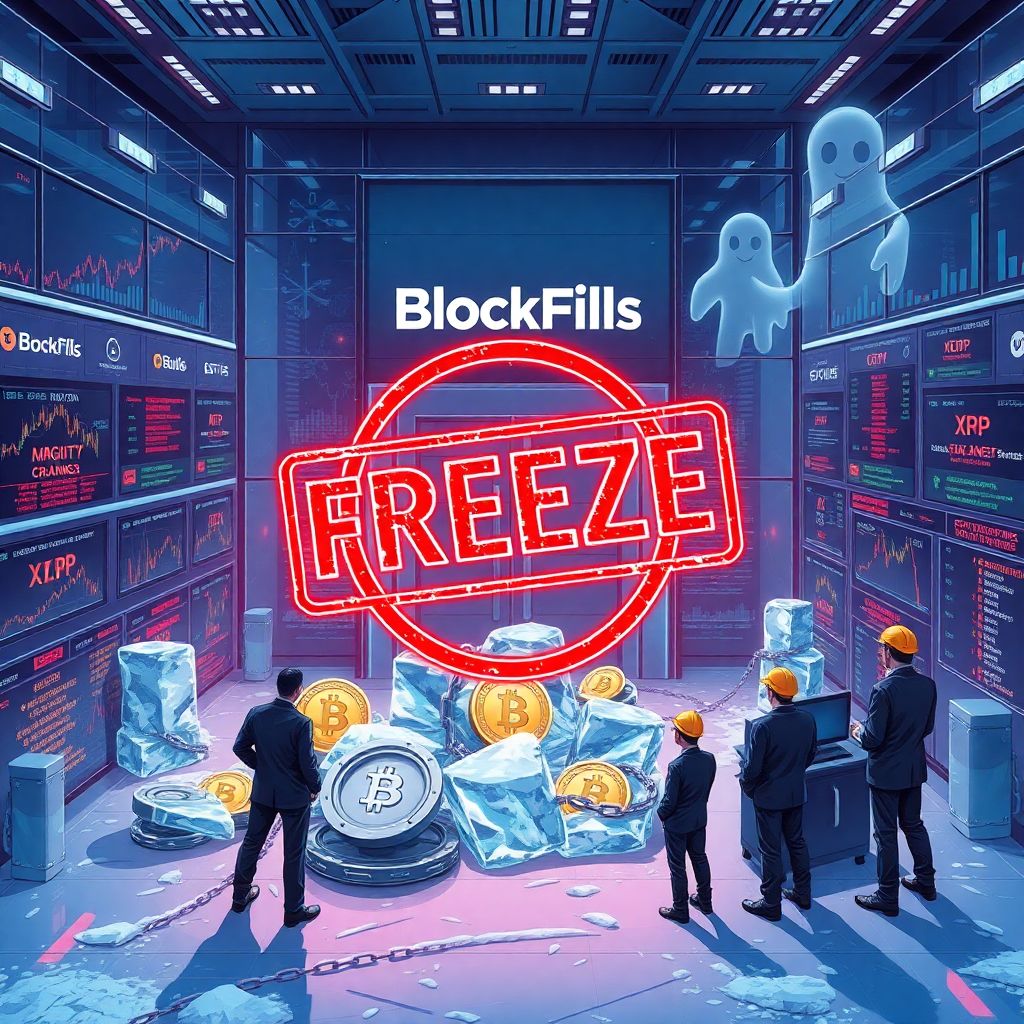
BlockFills Freezes Client Funds: Early Warning Sign Of A New Crypto Liquidity Crunch?
Chicago-based crypto trading and lending firm BlockFills has moved to suspend client deposits and withdrawals, reigniting fears that the industry could be edging toward another liquidity shock similar to the chaos of 2022.
The firm, which primarily serves institutional players such as hedge funds, bitcoin miners, and professional trading firms, halted on- and off-ramp activity after the latest sharp sell‑off in digital assets. Bitcoin’s slide to the low 60,000‑dollar range last week — before a partial rebound — appears to have been the immediate trigger.
A BlockFills spokesperson confirmed that the freeze remains in force and gave no specific date for when normal operations would resume. Internally, clients were informed that the pause was implemented “to further the protection of our clients and the firm,” framing the move as a defensive response to market stress rather than an outright collapse.
Deposits And Withdrawals On Ice — But Trading Still Possible
Despite the suspension of fund movements, BlockFills has not completely shut down its platform. Trading activity is still allowed, though it now comes with heightened controls and risk‑management guardrails.
Clients can open and close positions in both spot and derivatives markets, but margin requirements are being applied more aggressively. Positions and loans that require additional collateral may be force‑closed if the necessary margin top‑ups are not met. In practice, this means some traders could be liquidated even if they would have been able to add collateral — had withdrawals and deposits not been frozen.
The company has also made clear that any new funds sent to its accounts during the suspension period will not be accepted. Incoming transfers are being rejected and returned to the sender, effectively sealing the platform off from fresh capital while the pause is in effect.
A Precautionary Move Or A Red Flag?
BlockFills, backed by Susquehanna Private Equity Investments and the venture arm of CME Group, described the halt as a precaution driven by “recent market and financial volatility.” The firm says it is actively working to restore liquidity as soon as possible, but has avoided detailing the specific pressures behind the decision.
That lack of detail leaves open key questions:
– Is BlockFills facing a short‑term liquidity squeeze tied to collateral calls and client leverage?
– Are there counterparties failing to meet obligations, forcing the company to ring‑fence assets?
– Or is this a prudential pause to avoid becoming the next casualty of a deepening downturn?
For now, BlockFills is emphasizing continuity of trading and risk controls, but without transparent balance‑sheet data or a clear roadmap to resuming normal services, counterparties are left to read between the lines.
Echoes Of The 2022 Crypto Winter
Temporary freezes are not new to the crypto industry — and history has often shown that they can be early signals of deeper structural problems.
During the 2022 “crypto winter,” several high‑profile centralized platforms – including Celsius, Voyager Digital, BlockFi, and Genesis – initially framed withdrawal suspensions as temporary and driven by volatility. Many of those platforms eventually entered bankruptcy proceedings after liquidity shortfalls and mismatched liabilities came into focus.
In contrast, more recent disruptions at major exchanges have sometimes been brief and technical rather than solvency‑related. In 2025, for instance, some venues experienced short‑lived outages; one leading exchange halted futures trading for under an hour, attributing the interruption to system issues rather than financial stress.
BlockFills currently sits somewhere between those two poles: not claiming a mere technical hiccup, but also not signaling outright distress. The absence of a clear end date, however, will remind industry veterans how quickly “temporary measures” can harden into long‑term freezes when markets stay hostile.
Market Backdrop: Bitcoin, Ethereum, And Majors Under Pressure
The timing of BlockFills’ move is closely tied to a broader market downturn. After briefly stabilizing near previous highs, Bitcoin resumed its slide this week. On Wednesday, the leading cryptocurrency dropped toward the 67,554‑dollar level, logging a 2% loss over 24 hours and down around 8% over the past seven days. From its all‑time highs, BTC now trades at a discount of roughly 46%.
Other large‑cap cryptocurrencies have not been spared. Ethereum, XRP, and Solana have mirrored Bitcoin’s weakness, posting 24‑hour losses of about 3%, 2%, and 3.5%, respectively, according to aggregated market data. This broad‑based sell‑off is deepening concern that the market could be transitioning from a correction into a full‑scale bear phase.
For a firm like BlockFills — which runs spot and derivatives execution, structured products, and crypto‑backed lending — such synchronized declines hit multiple parts of the business at once. Collateral values fall, margin calls spike, and hedging strategies can become more expensive or less effective in fast‑moving markets.
How Institutional Crypto Lenders Get Squeezed
BlockFills operates at the institutional end of the spectrum, providing financing and execution to parties that typically manage large, leveraged positions. In this environment, sharp price swings can trigger a cascade of pressures:
– Margin calls on loans and derivatives: When asset prices sink, borrowers must post more collateral. If they cannot, lenders are forced to close positions or liquidate collateral.
– Liquidity mismatch: Clients may demand withdrawals just as markets are least liquid, forcing firms to sell assets at a discount or lock withdrawals to avoid fire‑sale losses.
– Counterparty risk: If one major borrower or trading partner defaults, losses can ripple through lending books and structured products.
– Funding costs: Tighter conditions can prompt lenders to hoard capital, pushing up borrowing costs and making it harder to roll over short‑term funding.
By halting deposits and withdrawals while still permitting trading, BlockFills is effectively trying to stabilize the asset‑liability balance on its platform. It reduces the risk of a sudden drain on liquidity, while still allowing clients to adjust or hedge positions within a controlled environment.
Is This The Start Of Another Crisis?
Whether BlockFills is a one‑off case or an early indicator of a broader credit crunch across the digital asset ecosystem will depend on a few key factors in the coming weeks:
1. Duration of the freeze: A short, clearly explained pause that resolves within days or a few weeks would lean toward a risk‑management maneuver. An indefinite freeze with minimal communication would increase speculation that the firm is struggling with deeper solvency or counterparty issues.
2. Contagion to other platforms: If more trading and lending firms catering to institutions begin to limit withdrawals, tighten leverage terms aggressively, or halt certain products, that could signal a systemic liquidity problem.
3. Market trajectory: A continued downtrend in bitcoin and major altcoins would intensify collateral pressure. Conversely, a stabilization or rebound could relieve stress and make it easier for BlockFills and similar firms to restore services.
4. Transparency from BlockFills: Detailed disclosures about exposure, balance‑sheet health, and the conditions required to lift the suspension would go a long way toward reassuring counterparties. Silence or vague statements, on the other hand, tend to fuel panic in a market already scarred by past collapses.
At this stage, there is not enough public information to conclude that the industry is facing a repeat of 2022. But the situation underscores how quickly confidence can shift when a key intermediary locks up funds.
What This Means For Institutional Clients
For miners, hedge funds, and professional trading desks using BlockFills, the immediate challenge is operational:
– Access to capital: With withdrawals paused, firms may need to tap alternative providers for liquidity or collateral.
– Risk management: The inability to move assets freely between venues complicates hedging, arbitrage, and market‑making strategies.
– Counterparty diversification: Clients heavily concentrated with BlockFills may reassess their exposure, exploring additional prime brokers, OTC desks, and lenders to avoid single‑point failures.
Many institutional players have already shifted toward multi‑prime relationships after the failures of 2022. The BlockFills episode may accelerate that trend, encouraging clients to build even more redundancy into their infrastructure and liquidity planning.
Lessons For Retail And Professional Traders Alike
Even though BlockFills mainly serves institutions, the situation holds broader lessons for all market participants:
– “Not your keys, not your coins” still applies: Funds held on centralized platforms are subject to the platform’s risk, policies, and legal framework. Regardless of reputation or backing, access can be restricted in stressed markets.
– Due diligence is essential: Understanding how a platform manages collateral, rehypothecates assets, and handles counterparty risk is crucial. Marketing materials rarely tell the full story.
– Stress‑testing assumptions: Traders and investors should plan for the possibility that one or more service providers become inaccessible at the worst possible time. That includes having backup exchanges, wallets, and liquidity arrangements.
– Watch for early warning signs: Sudden changes in margin requirements, unexplained delays in withdrawals, and vague references to “volatility” without concrete disclosure can be red flags worth monitoring closely.
Regulatory And Industry Implications
Episodes like the BlockFills freeze are likely to fuel ongoing regulatory debates about oversight of crypto lenders, prime brokers, and market‑making firms. Policymakers have repeatedly flagged opacity in lending practices and collateral management as core vulnerabilities.
In parallel, the industry itself has been slowly experimenting with more transparent and on‑chain models of credit, collateral, and risk‑sharing. While decentralized finance is far from immune to crises, the ability to audit reserves and positions on‑chain can, in theory, reduce information asymmetry during periods of stress.
Hybrid models — where centralized, regulated entities provide interfaces and compliance layers while settling collateral or positions on transparent infrastructure — may gain additional attention as firms seek to prove their solvency in real time rather than only through periodic reports.
What To Watch Next
In the near term, several developments will help clarify whether this is an isolated liquidity pause or the prelude to something bigger:
– A detailed update from BlockFills explaining the conditions for lifting the suspension.
– Changes in leverage and lending terms across other institutional trading venues.
– Continued price action in bitcoin and top altcoins, particularly if losses accelerate or a sharp rebound occurs.
– Any signs of stress in stablecoins, on‑chain lending protocols, or major market makers that could indicate broader cracks in the liquidity structure.
Until then, the BlockFills freeze functions as a reminder that in crypto, liquidity can evaporate faster than many models predict — and that even well‑connected, institution‑focused firms are not immune to the consequences of extreme volatility.