
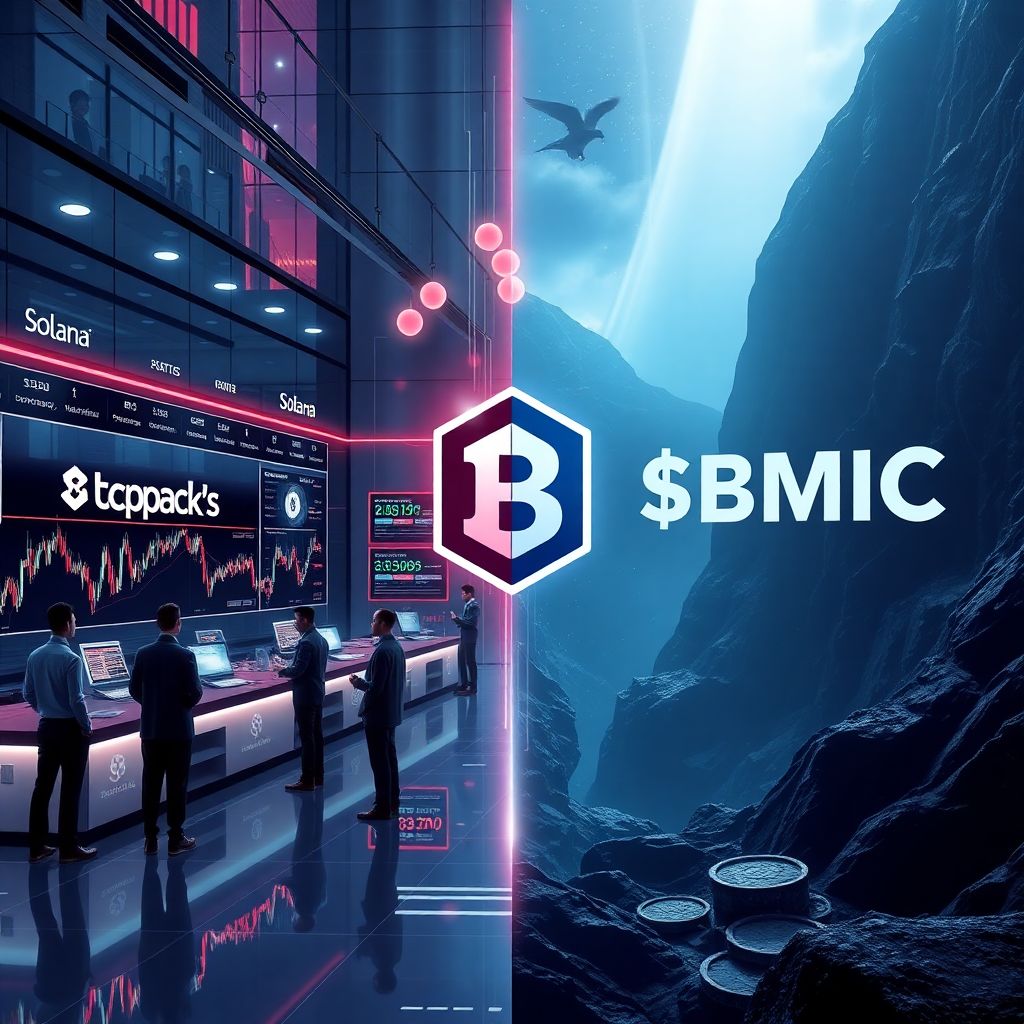
Crypto exchange Backpack is edging toward one of the most closely watched token launches in the Solana ecosystem, while a newer player, BMIC, is quietly positioning itself as a shield against the next existential threat to digital assets: quantum computing.
Backpack, built by the team behind the Mad Lads NFT collection, has been running a sustained points campaign that rewards trading activity and platform engagement. In today’s market, such points programs are rarely ambiguous; they usually foreshadow a token generation event and, in many cases, an airdrop to early and active users. As the points accrual continues and speculation intensifies, traders are increasingly treating Backpack as a future Solana-native heavyweight rather than just another exchange.
What sets Backpack apart is its attempt to merge several roles into a single, regulated “super app.” Instead of choosing between a centralized exchange with compliance and liquidity or a non-custodial wallet with control and sovereignty, Backpack aims to combine both. Users can trade through a CEX interface while still interfacing with a wallet infrastructure designed for users who prefer to maintain tighter control over their assets.
The macro backdrop is working in Backpack’s favor. Bitcoin is hovering close to historic highs, and capital is rotating into high-throughput ecosystems like Solana, which have proven they can handle heavy volumes and complex applications. In those conditions, infrastructure platforms—exchanges, wallets, and security layers—tend to attract the most persistent capital, because they collect fees and deliver services regardless of which narrative or memecoin is dominating headlines in a given week.
For many traders, the thesis is straightforward: if Backpack can capture and retain enough volume, its token could become a core asset within the Solana stack, benefiting from trading fees, ecosystem incentives, and possible buyback or staking mechanisms down the line. In other words, Backpack’s looming token event is being treated not just as a speculative bet but as a wager on the long-term maturation of Solana’s trading and liquidity infrastructure.
Yet at the same time that new exchanges and DeFi protocols sprint ahead, the foundations of current cryptographic security are facing a slower, more insidious challenge. Quantum computing, once largely theoretical, is creeping closer to practical reality. When sufficiently powerful quantum machines emerge, the cryptographic primitives that secure Bitcoin, Ethereum, and most modern blockchains—especially RSA and Elliptic Curve Cryptography (ECC)—will be vulnerable to entirely new classes of attacks.
This danger is often summarized as “Harvest Now, Decrypt Later.” Adversaries, including sophisticated criminal organizations and state-level actors, can already capture vast amounts of encrypted blockchain traffic and store it indefinitely. Because blockchains are immutable, any information protected by today’s algorithms will remain on-chain in its current form. Once quantum capabilities mature, those previously “secure” records could be decrypted retroactively, exposing transaction histories, wallet relationships, and in some cases long-term secrets.
Most retail traders focus on near-term catalysts like airdrops, token listings, or yield opportunities; few stop to ask a harder question: if my portfolio grows significantly in value, what ensures that it remains safe five or ten years into the future? That is the gap BMIC ($BMIC) is trying to fill, by designing a quantum-resilient financial stack aimed at both individual and institutional users.
BMIC’s core proposition is a wallet and infrastructure layer powered by post-quantum cryptography (PQC). Unlike conventional wallets, which often expose public keys during or after transaction execution, BMIC’s architecture is engineered to eliminate public key exposure altogether. This design choice is essential, because quantum attacks target the mathematical relationship between public and private keys—if the public key is never on display, the attack surface shrinks dramatically.
On top of cryptographic design, BMIC adds a second line of protection through AI-enhanced threat detection integrated into what it describes as a Quantum Meta-Cloud. This environment continuously analyzes on-chain behavior and transaction patterns, searching for anomalies that could signal targeted attacks, coordinated exploits, or unusual account activity. The system is not limited to signature verification; it treats security as an ongoing behavioral and statistical problem, not just a mathematical one.
The result is a dual-layer defense: PQC algorithms harden the system against brute-force decryption, while AI-driven monitoring works to spot and mitigate real-time threats. This is particularly relevant for enterprises, asset managers, and high-net-worth individuals whose holdings make them prime targets. Traditional wallet security tends to emphasize user-side best practices—avoiding phishing, storing seed phrases securely, and using hardware wallets—but it rarely addresses the looming quantum threat that could expose keys and decrypt past transactions wholesale.
BMIC also supports ERC-4337-style smart accounts, which abstract away some of the complexity of using blockchains directly. Features like gas abstraction and social recovery—typically seen as “quality of life” improvements—are integrated without diluting the project’s quantum-resistant posture. This is a key point: security that is too difficult to use is often ignored; BMIC’s strategy is to make next-generation protection feel as seamless as a modern fintech app.
The market has begun to notice. BMIC’s presale has already raised over $445,000, with tokens currently offered at a sub-$0.05 price level—around $0.049474. At this stage, investors are effectively betting that quantum resilience will evolve from a niche talking point into an industry standard, and that early infrastructure providers in this space will command premium valuations as adoption grows.
The BMIC token is designed as more than just a governance chip. It serves as the primary unit of value within the project’s ecosystem, powering payment layers, granting access to quantum-secure services, and fueling a “Burn-to-Compute” mechanism intended to align network usage with token demand. By linking token utility to core functions like computation and security provisioning, BMIC aims to avoid the trap of becoming a purely speculative asset divorced from underlying activity.
The strong initial raise signals growing recognition that the security narrative in crypto is evolving. For years, the industry competed almost exclusively on speed, throughput, and composability. Now, as institutional capital grows and regulators scrutinize systemic risks more closely, the conversation is shifting toward durability, compliance, and long-horizon safety—precisely the domains where quantum threats can no longer be ignored.
For early investors, BMIC appeals to a specific thesis: the idea that protocols securing the entire ecosystem—rather than just one chain or app—could become foundational infrastructure. If blockchains must eventually migrate to post-quantum standards, the projects that solve wallet-level and account-level security first may enjoy a significant advantage. In such a scenario, BMIC could serve as a reference implementation or a plug-and-play layer for exchanges, custodians, and DeFi platforms seeking quantum-proof solutions.
Backpack and BMIC together illustrate two parallel but interconnected narratives in crypto’s current cycle. Backpack embodies the ongoing professionalization of trading infrastructure on fast, scalable chains like Solana, where user experience, regulation, and liquidity aggregation are converging into polished products. BMIC, by contrast, speaks to the underlying cryptographic and security evolution that must occur if any of these platforms are to remain viable in a post-quantum world.
One of the crucial questions for the next wave of exchanges will be whether they choose to integrate post-quantum solutions proactively. A platform like Backpack, which is branding itself as a regulated super app, may eventually need to demonstrate not just compliance and operational security, but also long-term cryptographic resilience. Early adoption of PQC-based wallets or quantum-hardened custody modules could become a competitive differentiator, particularly for institutional clients.
From a strategic perspective, there is also a timing issue. Migrating entire user bases, wallets, and smart contract systems to new cryptographic standards is a major logistical challenge. Exchanges and protocols that wait until quantum machines are visibly threatening may find themselves in a rushed, reactive transition, risking user confusion, security lapses, and reputational damage. Starting the shift while quantum capabilities are still emerging allows for a smoother, staged migration.
For retail traders trying to position themselves today, this raises two complementary angles. On one side are short-to-medium-term catalysts like the Backpack token generation event, which could reward early users if liquidity and trading fees accrue as expected. On the other side are long-term infrastructure bets like BMIC, which may not spike overnight but are built around a thesis that extends years into the future: that quantum safety will become non-negotiable.
Risk management remains essential. Both Backpack’s token and BMIC’s presale represent early-stage opportunities with significant uncertainty. Regulatory interpretations, competition from established players, technical execution risks, and market cycles can all affect outcomes. Diversifying exposure—allocating a portion of capital to near-term narratives and another portion to infrastructure and security—can be a way to balance potential upside with structural resilience.
Another often-overlooked dimension is regulatory perception. Authorities across jurisdictions are increasingly focused on operational resilience, data protection, and systemic risk within digital asset markets. Projects that can demonstrate advanced security measures, especially ones that anticipate future threats like quantum decryption, may find themselves better positioned during licensing, institutional onboarding, and compliance reviews. In that sense, BMIC’s focus could prove to be as much a regulatory asset as a technical one.
For developers and builders in the ecosystem, the rise of post-quantum solutions opens up new design spaces. Integrating PQC into smart contracts, custody tools, and multi-signature schemes will require new standards, libraries, and best practices. If BMIC succeeds in creating a modular, developer-friendly stack, it could become one of the default toolkits for teams that want to ship quantum-hardened applications without reinventing the wheel.
All of this underscores a broader shift in crypto: the industry is maturing beyond isolated trends and into an era where user experience, regulation, security, and long-term viability must all advance together. Backpack’s looming token launch is a snapshot of that maturation on the front end—clean interfaces, strong branding, and regulated access to liquidity. BMIC’s presale is a glance at the back end—deep, technical work on the cryptographic and infrastructural core.
Looking ahead, the projects that thrive are likely to be those that can bridge both worlds. Exchanges and apps will need to delight users in the present while quietly preparing for threats that are still a few years out. Security protocols will need to offer enterprise-grade protection while remaining accessible and understandable to everyday participants. In that emerging landscape, Backpack and BMIC highlight where capital, innovation, and concern are converging: high-performance trading today, and quantum-proof safety for the value that survives into tomorrow.