
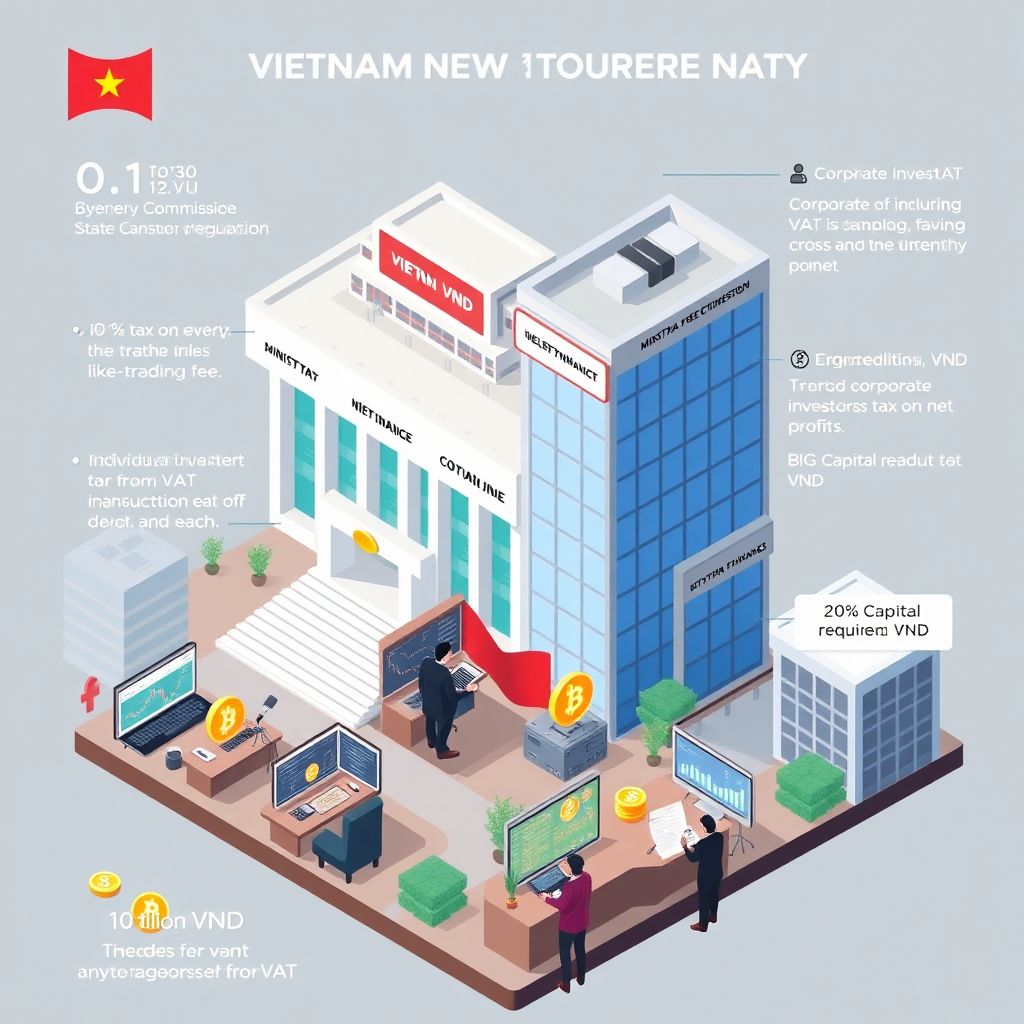
Vietnam moves to tax crypto like stocks with 0.1% trading levy
Vietnam is moving closer to a full-fledged tax and licensing regime for cryptocurrencies, treating digital assets in many respects like traditional securities. A new draft circular from the Ministry of Finance lays out how individual and corporate investors, as well as exchange operators, will be taxed and supervised under the upcoming framework.
0.1% tax on every crypto transfer
According to the draft rules, any individual transferring crypto through a licensed service provider would pay a 0.1% personal income tax on the value of each transaction. This is a turnover-based tax applied per transfer, not on net profit, mirroring the levy already imposed on stock trades in Vietnam.
For example, if a user sells the equivalent of $10,000 in crypto, they would owe $10 in tax for that transaction, regardless of whether they made a profit or a loss on the trade. This approach makes it easy for authorities to calculate and collect tax but may be more burdensome for high-frequency traders who execute a large number of small transactions.
Exemption from value-added tax (VAT)
While imposing a transaction tax, the draft circular classifies crypto transfers and trading as exempt from value-added tax. This means investors would not pay VAT on the purchase or sale of digital assets, bringing crypto in line with many countries that treat it more like a financial instrument than a consumer good.
The turnover-based 0.1% tax, however, would apply to all investors, regardless of whether they are residents or non-residents, as long as the transfer is carried out through a licensed Vietnamese service provider. That gives the government a clear point of collection and oversight on cross-border activity routed through domestic platforms.
Corporate tax on institutional crypto profits
The regime distinguishes between individual traders and institutional participants. Companies that earn income from crypto transfers in Vietnam would face a 20% corporate income tax on net profits, after deducting purchase costs and related operating expenses.
In practice, that means a company would need to maintain detailed records of acquisition prices, transaction fees, custody costs and other relevant expenditures to correctly calculate taxable income. This aligns crypto with the treatment of many other business lines and could push professional players to adopt more sophisticated accounting, compliance and reporting systems.
Formal legal definition of crypto assets
For the first time, authorities have also provided a clear legal definition of crypto assets. Under the draft, they are described as digital assets that rely on cryptographic or similar technologies for issuance, storage and verification of transfers.
This definition is broad enough to cover most mainstream cryptocurrencies and tokens while giving regulators a basis to distinguish them from traditional forms of money or purely digital records. A formal definition is crucial for applying existing laws on taxation, anti–money laundering, consumer protection and securities regulation.
Stringent licensing standards for exchanges
The draft circular goes beyond taxation and targets market infrastructure. Any company that wants to operate a digital asset exchange in Vietnam would be required to hold at least 10 trillion Vietnamese dong (around $408 million) in charter capital. This threshold is higher than the capital requirements imposed on commercial banks and significantly exceeds that of most other domestic industries.
Such a high bar eliminates small and lightly capitalized players from the market, effectively reserving exchange licenses for major financial institutions or large, well-funded technology firms. Authorities appear to be prioritizing stability and risk management over rapid market expansion.
Foreign investors will be allowed to participate in these platforms, but their ownership is capped at 49% of an exchange’s equity. This maintains domestic control over critical financial infrastructure while still leaving room for international expertise and capital.
Connection to Vietnam’s five-year crypto pilot
These proposed rules are unfolding against the backdrop of a broader experiment in regulated digital asset markets. Vietnam launched a five-year pilot program for a regulated crypto asset ecosystem in September 2025.
Yet, by October 6, 2025, the Ministry of Finance disclosed that no companies had applied to join the pilot. Officials cited the same issues now visible in the draft circular: demanding capital requirements and tough eligibility conditions. Potential participants appeared reluctant to tie up hundreds of millions of dollars in a sector still facing evolving rules and uncertain commercial prospects.
Licensing window opens in 2026
Despite the slow start, the pilot is now moving into a more operational phase. Vietnam has begun accepting applications for licenses to operate digital asset trading platforms, marking the practical launch of the regulated market.
The State Securities Commission of Vietnam announced that it would start accepting applications for the relevant administrative procedures from January 20, 2026. The stated objective is to bring digital assets under clear regulatory oversight, rather than leave the sector in a legal gray area.
What this means for individual investors
If the draft rules are adopted largely as written, retail crypto users in Vietnam will face a relatively straightforward, though unavoidable, tax mechanism:
– Every on-exchange transfer or trade through a licensed provider will incur a 0.1% tax, similar to stock trades.
– No VAT will be charged on buying or selling crypto.
– Tax will be collected at the point of transaction, likely by the exchanges themselves, reducing the need for complex annual declarations for each trade.
This setup simplifies administration but impacts frequent traders and arbitrage strategies, as transaction costs rise with every move in and out of positions. Long-term investors who trade less often may feel the burden less acutely.
Implications for companies and institutional players
For businesses, the combination of a 20% corporate income tax on crypto-related profits and high capital requirements for exchanges suggests that authorities are targeting large, serious operators rather than speculative ventures.
Institutional investors may welcome the regulatory clarity, as it can legitimize digital assets in corporate portfolios and reduce legal uncertainty. However, they will need to invest in compliance systems to track cost basis, integrate crypto into existing accounting frameworks and ensure alignment with tax rules, anti–money laundering obligations and reporting standards.
Potential impact on the local crypto ecosystem
The strict licensing and capital thresholds are likely to reshape the market:
– Smaller domestic platforms may be forced to shut down, merge, or pivot to non-exchange services such as analytics, software or consulting.
– Large banks and established financial groups may step in to capture the newly regulated market segment.
– International exchanges may seek partnerships or joint ventures with local firms to remain within the 49% foreign ownership cap.
This may result in fewer but more robust platforms, potentially improving consumer protection and reducing the risk of sudden collapses, but also limiting competition and innovation from smaller startups.
Alignment with global regulatory trends
Vietnam’s approach mirrors a broader global movement to treat crypto assets more like financial instruments than unregulated digital commodities. Turnover taxes, corporate profit taxes and licensing systems are increasingly common, as governments look to capture revenue and mitigate systemic risks while still allowing digital asset markets to exist.
At the same time, the combination of a low transaction tax and no VAT places Vietnam somewhere between high-tax jurisdictions and crypto-friendly hubs. The success of this model will likely depend on how efficiently rules are implemented and whether enforcement is predictable and transparent.
Challenges in implementation
Translating the draft framework into practice will be complex. Authorities will need to:
– Build systems that allow exchanges to withhold and remit the 0.1% tax accurately and in real time.
– Coordinate between tax authorities, financial regulators and law enforcement to monitor compliance.
– Clarify how off-exchange activity, peer-to-peer trading and use of foreign platforms will be treated.
– Provide guidance on the tax treatment of more complex products such as derivatives, staking rewards, lending, and decentralized finance protocols.
Without clear secondary regulations and technical guidance, both investors and businesses may struggle to adjust to the new environment.
Outlook: more regulation, greater legitimacy
For Vietnamese crypto users and companies, the draft circular signals a decisive policy direction: digital assets are not being banned, but they will be heavily regulated and taxed much like conventional financial instruments.
In the short term, the rules may dampen speculative activity and keep smaller players on the sidelines. In the longer term, a transparent regulatory regime could make Vietnam a more predictable environment for institutional investment and infrastructure development in the digital asset space.
The coming years of the five-year pilot will show whether this balance between strict oversight and market openness can attract serious operators while still protecting investors and the broader financial system.