
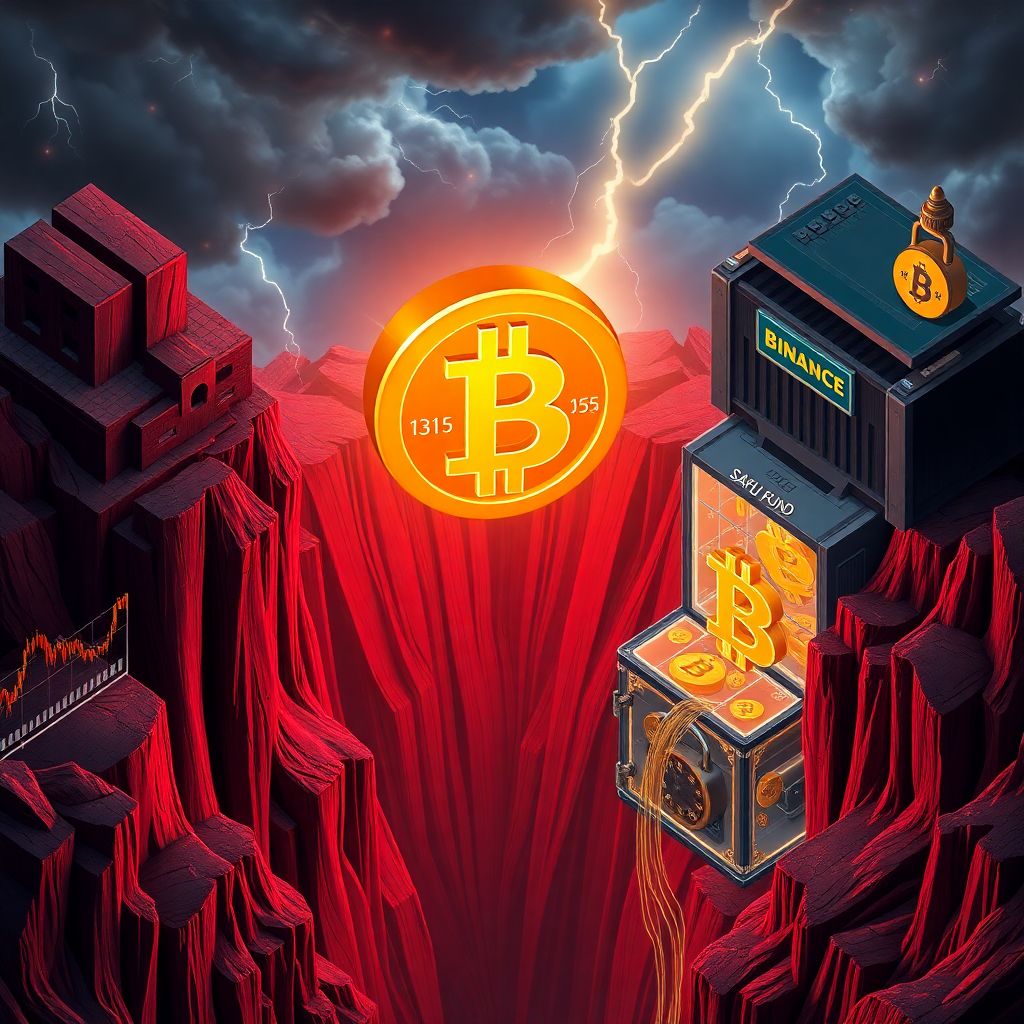
Binance’s SAFU Insurance Fund Quietly Buys 1,315 BTC As Fear Dominates The Market
Binance has moved back into the spotlight after the violent October 10 sell-off, one of the sharpest deleveraging events of the current cycle. On that day, a cascade of forced liquidations ripped through derivatives markets, wiping out billions in open interest and exposing just how much excessive leverage had built up across major crypto exchanges.
During that turmoil, Binance stood out not as the main driver of the crash, but for the opposite reason: relative to its dominant market share, the exchange’s share of liquidations was noticeably smaller. That divergence underscored significant differences in where leverage was concentrated and how risk was managed compared with competing platforms.
Today, the broader backdrop remains fragile. Bitcoin trades below the psychologically important 80,000-dollar mark, while Ethereum has fallen under 2,300 dollars. The combination of macroeconomic uncertainty, thinning liquidity and fading spot demand is reinforcing the view that crypto is in a corrective – if not fully bearish – phase. Many market participants now expect further downside or, at best, a prolonged period of choppy consolidation before any sustainable uptrend can re-emerge.
Arkham Data: Binance’s SAFU Fund Scoops Up 1,315 BTC
Amid this risk-off environment, new data from Arkham has introduced a surprising countertrend signal. According to Arkham, Binance’s SAFU (Secure Asset Fund for Users) wallet has accumulated 1,315 BTC in a short window, an allocation worth roughly 100 million dollars at current prices.
This buying spree arrives at a time when sentiment indicators and positioning data show extreme caution, if not outright capitulation, among traders. While most market participants are de-risking, the SAFU fund is moving in the opposite direction, adding Bitcoin exposure as prices fall. The move suggests Binance is either taking advantage of lower prices to strengthen its insurance reserves or repositioning the fund in anticipation of longer-term recovery.
What The SAFU Fund Actually Is – And Why Its Allocation Matters
The SAFU fund functions as an emergency insurance pool designed to protect users in the event of extreme, unforeseen incidents such as major hacks, systemic failures or black swan events. Binance has repeatedly highlighted SAFU as a key pillar of its user protection framework, and has previously committed to maintaining it at a substantial nominal value.
Historically, the SAFU fund has held a mix of assets, including native exchange tokens and leading cryptocurrencies. Adjusting that mix is not unusual. However, shifting such a large sum into Bitcoin at a moment of pronounced market weakness is notable. It effectively ties a portion of Binance’s insurance capital more directly to BTC’s long-term trajectory rather than to stablecoins or alternative assets.
This allocation carries two important implications. First, it can be interpreted as a vote of confidence in Bitcoin’s resilience, even if short‑term price action remains negative. Second, it potentially increases the sensitivity of the insurance fund’s value to BTC volatility, which can be a double‑edged sword in the event of deeper drawdowns.
Binance Under The Microscope After October 10
In the wake of the October 10 crash, Binance and its founder Changpeng Zhao have been repeatedly blamed by critics who argue that the exchange’s outsized role in derivatives trading allows it to shape funding rates, open interest and, by extension, volatility across the market.
Binance commands a leading share of global futures volume and offers deep liquidity in perpetual swaps, options and other leveraged products. In such an environment, any abrupt move in order flow or liquidation activity originating on Binance can quickly propagate across other platforms through arbitrageurs and cross-exchange traders.
This central role in the market’s plumbing has fueled the narrative that Binance is a “volatility hub” – a venue where sharp moves either begin or become amplified. When prices crash, many are quick to attribute causality to the exchange’s derivatives complex, often before a detailed analysis of leverage distribution across platforms is complete.
No Hard Evidence Binance Engineered The Sell-Off
Despite the intensity of accusations, current on-chain and market-structure data do not provide firm evidence that Binance or CZ deliberately triggered or orchestrated the latest downturn. Liquidation statistics show that leverage was heavily spread across multiple venues. In several instances, Binance’s share of forced liquidations was actually smaller than what its overall market share would suggest.
This undercuts claims that Binance was uniquely responsible for systemic pressure. A more plausible explanation is that structural vulnerabilities – excessive leverage, shallow liquidity outside the top pairs, and fragile investor psychology – set the stage for an aggressive flush that could have originated anywhere and then rippled through the entire ecosystem.
When markets are this fragile, even routine liquidations can snowball into full‑scale deleveraging events. Binance’s size makes it highly visible during such episodes, but visibility is not the same as culpability.
Broader Structural Issues: Leverage, Liquidity And Sentiment
The current episode highlights deeper issues that extend beyond any single exchange. Over recent months, crypto markets have seen:
– Elevated levels of perpetual futures open interest relative to spot volumes
– Increasing use of high leverage among both retail and institutional traders
– Thinning order books during off-peak hours, particularly on smaller pairs
– Growing sensitivity to macro headlines, from interest rate expectations to regulatory news
This combination creates an environment where modest catalysts can trigger outsized moves. Investors and traders are no longer simply reacting to price; they are reacting to each other’s positioning, hedging behavior and perceived risk tolerance. That reflexivity can drive cascades that far exceed the initial trigger.
In such conditions, a large exchange like Binance inevitably becomes a focal point, even if the underlying problem is systemic rather than localized.
Bitcoin’s Weekly Structure Signals A Clear Trend Shift
On a higher timeframe, Bitcoin’s weekly chart confirms that market structure has deteriorated. Losing the 80,000-dollar psychological level was a key blow. BTC failed to reclaim the 50‑week moving average – which had been acting as an important pivot – and instead turned lower, confirming that average as active resistance rather than a neutral consolidation band.
The rejection in the mid‑90,000-dollar zone formed a lower high compared with the prior peak earlier in the 2025 cycle, solidifying a broader bearish pattern on weekly timeframes. With price now trading below both the 50‑week and 100‑week moving averages, momentum has clearly shifted to the downside.
At the same time, the 200‑week moving average continues to slope upward and remains well below current levels. Historically, this configuration has often marked a transition phase: shorter‑term trend dynamics turn negative, but long‑term structural support has yet to be tested. The recent slide into the 74,000–78,000-dollar band pushes Bitcoin back into a previous area of consolidation, where bulls and bears will likely battle for directional control.
A decisive weekly close below that range would open the door to a deeper retest of long‑term supports, while a sharp reclaim could signal the start of a base‑building phase ahead of the next macro move.
How The SAFU BTC Purchase Fits Into This Technical Picture
Placing the SAFU fund’s 1,315‑BTC purchase into this technical context is key. From a timing perspective, the accumulation is happening precisely as weekly structure turns more bearish and as many traders reduce exposure. For risk managers at a large exchange, such a moment can be interpreted in two ways:
1. Defensive positioning: Securing more BTC when prices have already corrected can help ensure that, if volatility persists, the insurance fund holds assets perceived as most robust over the long term.
2. Opportunistic allocation: If internal models suggest that the bulk of forced deleveraging has already occurred, adding Bitcoin exposure at depressed levels may be seen as a prudent, contrarian strategy.
In both cases, the move signals that Binance is not treating current price levels as unsustainably high, even though short‑term risk remains elevated.
What This Means For Everyday Traders And Investors
For individual market participants, the SAFU fund’s rotation into Bitcoin is not a direct trading signal, but it does carry informational value:
– It underscores that a major exchange is willing to hold substantial BTC exposure as part of a long‑term protection pool.
– It suggests that, internally, Binance’s risk framework can accommodate more BTC volatility within its insurance reserves.
– It offers a contrast to the behavior of highly leveraged traders, many of whom have been forced out of positions or have chosen to stand aside.
However, this should not be interpreted as a guarantee of imminent price recovery. The SAFU allocation is structured with a multi‑year horizon in mind, not as a short‑term bet. Traders still need to manage risk based on their own time frames, capital constraints and tolerance for drawdowns.
Possible Scenarios: From Capitulation To Gradual Recovery
Looking ahead, several broad scenarios could unfold:
1. Extended deleveraging
If macro conditions deteriorate further or if another wave of forced selling hits derivatives markets, Bitcoin could break below the 74,000-dollar support zone and move toward the 200‑week moving average. In this case, the SAFU fund’s BTC allocation would temporarily lose value on paper, but would still serve its intended purpose as a long‑horizon reserve.
2. Sideways consolidation
Bitcoin could oscillate between roughly 74,000 and 90,000 dollars for an extended period, allowing leverage metrics and funding rates to normalize. Under this scenario, the SAFU fund benefits from relative stability, and the broader market has time to rebuild a healthier base of spot demand.
3. V‑shaped rebound
A strong macro catalyst – such as improved liquidity conditions or unexpectedly dovish monetary policy – could trigger a sharp rebound that squeezes shorts and restores BTC above key moving averages. The SAFU fund’s recent purchase would look particularly well‑timed in this outcome, but history suggests that rapid V‑shaped recoveries from heavily leveraged crashes are less common than grinding bases.
In all three scenarios, the SAFU Bitcoin purchase is best interpreted as part of a long‑term risk management strategy rather than as a directional trading call.
Regulatory And Perception Risks Still Lurk
While the focus now is on market structure and price action, Binance still faces non‑market challenges that can influence sentiment. Ongoing regulatory scrutiny in multiple jurisdictions, debates over exchange transparency and concerns about internal controls all feed into how investors perceive risk when entrusting assets to centralized venues.
The SAFU fund is, in part, a response to those concerns: a tangible mechanism designed to reassure users that there is a dedicated pool of capital ready to absorb unexpected shocks. However, perception risk does not disappear simply because an insurance fund exists. For many institutions and sophisticated traders, questions around governance, compliance and jurisdictional oversight remain central.
If Binance successfully strengthens its regulatory standing and demonstrates robust internal oversight, moves like the recent SAFU Bitcoin purchase could be seen as evidence of a mature, well‑capitalized platform. If not, critics may frame the same move as an aggressive bet taken with user‑protection capital – even if, in practice, it serves a conservative, long‑term purpose.
Key Signals To Watch Next
In the coming days and weeks, several data points will help clarify whether the market is stabilizing or sliding into a more pronounced bearish phase:
– Leverage metrics: Open interest in futures and perpetuals, especially relative to spot volume.
– Liquidations: The size and frequency of liquidation clusters across major exchanges.
– Funding rates: Whether they normalize around flat levels or remain skewed, indicating persistent one‑sided positioning.
– Spot flows: Net inflows or outflows from large holders and exchange balances.
– Price reaction around support: How BTC behaves in the 74,000–78,000-dollar band and whether any bounce is supported by rising volume.
Binance’s SAFU fund activity will remain a secondary, but noteworthy, piece of this puzzle. Further significant reallocations into or out of Bitcoin could signal shifting internal views on risk and opportunity.
Bottom Line
The accumulation of 1,315 BTC – around 100 million dollars – by Binance’s SAFU fund during a period of heightened fear cuts against the dominant narrative of retreat and risk‑off positioning. At a time when weekly charts point to a clear structural downshift and derivatives markets are still digesting a brutal deleveraging, Binance is choosing to expand its Bitcoin‑backed insurance reserves rather than shrink exposure.
Whether this proves prescient or premature will depend on how deep the current correction runs and how quickly spot demand can return. What is clear for now is that the world’s largest exchange by derivatives volume is signaling confidence in Bitcoin’s long‑term role, even as the short‑term outlook remains clouded by volatility, regulatory uncertainty and fragile sentiment.