
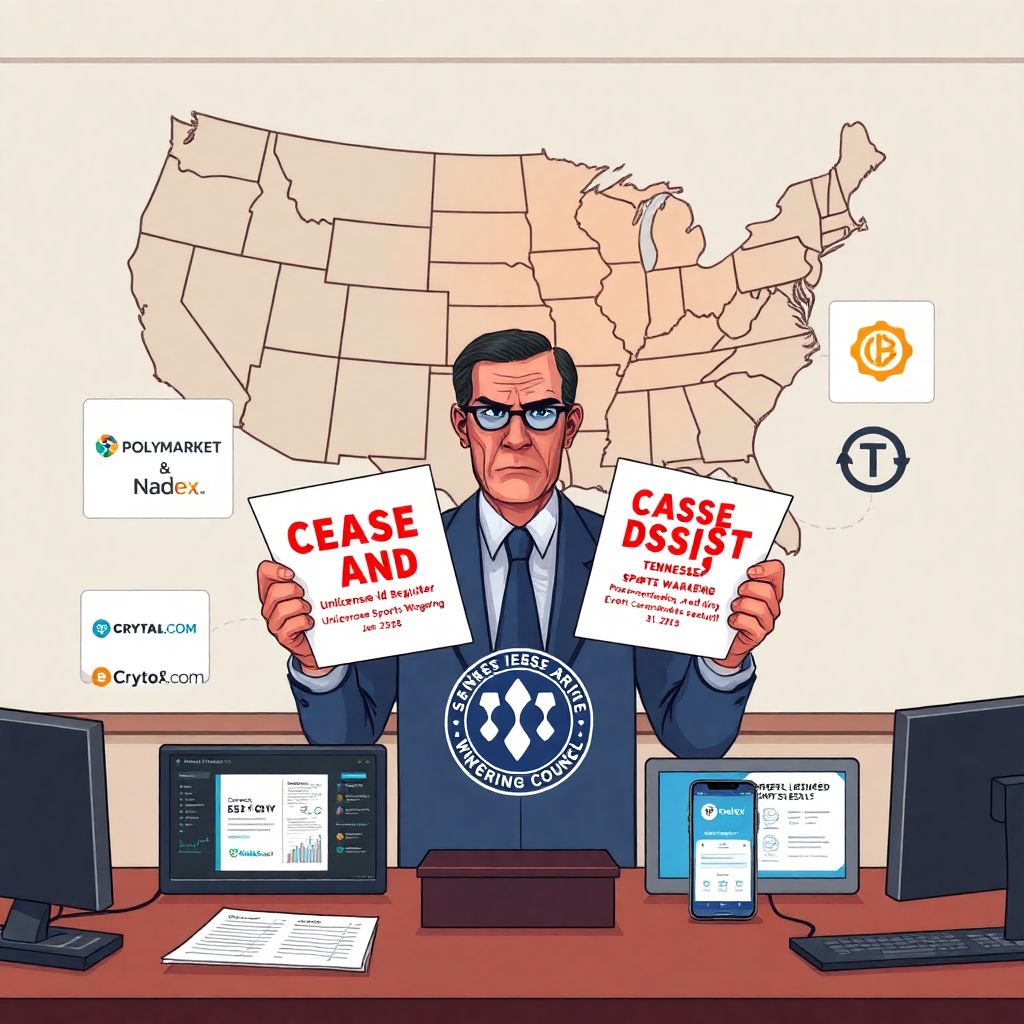
Tennessee orders Kalshi, Polymarket and Crypto.com to stop sports event contracts, demands refunds
Tennessee’s sports betting watchdog has moved aggressively against three major prediction-market and crypto platforms, ordering them to shut down all sports-related contracts for state residents and return customer funds or face substantial penalties.
In a series of cease-and-desist letters dated Friday, the Tennessee Sports Wagering Council (SWC) directed Kalshi, Polymarket and Crypto.com’s North American Derivatives Exchange (Nadex) to immediately halt what it describes as unlicensed sports wagering. The letters allege that all three firms have been offering sports betting products in violation of the Tennessee Sports Gaming Act because they do not hold the state’s required sports wagering licenses.
According to the SWC, the “sports event contracts” available on these platforms let users stake money on the outcome of sporting events in a way that is functionally identical to traditional sports bets. Labeling them as “event contracts” or derivatives, the council stressed, does not remove them from the scope of Tennessee’s gambling laws, which reserve sports wagering exclusively for approved and licensed sportsbooks operating under state oversight.
The regulator went further, emphasizing the consumer safeguards that licensed operators must implement. These include age verification to block underage users, responsible gambling tools such as deposit limits and self-exclusion options, and robust anti-money laundering procedures. The SWC argues that the contracts offered by Kalshi, Polymarket and the Crypto.com-affiliated exchange are not being provided within that regulated framework, potentially leaving consumers exposed.
Under the order, the three platforms must stop taking any new sports-related positions from Tennessee residents and must void all existing contracts tied to sporting events that involve users from the state. The SWC has set a firm deadline: all Tennessee customers’ funds related to these products must be fully refunded and available to withdraw by January 31, 2026.
Noncompliance carries serious consequences. The letters warn that each violation could incur civil penalties of up to 25,000 dollars. In addition, the SWC signaled that prolonged or willful disregard of the order could lead to court injunctions and referrals to law enforcement agencies for potential criminal investigation into illegal gambling activity.
The clash highlights a broader tension between state gambling law and the rapidly evolving world of prediction markets and crypto-based trading platforms. Kalshi and Polymarket, in particular, have positioned themselves as federally regulated marketplaces for event-based contracts governed by commodities law. Both have engaged with the United States Commodity Futures Trading Commission (CFTC), which treats many of their offerings as derivatives rather than gambling.
However, the SWC’s position is that federal commodities oversight does not erase Tennessee’s authority to define and regulate sports wagering within its borders. From the council’s perspective, if a contract allows a Tennessee resident to risk money on a sports outcome and get paid based on that outcome, it is sports betting, regardless of the product’s branding or its treatment under federal financial law.
As of the time referenced in the letters, the platforms had not publicly responded to the Tennessee regulator’s demands. The dispute adds yet another chapter to the mounting legal and regulatory scrutiny facing event-contract platforms across the United States, particularly where sports and politics intersect with financial markets.
The wider legal backdrop: Kalshi’s fights with state regulators
Tennessee is not the first state to clash with Kalshi over its event-based products. Recently, a federal judge temporarily blocked regulators in another state from enforcing a similar cease-and-desist order against the company, granting Kalshi short-term relief while the courts determine whether its products fall under federal commodities law, state gambling law, or both.
In that case, state authorities had accused Kalshi and several other platforms of facilitating unlicensed sports wagering through online event contracts. Kalshi countered that its contracts are federally regulated derivatives and therefore should be supervised solely by the CFTC. The presiding judge ordered regulators to pause enforcement while considering Kalshi’s request for a preliminary injunction, underscoring that the legal issues are far from settled.
Parallel disputes are unfolding around the country. Kalshi has filed lawsuits or become embroiled in regulatory actions in multiple jurisdictions, including New York, Massachusetts, New Jersey, Nevada, Maryland and Ohio. Many of these cases revolve around the same core question: when does an “event contract” become a sports bet or a gambling product under state law?
Why Tennessee is targeting “event contracts” now
Tennessee’s move fits into a larger pattern of states reasserting control over sports wagering following the nationwide expansion of legal sports betting. Since states began legalizing sports betting after the repeal of the Professional and Amateur Sports Protection Act, regulators have been rigorous about licensing, tax collection and consumer protections.
Event-contract platforms threaten to blur the lines regulators have drawn. On the surface, a futures-style contract on whether a team wins a championship might look like a financial derivative, especially when traded on an exchange with order books and margin requirements. But to state regulators, that same product can appear indistinguishable from placing a bet with a sportsbook, particularly from the consumer’s perspective.
By going after Kalshi, Polymarket and Crypto.com’s Nadex together and by explicitly grouping their products as “sports wagering,” Tennessee is sending a clear signal that it will not allow alternative labels or novel technologies to sidestep its gambling rules. The order to issue refunds and void contracts also suggests the state wants to reset the market before it grows further, rather than simply fine operators after the fact.
What this means for Tennessee users
For residents who used these platforms to trade or bet on sports outcomes, the SWC’s directive has several practical implications:
– New sports-related contracts on the platforms should no longer be available to Tennessee users once the order is implemented.
– Existing open positions linked to sporting events may be canceled or cashed out early, depending on how each platform chooses to structure its refunds to comply with the order.
– Users must eventually receive full refunds of deposits and unsettled balances tied to prohibited contracts no later than January 31, 2026.
– Access to non-sports contracts (such as certain financial or macroeconomic event contracts, where permitted) may depend on how the platforms interpret Tennessee law and whether regulators draw a distinction between sports and non-sports products.
Users who rely on these platforms not just for speculation but also for hedging—such as using event contracts to manage financial exposure to sports-related business outcomes—may need to seek alternatives, at least within Tennessee’s boundaries.
The consumer protection angle
From a policy perspective, Tennessee’s regulator is framing the dispute in consumer protection terms. Licensed sportsbooks must:
– Verify the identity and age of customers and prevent underage gambling.
– Offer tools that allow players to set limits, self-exclude or seek help if gambling becomes problematic.
– Implement comprehensive monitoring and reporting systems to address money laundering and suspicious transactions.
– Submit to regular audits and regulatory reviews.
By contrast, event-contract platforms are typically regulated as financial venues, focusing on market integrity, margin, and settlement rather than classic gambling concerns. Tennessee’s letters implicitly argue that this financial-market model is not a substitute for dedicated gambling protections when the underlying activity closely resembles betting.
For users, this tension raises an important question: are they primarily traders in a regulated financial market, or bettors in a quasi-casino environment that happens to use order books and tokens?
Implications for prediction markets and crypto platforms
The Tennessee order illustrates how fragile the regulatory footing is for prediction and event markets, especially those intersecting with sports. Key implications include:
– Regulatory fragmentation: Platforms may find that a product considered a legal derivative under federal law is simultaneously treated as illegal gambling under certain state laws.
– Operational complexity: To stay compliant, firms might need to geofence specific states, redesign product offerings, or split sports contracts from other types of predictive instruments.
– Legal risk and costs: Frequent litigation and regulatory disputes can slow product development, increase compliance spending and deter institutional partners.
– Innovation pressure: Operators may need to develop new product structures that clearly separate speculative trading from pure wagering, or introduce stronger consumer protections to align more closely with gambling regulations.
Crypto-native platforms also face an added layer of scrutiny because tokens, on-chain settlement and global access can make it more difficult for regulators to enforce geographic restrictions and traditional compliance checks.
What platforms might do next
Although the specific responses of Kalshi, Polymarket and Crypto.com were not detailed in the letters, platforms in this situation typically consider several strategies:
– Temporarily or permanently blocking access to certain products for users located in the affected state.
– Negotiating with regulators to create exemptions or licensing pathways tailored to event-contract platforms.
– Challenging state interpretations of the law in court, arguing preemption by federal statutes or asserting that the products are fundamentally financial derivatives, not gambling.
– Enhancing compliance frameworks—such as stricter KYC, AML and responsible gambling-like tools—to persuade regulators that consumers are adequately protected.
The outcome in Tennessee could influence how other states approach similar platforms, especially if the companies choose to contest the SWC’s authority or interpretation in court.
The future of sports-linked prediction markets in the US
The core issue exposed by Tennessee’s action is the lack of a harmonized framework for products that sit at the crossroads of finance, gambling and technology. Prediction markets grew out of a desire to aggregate information and generate accurate forecasts about real-world events. But when money changes hands based on game scores and player performance, regulators inevitably compare them to sportsbooks.
Several possible future directions are emerging:
– Convergence with licensed sportsbooks: Some prediction platforms may seek sports betting licenses, fully embracing gambling regulation for sports-related products while keeping non-sports markets under financial regulation.
– Clearer federal guidance: Federal agencies could eventually articulate more detailed standards for which event contracts are permissible as derivatives and which should be left to state gambling frameworks.
– Product segmentation: Platforms might restrict sports markets while focusing on non-sports events—such as macroeconomic indicators or corporate outcomes—that are easier to position as financial hedging tools rather than entertainment wagers.
– Technological solutions: Geo-fencing, on-chain compliance tools and advanced identity verification could help platforms tailor offerings to the legal environments of different states.
Until that clarity arrives, users and operators alike will face ongoing uncertainty every time a new state regulator decides to test the boundaries of its authority.
What Tennessee’s move signals to the market
By coupling cease-and-desist orders with a demand for refunds and a long-dated compliance deadline, Tennessee is sending a dual message. In the short term, it wants sports-related event contracts halted for state residents. In the longer term, it is signaling that any platform hoping to offer sports-linked prediction products in Tennessee must either secure a license or fundamentally change its business model.
For the broader industry, this confrontation underscores that regulatory risk is now one of the defining challenges for prediction markets and crypto-linked derivatives. Expansion across the United States will not hinge only on user demand or technological sophistication, but on the ability to navigate a patchwork of state laws that still draw bright lines around what constitutes sports betting.