
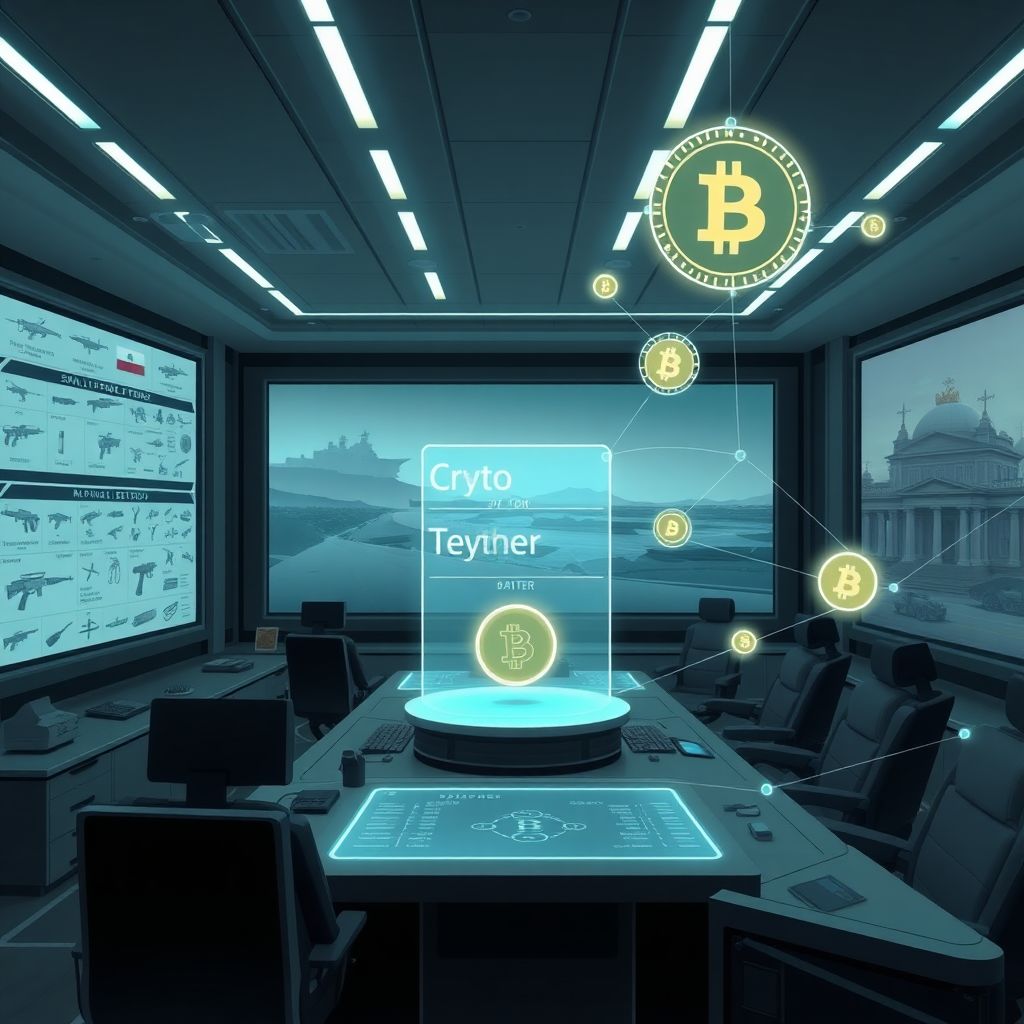
Crypto is emerging as a potential tool in Iran’s efforts to bypass traditional financial controls and expand its role in the global arms market, according to recently surfaced reports on the country’s state arms export agency.
The Ministry of Defence Export Center, commonly known as Mindex, has reportedly begun advertising that it is willing to accept cryptocurrency as payment for a wide range of military hardware. This is a notable escalation from earlier, more discreet uses of digital assets tied to Iran’s sanctioned economy and appears to bring crypto directly into the core of its defense export strategy.
Mindex Opens the Door to Crypto, Rial and Barter
Listings attributed to Mindex’s online export platform describe payment options that go beyond conventional banking rails. Prospective buyers are told they can settle deals in several ways: using cryptocurrency, paying in Iranian rials, or arranging barter-based transactions. The advertisements invite foreign clients to contact Iranian officials to negotiate the details of each contract, implying a high degree of flexibility on price, structure, and settlement method.
In practice, this mix of payment options is designed to dilute the impact of international banking sanctions. Restrictions imposed by the United States, the United Kingdom, the European Union and other allies have heavily constrained Iran’s access to dollar- and euro-based payment systems, as well as to SWIFT. By layering crypto and barter on top of local-currency payments, Tehran appears to be constructing an alternative ecosystem that can function with minimal reliance on traditional banks.
From Drones to Warships: A Broad Arsenal on Offer
Reports describing Mindex’s catalogue indicate that the export offer is not limited to niche or low-grade equipment. The platform is said to promote a full spectrum of hardware, including:
– Small arms and ammunition
– Reconnaissance and combat drones
– Ballistic and other missile systems
– Air defense platforms
– Naval vessels, including warships
This breadth suggests that Iran is positioning itself as a comprehensive supplier for states and non-state actors looking for affordable and politically less scrutinized alternatives to Western and some Eastern arms manufacturers. Public claims that Mindex maintains commercial relations with roughly 35 countries further underscore the scale at which Tehran wants the world to perceive its export capability, even if the exact volume and nature of these deals remain difficult to verify.
Sanctions Pressure and the Turn to Digital Assets
Iran’s shift toward openly advertising crypto payments must be understood against the backdrop of years of financial isolation. Major sanctions have targeted its banking sector, oil exports, shipping, aviation and military procurement. Traditional correspondent banking relationships have been cut off or heavily monitored, making it difficult to receive large cross-border payments through normal channels.
External authorities have previously linked Iran to the use of cryptocurrency in other sanctioned sectors, most notably energy. Past investigations have tied more than 100 million dollars’ worth of crypto flows to Iranian oil-related activities designed to sidestep restrictions. The arms trade is a logical, though more politically sensitive, extension of this strategy: the same attributes that make crypto attractive for oil sales – pseudonymous transfers, borderless settlement, and the ability to route funds through multiple intermediaries – can be applied to weapons exports.
How Crypto Could Move Through Iran’s Arms Deals
The exact mechanics of how crypto would be used in finalized arms contracts remain unclear. Several scenarios are possible:
– Direct wallet-to-wallet transfers: Buyers could send funds directly to addresses controlled by Iranian state entities or their proxies, using coins such as bitcoin, tether, or other widely traded assets.
– Layered transactions: Payments might move through a series of intermediate wallets, mixers or over-the-counter brokers to obscure the origin and destination of funds.
– Hybrid settlements: A buyer could pay a portion in crypto, with the remainder settled through barter (for example, commodities or industrial goods) or local currencies that can later be converted.
Iranian negotiators may also use over-the-counter trading desks or smaller crypto exchanges in jurisdictions with weak compliance controls to turn digital assets into fiat currencies, or to send payments on to domestic contractors and suppliers.
Tracking Challenges for Regulators and Investigators
Observers warn that formal acceptance of crypto in arms deals would complicate monitoring and enforcement. Public blockchains can in theory offer transparency, but that advantage is blunted when:
– Privacy tools, mixing services or privacy-focused coins are used
– Ownership of wallets is hidden behind shell companies or informal brokers
– Payments are broken into many smaller transfers across multiple chains
For law enforcement and sanctions enforcers, the biggest problem is attribution: connecting on-chain activity definitively to a sanctioned entity, a specific weapons transaction, or a particular end-user. If arms shipments occur months after crypto transfers and pass through intermediaries, linking payment and delivery may become exceptionally complex.
At the same time, some analysts note that highly public listings that openly reference crypto could attract exactly the type of buyer already accustomed to avoiding SWIFT and Western banks – governments under sanctions, paramilitary groups, or regimes seeking plausible deniability.
International Response and Potential Countermeasures
Governments with active sanctions regimes on Iran are treating this reported shift seriously. Authorities have a long track record of blacklisting individuals, front companies and networks that use digital assets to assist sanctioned programs, including those related to Iran. Officials are expected to:
– Expand sanctions lists to cover new wallets, exchanges, or intermediaries identified as part of arms-related payment flows
– Pressure crypto service providers to step up sanctions screening, including blockchain analytics and enhanced due diligence on high-risk customers
– Consider regulations specifically limiting the use of crypto in cross-border defense and dual-use goods trade
These responses may not fully stop the activity, but they can raise costs and risks for facilitators and reduce the number of reputable platforms willing to touch such flows.
Open Questions Around Scale and Feasibility
Despite the eye-catching nature of the listings, it is still uncertain how many actual arms contracts will be concluded using cryptocurrency as the main payment rail. Key unknowns include:
– Which coins or tokens Mindex is willing to accept, and under what conditions
– Whether any form of escrow, third-party arbitration or milestone-based payment system is planned
– How shipping, insurance and logistics would be structured to match crypto-based settlements
– Whether states that buy weapons from Iran are technologically and politically ready to adopt crypto at scale for such sensitive purchases
Without answers to these operational questions, some experts believe the current move could be as much about signaling – showcasing defiance of sanctions and technological adaptability – as about immediate large-scale adoption.
Why Crypto Appeals to Sanctioned States in the Arms Context
Beyond Iran, the episode highlights broader reasons why heavily sanctioned countries might look to crypto in arms trading:
– Reduced reliance on Western financial infrastructure: Crypto transactions can, in principle, bypass Western banks, clearinghouses and payment networks.
– Speed and global reach: Funds can be moved quickly across borders, 24/7, with fewer intermediaries.
– Negotiating leverage: A seller can offer flexible payment combinations – digital assets, local currencies and barter – making it easier for buyers with their own financial constraints to proceed.
– Difficulty of uniform global enforcement: Not all jurisdictions enforce sanctions equally, and some may overlook crypto activity that does not obviously touch their domestic systems.
However, these advantages are balanced by volatility risks, technical complexity, and the growing ability of analytics firms and regulators to trace blockchain activity.
Risks for Buyers, Intermediaries and the Broader Crypto Sector
States or entities that choose to pay Iran in crypto for arms face their own set of risks. If their wallets, facilitators or favored exchanges are identified, they may find themselves cut off from major fiat on- and off-ramps, or subjected to secondary sanctions. Logistics companies, insurers and brokers that unknowingly support crypto-funded shipments could also be exposed.
For the wider crypto ecosystem, the association of digital assets with clandestine weapons deals carries reputational and regulatory consequences. Each high-profile case can be used as justification for stricter oversight, more intrusive compliance obligations and, in extreme scenarios, partial bans on certain privacy tools or coins. Industry participants who want to maintain access to mainstream markets have strong incentives to distance themselves from such activity and invest in monitoring and risk controls.
Outlook: A Test Case for Crypto in High-Risk Trade
Iran’s reported willingness to accept cryptocurrency for arms exports serves as a real-time test of how digital assets function in one of the most sanctioned and politically sensitive corners of global commerce. If even a small number of contracts are successfully executed using crypto, it may encourage other isolated regimes or blacklisted groups to attempt similar approaches. Conversely, if enforcement agencies move swiftly and effectively, the deterrent effect could limit broader adoption.
For now, the move signals a new phase in the cat-and-mouse game between sanctions architects and those trying to circumvent them. Crypto, designed as a borderless financial technology, is becoming a central battlefield in that contest — and the arms trade may be one of the most consequential arenas in which its role is tested.