
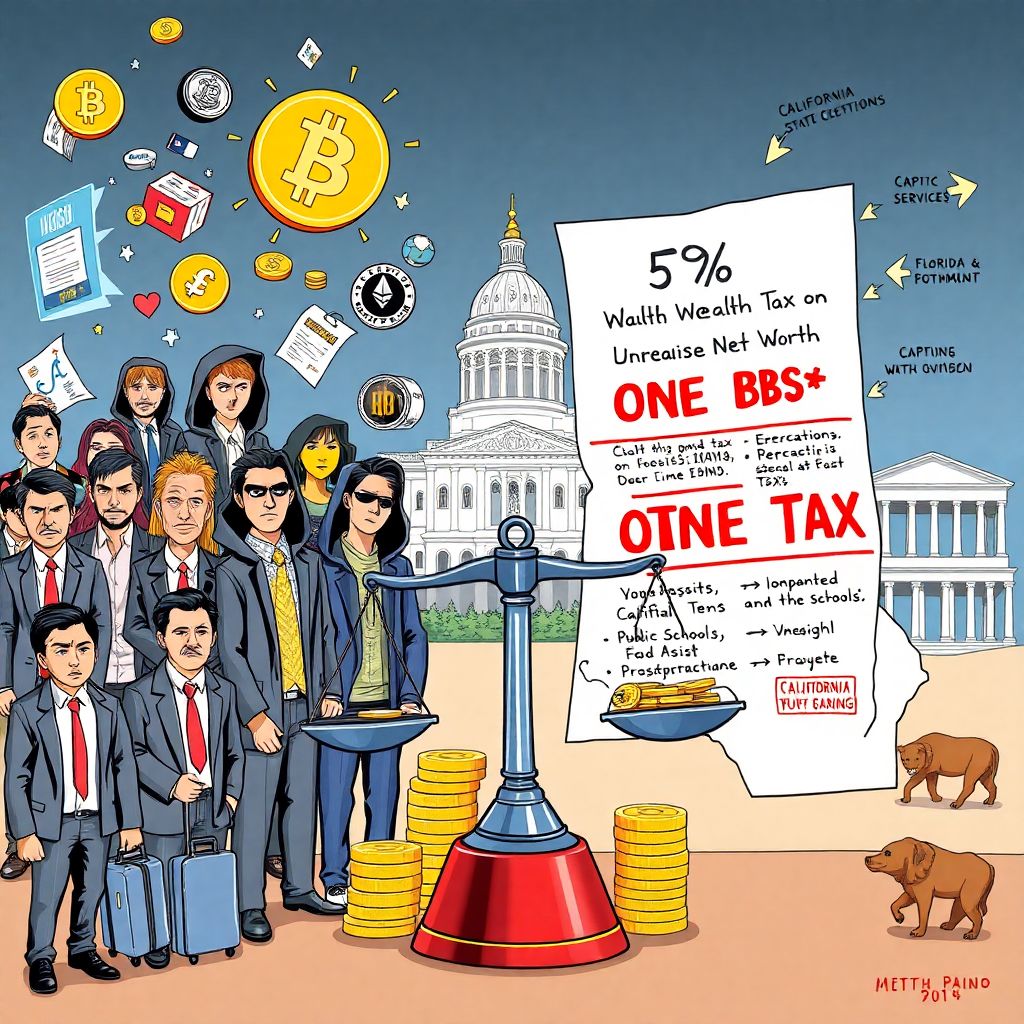
Crypto Heavyweights Clash With California Over Controversial 5% Wealth Tax
A growing chorus of crypto founders, venture investors, and tech executives is mobilizing against a proposed one‑time 5% wealth tax in California, calling it a direct attack on innovation and capital formation in the state.
The initiative targets residents with a net worth exceeding $1 billion, applying the levy to their assets as of January 1, 2026. Crucially, it would not just tax realized income or gains, but also “paper wealth” — unrealized gains in stocks, private company equity, crypto holdings, and other assets that have not been sold.
How the Proposed Tax Works
Under the plan, an individual’s net worth would be calculated as of a specific date, with all assets marked to their estimated market value. That includes:
– Publicly traded stocks and bonds
– Private company shares and startup equity
– Real estate holdings
– Crypto assets and other digital tokens
– Other financial and tangible assets
Anyone whose net worth comes in above the $1 billion threshold would be subject to a 5% charge on the total amount above that line.
Officials behind the proposal estimate that the tax could bring in close to 100 billion dollars, drawn from roughly 200 of the wealthiest Californians. That revenue, supporters say, would be earmarked to fund health care, education, and food assistance programs, without increasing taxes on middle‑income households.
Taxpayers would be given two options: pay the full amount immediately in a lump sum, or spread payments over a five‑year period. Those who choose the installment route would also pay interest over that time, increasing the final cost.
To put it in concrete terms:
– A resident with 20 billion dollars in assets could face a bill of around 1 billion dollars.
– Someone whose net worth exceeds 200 billion dollars could see liabilities climb past 10 billion dollars.
Because the levy is structured as a one‑time charge on a specific valuation date, it functions less like an annual wealth tax and more like a massive, extraordinary assessment on a small group of ultra‑rich residents.
Why Crypto and Tech Leaders Are Angry
Prominent figures in the digital asset and tech ecosystems argue that taxing unrealized gains at such a high rate is both unfair and destabilizing.
Kraken co‑founder Jesse Powell was especially blunt, describing a 5% tax on unrealized gains — and on assets that have already been subject to previous taxes — as “about the most retarded thing” he has ever heard. He warned that this would be “the final straw,” predicting that billionaires would leave the state and take with them their spending, hobbies, philanthropy, and jobs. In his view, lawmakers should instead focus on tackling government waste and fraud before demanding more money from taxpayers.
Others share the same concern, though they use more measured language. The core argument from industry critics is that wealth tied up in equity or crypto is often illiquid. On paper, founders and early investors might appear extraordinarily rich, but they cannot easily convert their holdings into cash without selling off significant stakes — sometimes in companies they run or ecosystems they help maintain.
From their perspective, a sudden multibillion‑dollar tax bill could:
– Force founders to liquidate shares or tokens, potentially harming their own companies or projects
– Push investors and entrepreneurs to relocate to states with more favorable tax regimes
– Accelerate capital flight from California’s tech and crypto hubs
– Undermine the long‑term competitiveness of Silicon Valley and related ecosystems
Hunter Horsley, a well‑known asset manager in the crypto space, has suggested that many of the individuals who helped build California’s tech dominance are now quietly planning to leave within the next year. He frames the trend as part of a broader pattern: people increasingly “vote with their feet,” choosing jurisdictions that better align with their financial and political preferences.
The Special Vulnerability of Crypto and Startup Founders
Crypto and tech founders are often “asset rich” but “cash poor.” Their perceived fortunes are frequently locked into:
– Early‑stage private company equity that cannot be easily sold
– Large, illiquid crypto positions that would move markets if aggressively liquidated
– Long‑term investment vehicles subject to restrictions and lockup periods
For such individuals, paying a 5% charge on total net worth is not as simple as moving money from a bank account. They might need to:
– Sell chunks of their company, potentially surrendering control
– Dump crypto holdings, adding selling pressure to already volatile markets
– Take on debt, using assets as collateral, which introduces new risks
Critics warn that this dynamic could hit exactly the types of people California usually wants to attract: high‑growth entrepreneurs, protocol founders, venture capitalists, and early backers of disruptive technologies.
In the crypto sector specifically, a forced wave of selling to cover tax obligations could contribute to price swings, damage confidence in local projects, and reduce the appeal of California as a global hub for blockchain innovation.
Supporters’ Case: “Tax the Very Top, Protect the Middle”
Backers of the proposal argue that the measure is tightly focused on a tiny, ultra‑rich slice of the population. By design, it spares the middle class and even the ordinary upper‑middle class, instead concentrating obligations on those with nine‑ and ten‑figure fortunes.
In their view:
– The top 0.001% have benefited disproportionately from asset inflation, stock market booms, and the expansion of digital wealth.
– A one‑time contribution from this group could significantly bolster social safety nets.
– Funds raised could expand health services, improve public education, support nutrition programs, and stabilize essential state services.
Representative Ro Khanna has been cited as a supporter who views the initiative as a way to strengthen public infrastructure without burdening everyday families. For advocates, the central fairness argument is straightforward: when a small group holds a massive concentration of wealth, asking them to contribute more to the collective good is justified.
The Big Question: Will the Money Actually Materialize?
On paper, the math looks compelling. Five percent of extremely high net worths quickly translates into tens of billions of dollars. But converting theoretical liability into actual revenue is far less certain.
Critics point to several practical and historical problems:
– Tax migration: Wealthy individuals can and do move. Previous attempts at wealth taxation in other regions have sometimes produced less revenue than advertised because high‑net‑worth residents changed their tax domicile.
– Asset relocation: Even if people stay, they can shift assets offshore or into structures that are more difficult to value or tax.
– Valuation complexity: Privately held companies, early‑stage startups, and crypto portfolios are notoriously hard to price, especially at a single fixed moment in time. Disagreements over valuations could spark legal disputes, appeals, and lengthy negotiations.
– Administrative costs and delays: Implementing and enforcing such a tax demands significant bureaucratic resources. That could eat into the funds raised and slow down the arrival of money for public programs.
For digital assets, the valuation challenge is particularly acute. Crypto prices can swing dramatically within hours. Determining a “fair value” on a single reference date could be contentious, especially for thinly traded tokens or complex DeFi positions.
Legal and Constitutional Uncertainties
Beyond economics, there are potential legal battles looming. Opponents may challenge the tax on several fronts:
– Whether taxing unrealized gains in this fashion aligns with existing state and federal tax principles
– Whether the measure violates constitutional protections on interstate commerce or property rights
– Whether it conflicts with existing limitations on retroactive taxation or due process
Legal fights could delay implementation for years, adding further uncertainty for both taxpayers and the state budget planners counting on the projected revenue.
How This Fits Into a Global Debate on Wealth Taxes
California’s proposal lands in the middle of a broader international conversation about how to tax extreme wealth in an era of soaring asset prices and widening inequality.
Some countries that experimented with wealth taxes in past decades ultimately rolled them back, citing:
– Lower‑than‑expected revenue
– High administrative costs
– Capital flight and brain drain
Others have continued to refine or expand such measures, arguing that taxing concentrated wealth is essential for funding universal services and preventing social fragmentation.
The California initiative, because of the state’s outsized role in technology and finance, is likely to be watched closely by policymakers elsewhere. A successful implementation might embolden similar efforts in other states or countries. A messy, litigious, or economically damaging rollout, by contrast, could become a cautionary tale.
What This Means for California’s Crypto Ecosystem
California has long been a magnet for blockchain developers, exchange operators, NFT platforms, and Web3 startups. A large share of venture capital in crypto and adjacent fields still flows through networks centered in the Bay Area and Los Angeles.
If the wealth tax goes ahead, potential consequences for the local crypto scene include:
– Relocation of founders and funds to states such as Texas, Florida, or Wyoming, which market themselves as more crypto‑friendly and tax‑advantageous
– Shift in where new projects incorporate and hire, with more teams choosing to base core operations elsewhere while keeping only a small presence in California
– Talent diffusion, as engineers and product leaders follow founders and investors to new hubs
– Reduced local lobbying power, if many of the biggest players in digital assets no longer reside in the state and therefore have less direct stake in its policies
On the other hand, if the measure fails or is significantly watered down, it could reinforce California’s status as a place where aggressive tax experiments face pushback from the tech and crypto elite.
Could Compromise Solutions Emerge?
Some policy analysts suggest that there may be middle‑ground approaches that address both inequality concerns and business‑climate fears. Possibilities often floated in broader debates include:
– Narrower surtaxes on very high realized capital gains rather than on unrealized paper wealth
– Temporary levies triggered only during extraordinary market booms
– Exemptions or special treatment for founders with illiquid stakes, phasing in obligations over longer periods
– Clear safe‑harbor rules for hard‑to‑value assets like early‑stage startup equity and certain crypto holdings
Whether California lawmakers or voters would embrace such nuances is unclear. The current proposal, as described, is intentionally bold and highly redistributive, which appeals to some but alarms those whose fortunes are on the line.
The Stakes for Both Sides
For supporters of the measure, the wealth tax represents a rare opportunity to tap immense fortunes and convert them into immediate funding for public good. They see it as a chance to rebalance a system in which a few individuals have amassed sums that dwarf entire public budgets.
For crypto founders, tech leaders, and major investors, however, it sets a dangerous precedent: if the state can impose a 5% one‑time take on unrealized wealth today, what prevents similar or larger grabs tomorrow?
The clash over California’s proposed 5% wealth tax is therefore about more than one policy. It encapsulates a deeper struggle over who should bear the cost of public services in a digital, asset‑driven economy — and whether jurisdictions that push too hard on top earners risk losing the very people and industries that have fueled their growth.
As the debate intensifies, one thing is clear: the outcome will help define the future relationship between California and the global crypto and tech elite, and may influence how other regions approach the question of taxing extreme wealth in the years ahead.