
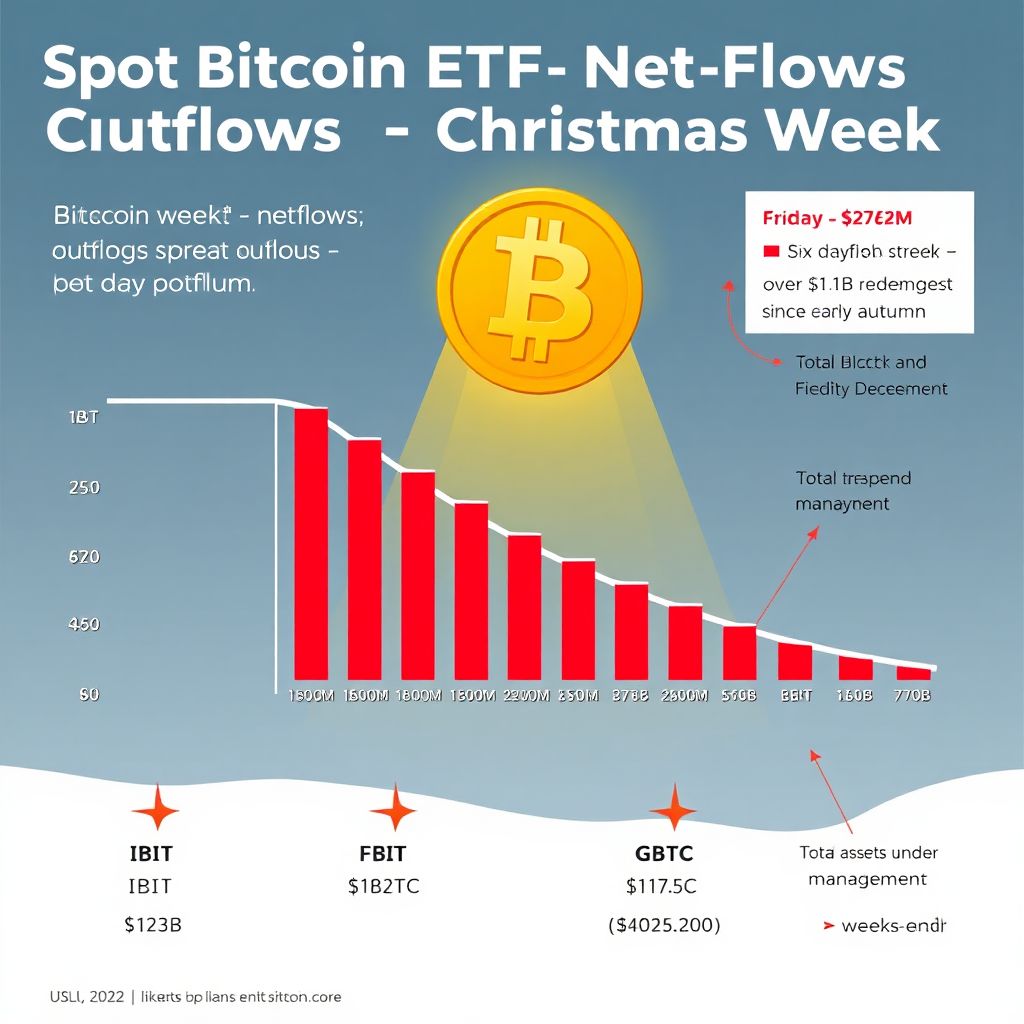
Spot Bitcoin ETFs See $782M Withdrawn Over Christmas Week Amid Seasonal Rebalancing
Spot-based Bitcoin exchange-traded funds faced a sharp wave of redemptions over the Christmas period, with investors withdrawing roughly $782 million in just one week. Data from ETF tracking platforms show that the outflows, which stretched across six consecutive trading days, were driven less by a collapse in demand and more by typical year-end positioning and thin holiday liquidity.
Six-Day Outflow Streak Marks Longest Since Early Autumn
The heaviest blow came on the final trading day of the week, Friday, when spot Bitcoin ETFs collectively registered about $276 million in net outflows. That capped a six-session run of withdrawals — the longest such streak since early autumn — pushing total redemptions over that period to more than $1.1 billion.
By the end of the week, the combined net assets of United States–listed spot Bitcoin ETFs had fallen to roughly $113.5 billion. Earlier in December, that figure had climbed above $120 billion, reflecting strong demand through much of the quarter. Notably, this pullback in ETF assets occurred even though the underlying Bitcoin price hovered near the $87,000 level, showing that price stability did not prevent tactical outflows.
BlackRock and Fidelity Lead Weekly Redemptions
Among individual issuers, BlackRock’s IBIT fund recorded the most pronounced single-day outflow on Friday, with nearly $193 million leaving the product. Fidelity’s FBTC followed with approximately $74 million in net redemptions, while Grayscale’s GBTC continued to see smaller but persistent withdrawals.
These moves reflect a broader trend across the sector, as multiple spot Bitcoin ETFs simultaneously experienced selling pressure. The pattern suggests that investors were not abandoning one issuer in favor of another, but rather scaling back exposure to the asset class as a whole — at least temporarily.
“Holiday Positioning,” Not Structural Demand Collapse
Despite the headline numbers, some market professionals argue that the Christmas week slump should not be interpreted as a fundamental shift in institutional conviction. Vincent Liu, chief investment officer at Kronos Research, described the moves as consistent with “holiday positioning,” pointing to thinner liquidity conditions and year-end portfolio adjustments rather than a breakdown in the investment case for Bitcoin.
In his view, large trading desks often reduce risk ahead of the holidays, particularly in more volatile asset classes. Fewer active participants can also magnify flows during this period, making outflows appear more dramatic than they might in a fully liquid market.
Liu expects that once institutional players return to their desks in early January, ETF flows are likely to stabilize and potentially return to net inflows, assuming macro conditions do not deteriorate sharply.
Macro Backdrop: Rate Cut Expectations May Support Crypto
Looking beyond the immediate holiday period, Liu highlighted monetary policy as a key factor that could underpin renewed demand for spot Bitcoin ETFs. He noted that interest rate markets are already pricing in approximately 75 to 100 basis points of cuts over the coming cycles, signaling a shift toward policy easing.
If central banks move away from aggressive tightening and toward a more accommodative stance, risk assets — including crypto — typically find more support. Lower yields on traditional fixed-income products can make alternative assets relatively more attractive, especially for investors seeking diversification or inflation hedges.
Another driver Liu underscored is the steady build-out of crypto infrastructure within the banking and institutional ecosystem. As more banks and large financial intermediaries offer custody, trading, and connectivity to crypto markets, friction for big allocators continues to fall, making it easier for pension funds, family offices, and asset managers to access Bitcoin through familiar vehicles like ETFs.
Glassnode: Bitcoin and Ether ETFs in a Sustained Outflow Phase
On-chain analytics firm Glassnode recently characterized Bitcoin and Ether ETFs as being in a “sustained outflow phase.” Since early November, the 30-day moving average of net flows into US spot Bitcoin and Ether ETFs has remained consistently negative, signaling that institutional investors, on balance, have been trimming exposure rather than adding to it.
This trend coincides with a broader tightening in global liquidity conditions and a more cautious stance across risk assets. While crypto had benefited significantly from institutional participation earlier in the year, the recent data suggest that large allocators are taking profits, rebalancing portfolios, or simply waiting on clearer macro signals before deploying fresh capital.
Because ETFs are widely seen as a transparent barometer of institutional sentiment, prolonged outflows can indicate a broader de-risking phase. That does not necessarily mean institutions are turning bearish on crypto over the long term, but it does reflect a shift away from aggressive accumulation — at least for the moment.
Are Institutional Investors Losing Interest in Bitcoin?
The recent numbers might tempt observers to conclude that institutional interest is fading. However, the picture is more nuanced. Several factors can help explain why investors might be pulling back without signaling a permanent turn away from digital assets:
1. Profit-taking after strong gains
Bitcoin’s sharp appreciation earlier in the year gave many funds a window to lock in gains. Reducing ETF positions into year-end can be part of deliberate performance management and risk control.
2. Portfolio rebalancing
As Bitcoin’s price rises, it can become an outsized portion of diversified portfolios. Some investors systematically rebalance back to target allocations, which translates into selling pressure in ETF products.
3. Regulatory and reporting considerations
Year-end is often when institutions reassess exposures ahead of audits, regulatory reporting, and internal reviews. Some may temporarily reduce positions to simplify books or maintain specific risk thresholds.
4. Waiting for macro clarity
With interest rate paths, inflation, and growth projections still uncertain, some allocators prefer to hold higher cash balances and delay new crypto commitments until 2025 forecasts look clearer.
In this context, the current outflows look more like a cyclical pause than a structural retreat.
What Holiday Outflows Mean for Retail Investors
For individual investors using ETFs to gain Bitcoin exposure, the Christmas-week withdrawals carry several implications:
– ETF outflows do not automatically mean Bitcoin will crash
While large redemptions can exert pressure, the underlying asset traded in deep global markets can absorb flows, especially if spot buying from other channels offsets ETF selling.
– Flows can reverse quickly in January
Historically, risk assets sometimes see a “January effect,” where fresh capital allocations and renewed risk appetite return after year-end. If institutional desks come back more constructive on crypto, ETF flows could swing back to positive.
– Liquidity conditions matter
Thin holiday trading can amplify price moves, even if the actual size of flows is moderate by institutional standards. Investors may want to interpret extreme prints during this period with caution.
Retail participants should pay attention not just to the direction of flows, but also to the context — macro policy expectations, regulatory developments, and broader market risk sentiment.
Comparing Bitcoin and Ether ETF Dynamics
While this article centers on spot Bitcoin ETFs, Ether products are experiencing similar crosswinds. Glassnode’s analysis includes both BTC and ETH funds, highlighting that the negative 30-day moving average of net flows affects the two largest crypto assets.
This parallel pattern suggests that the current phase is less about idiosyncratic risk to Bitcoin or Ether and more about a generalized pause in institutional appetite for crypto as a whole. Factors such as interest rate uncertainty, equity market valuations, and geopolitical tensions can collectively drive risk-off behavior across a range of asset classes.
Investors looking to understand whether the outflows are nearing exhaustion may watch for stabilization in both Bitcoin and Ether ETF flows, rather than focusing on one asset in isolation.
Longer-Term Outlook: From Volatile Flows to Structural Adoption
Despite short-term volatility in ETF flows, several structural themes continue to underpin the long-term case for spot Bitcoin products:
– Growing comfort with regulated crypto exposure
Many institutions prefer ETFs over direct coin custody due to clearer regulatory frameworks, exposure caps, and established operational processes.
– Integration with traditional wealth platforms
As more brokerages, banks, and advisory platforms list and recommend spot Bitcoin ETFs, access widens beyond early adopters to mainstream investors.
– Potential monetary regime shifts
If the forecasted easing cycle in interest rates materializes, the appeal of hard assets and alternative stores of value could rise, indirectly supporting demand for Bitcoin-linked products.
– Ongoing innovation in crypto infrastructure
Improvements in custody, risk management, compliance tools, and market surveillance continue to reduce perceived barriers for conservative capital.
These forces do not eliminate risk, but they create a foundation on which ETF-based exposure can grow over multiple years, even if quarterly flow data fluctuate.
Key Takeaways for the Coming Months
– Around $782 million exited spot Bitcoin ETFs over Christmas week, with total assets dropping from above $120 billion to roughly $113.5 billion.
– Friday’s $276 million in net outflows capped a six-day streak — the longest withdrawal run since early autumn — with cumulative redemptions over that period topping $1.1 billion.
– BlackRock’s IBIT and Fidelity’s FBTC were the main drivers of the latest pullback, while Grayscale’s GBTC continued to experience moderate but continued outflows.
– Analysts attribute much of the move to year-end “holiday positioning,” thin liquidity, and portfolio rebalancing rather than a decisive collapse in institutional interest.
– Glassnode’s data show a sustained outflow phase for both Bitcoin and Ether ETFs since early November, aligning with tighter global liquidity and more cautious risk sentiment.
– Expectations of future interest rate cuts and expanding bank-led crypto infrastructure may support a recovery in ETF demand as 2025 and 2026 approach.
For now, the Christmas-week redemptions highlight the sensitivity of crypto-linked ETFs to calendar effects and macro uncertainty — but they stop short of signaling the end of institutional engagement with Bitcoin.