
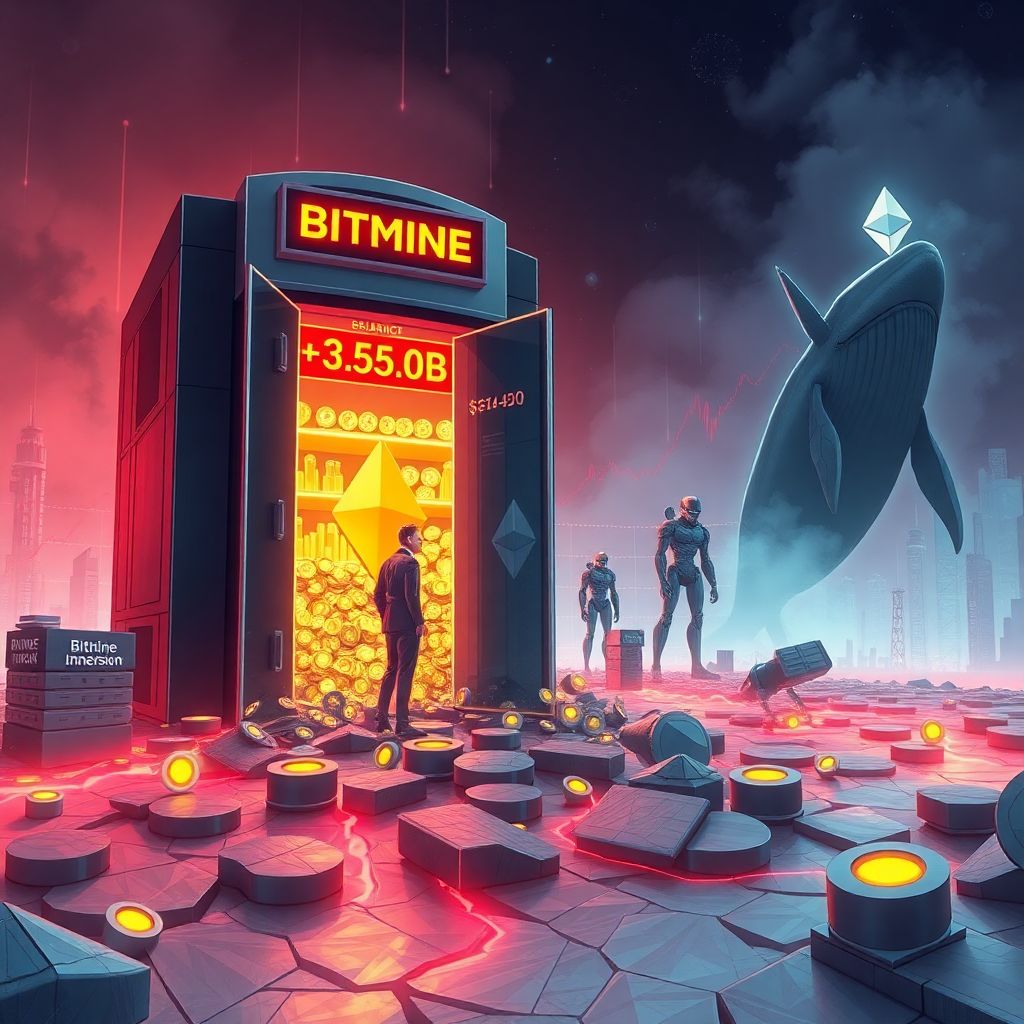
BitMines’ $15B Ethereum gamble sits on $3.5B in paper losses – but is the worst already over?
The brutal Q4 2025 crypto sell-off has turned into a major stress test for digital asset treasuries (DATs), especially those heavily exposed to Ethereum. BitMine Immersion, the largest known corporate holder of ETH, is now nursing an unrealized loss estimated at around $3.5 billion on its Ethereum position.
Over the last two months, as ETH has moved sideways in a tight band between roughly $2,600 and $2,750 following a 40% drawdown, BitMine’s paper loss has oscillated in a range between $3.5 billion and $4.2 billion. The market has effectively paused in consolidation mode, but the impact on large, highly concentrated treasuries has already been significant.
BitMine’s mega-ETH position under pressure
Tom Lee, the Chair of BitMine, has positioned himself as one of the most outspoken Ethereum bulls in the corporate world. His thesis rests on two main pillars:
– the long-term tokenization of real-world assets on Ethereum, and
– the structural growth of the stablecoin market settled on the network.
In line with this conviction, BitMine allocated approximately $14.6 billion to accumulate about 3.7 million ETH. With ETH trading around $2,900, that position has slid into a deep unrealized drawdown of over $3.5 billion.
Despite the pressure, there has been no sign of capitulation from BitMine. Lee has reportedly continued adding to the company’s ETH stack, treating the correction as a strategic, long-duration entry zone rather than a reason to unwind.
Not every treasury can afford to hold
Other crypto treasuries have been much less resilient. Firms such as SharpLink and ETHZilla, which also pursued aggressive Ethereum strategies, have been forced to offload large parts of their holdings. In some cases, they have effectively scrapped their ETH-focused treasury strategies altogether.
This wave of forced selling raised concerns among market observers. The fear was straightforward: if more distressed DATs were pushed into liquidation and no large buyers stepped in, the sell pressure could extend the bear market and drag ETH to even lower levels.
This risk is not trivial. Treasury entities collectively hold about 5.6% of Ethereum’s total circulating supply, a share comparable to some of the largest ETF structures in the market. Large-scale rotation or unwinding from this cohort can meaningfully affect price dynamics, especially during periods of thin liquidity and negative sentiment.
While some capitulate, whales quietly accumulate
Paradoxically, the same volatility that put treasuries under stress seems to have attracted deeper-pocketed buyers. On the institutional and whale side, Ethereum has seen a notable increase in accumulation during the late-2025 drawdown.
Jack Yi, founder of trading firm Liquid Capital, publicly confirmed that his firm bought about $1.72 billion worth of ETH when the price sank to the $2,600 area in November. According to his comments, Liquid Capital still plans to deploy another $1 billion into Ethereum, effectively signaling a multi-billion-dollar vote of confidence at current levels. Yi even went as far as cautioning bears, calling the current conditions a “historic opportunity” and warning against shorting ETH.
On-chain data appears to support this narrative. Wallets holding between 10,000 and 100,000 ETH – a classic whale cohort – have ramped up their buying pace throughout 2025, with a particular surge in accumulation during the Q4 downturn. As of the latest data, this group collectively controls more than 21 million ETH, underscoring sustained conviction among large holders even while some corporate treasuries are forced to sell.
ETH looks undervalued by multiple metrics
From a valuation standpoint, Ethereum’s spot price around $2,900 currently screens as undervalued across several fundamental and on-chain indicators. A basket of ten key metrics designed to measure ETH’s “fair value” recently showed seven flashing an outright “buy” signal.
Based on these models, the estimated fair value of ETH sits near $4,200, implying a potential upside of roughly 45% from current levels if the market realigns with underlying fundamentals. These indicators take into account factors such as network usage, fee revenue, realized value, and various on-chain flows, attempting to filter out short-term noise.
Historical readings provide some interesting context.
– In March, when ETH traded near $1,500, the same fair-value framework suggested a level around $2,500. Within two months, by May, the market had indeed climbed to that zone.
– Later, in June, with ETH hovering around $2,500, the model projected a move toward $3,600. Roughly a month later, that target area was tagged as well.
While this track record is noteworthy, it is crucial to acknowledge that past alignment between model and price does not guarantee future performance. Markets can stay mispriced for prolonged periods, and exogenous shocks can override fundamentals in the short term.
Could Ethereum really rally 45% from here?
If history rhymes and the current fair-value readings once again prove directionally correct, Ethereum could be poised for a mid-term rally of around 45%, potentially carrying the price into the $4,000+ region. For long-term holders like BitMine, a move back toward or above $4,200 would substantially reduce – or even erase – current paper losses.
However, several factors would need to align for such a scenario to play out:
1. Macro environment:
Rising interest rates, tighter liquidity, or broad risk-off sentiment across global markets could cap upside, regardless of ETH-specific fundamentals.
2. Regulatory clarity:
A friendlier or at least more predictable regulatory backdrop for Ethereum-based applications, including tokenization and stablecoins, would likely support the thesis held by BitMine and other bulls.
3. Network activity and revenue:
Sustained growth in on-chain activity, layer-2 adoption, and fee generation would help validate the models signaling undervaluation.
4. Treasury and ETF flows:
Continued accumulation by whales, DATs that can afford to hold, and institutional products would be a strong demand-side offset to any lingering sell pressure from distressed entities.
Why treasuries are still betting on ETH’s long game
For treasuries like BitMine that are structured to think beyond quarterly returns, Ethereum is more than just a speculative token. Their thesis is anchored in several structural trends:
– Tokenization of assets:
From securities and funds to real estate and credit instruments, Ethereum remains one of the leading platforms for asset tokenization. If this trend scales as many expect, the demand for ETH as the underlying settlement asset could increase significantly.
– Stablecoin expansion:
A large share of the global stablecoin ecosystem runs on Ethereum or its layer-2 networks. As stablecoins are increasingly used for payments, remittances, and on-chain finance, the value captured by the ETH economy – through fees and network effects – could grow correspondingly.
– DeFi and restaking infrastructure:
The development of restaking protocols, liquid staking tokens, and complex DeFi strategies continues to embed ETH deeper into the financial plumbing of the crypto economy. This creates additional utility and yield opportunities for long-term holders like BitMine.
From this perspective, short-term volatility – even large unrealized drawdowns – may be an acceptable cost for securing exposure to what they see as a foundational piece of future financial infrastructure.
The risk side: what if relief doesn’t come soon?
Despite encouraging accumulation signals and fair-value models pointing higher, there are clear risks that could delay or derail any relief rally:
– Extended consolidation or further downside:
If ETH remains trapped in a choppy range or breaks below recent lows, treasuries sitting on large unrealized losses may face mounting internal and investor pressure.
– More forced sellers:
Additional DATs or leveraged entities could be forced to liquidate if prices remain depressed, creating a feedback loop of selling and lower prices.
– Competition from other chains:
If alternative smart contract platforms capture significant share of tokenization, DeFi, or stablecoin activity, the long-term dominance assumed in many ETH bull theses could be challenged.
– Unfavorable policy moves:
Aggressive regulatory actions targeting stablecoins, staking, or on-chain finance could weigh heavily on Ethereum’s growth outlook.
Investors relying on BitMine’s conviction or whale accumulation as signals must weigh these downside scenarios carefully rather than assuming an automatic mean-reversion.
What this means for individual investors
For retail and smaller institutional players, this environment presents both opportunity and risk:
– Opportunity:
If the fair-value models are broadly correct and the structural drivers for Ethereum remain intact, current prices could indeed represent attractive long-term entry points, particularly for those employing dollar-cost averaging or multi-year time horizons.
– Risk:
Unrealized losses like BitMine’s highlight how quickly even large, sophisticated players can see positions move deeply against them. Anyone considering significant ETH exposure must be prepared mentally and financially for drawdowns of 40% or more.
Good risk management remains essential: position sizing, diversification beyond a single asset, and avoiding excessive leverage are all critical if the market takes longer than expected to recover.
Will BitMine’s strategy be vindicated?
Whether BitMine’s aggressive Ethereum bet ultimately looks visionary or reckless will depend heavily on how the next few years unfold:
– A scenario where ETH climbs above previous highs, tokenization and stablecoin volumes explode, and regulatory conditions stabilize would likely turn today’s $3.5 billion paper loss into a footnote in a successful long-term strategy.
– Conversely, if Ethereum underperforms, faces persistent regulatory headwinds, or gradually cedes its leadership role, the same position could be remembered as a costly overexposure to a single high-risk asset.
For now, BitMine appears committed to riding out the storm, continuing to accumulate rather than cutting losses. That stance aligns more with the whales and funds quietly buying the dip than with the distressed treasuries exiting the market.
Final thoughts
Ethereum’s current drawdown has exposed the vulnerabilities of highly concentrated treasuries, with BitMine’s $15 billion gamble now sitting on over $3.5 billion in unrealized losses. Yet, beneath the surface stress, large buyers are accumulating, valuation models flag ETH as undervalued, and the long-term structural narrative remains intact for many institutional players.
Relief is not guaranteed, and any prospective 45% upside comes with substantial risk. But if history and fundamentals once again converge, the current phase may be remembered less as the start of a prolonged collapse and more as an uncomfortable, but ultimately temporary, reset before the next leg higher.
Disclaimer: This material is intended for informational purposes only and should not be interpreted as investment, trading, or financial advice. Cryptocurrencies are highly volatile, and buying, selling, or holding them involves substantial risk. Every reader should conduct independent research and consider their own financial situation and risk tolerance before making any investment decisions.