
The first 15 minutes after a big headline hits are where chaos, fear and opportunity collide. In crypto, this tiny window is often the difference between catching a move early and becoming late exit liquidity. When you mix news, a real-time crypto market data platform and on-chain traces of smart money, you get something close to a radar system for asymmetric trades.
Below — how to think about these moments analytically, not emotionally, and how to turn real‑time news spikes into on-chain edge without LARPing as a high-frequency fund.
—
Why the First 15 Minutes Matter More in Crypto Than in TradFi
The crypto market is structurally designed to overreact fast: 24/7 trading, fragmented liquidity, a retail-heavy audience and a constant stream of headlines. Over 2022–2024, global crypto market cap swung from roughly $800–900B at the 2022 lows to around $1.7T by late 2023 and over $2T in 2024. A large share of the sharpest intraday moves clustered around news shocks: ETF filings, regulatory actions, protocol hacks, listings and macro numbers.
Studies by exchanges and market‑making desks over these years repeatedly showed:
– Intraday volume on top assets can spike 3–5x in the first 15–30 minutes after a major news release.
– Bid–ask spreads widen significantly in the first few minutes, then compress as more liquidity providers update quotes.
– Volatility regimes “step up” after big headlines and often stay elevated for hours, even after the initial move.
For anyone working on a systematic crypto news trading strategy, this says one thing: reaction time to information and capacity to verify it on-chain matter more than perfect prediction. You don’t have to be first; you need to be early, correct and size appropriately.
—
From Narrative to Flows: What “On-Chain Edge” Really Is
News creates a narrative; on-chain data shows who is actually betting on that narrative with size. That gap is the playground. In 2022–2024, on-chain transparency matured from a niche research tool into a key component of execution for both discretionary and systematic traders.
Modern on-chain analytics tools for traders combine several layers:
– Entity-level labelling (funds, market makers, notable DeFi whales, CEX hot wallets).
– Transaction pattern recognition (accumulation, distribution, bridging, MEV behaviour).
– Protocol-specific signals (staking, borrowing, LP withdrawals, governance moves).
During those first 15 minutes, you’re basically asking three questions:
– Is size actually flowing into the asset that the headline is about, or is this just social media noise?
– Are smart money wallets confirming the move (adding exposure) or fading it (selling into strength)?
– Is the on-chain behaviour consistent with the story, or does it contradict the headline?
In practice, the edge often comes from disagreement between the headline and the flows. For example: bullish partnership announcement, price spikes 12% in minutes, but on-chain shows key VC and market maker wallets systematically off‑loading into FOMO. That turns a chase-the-pump situation into a short-the-overreaction setup.
—
Anatomy of the First 15 Minutes: A Practical Microstructure View
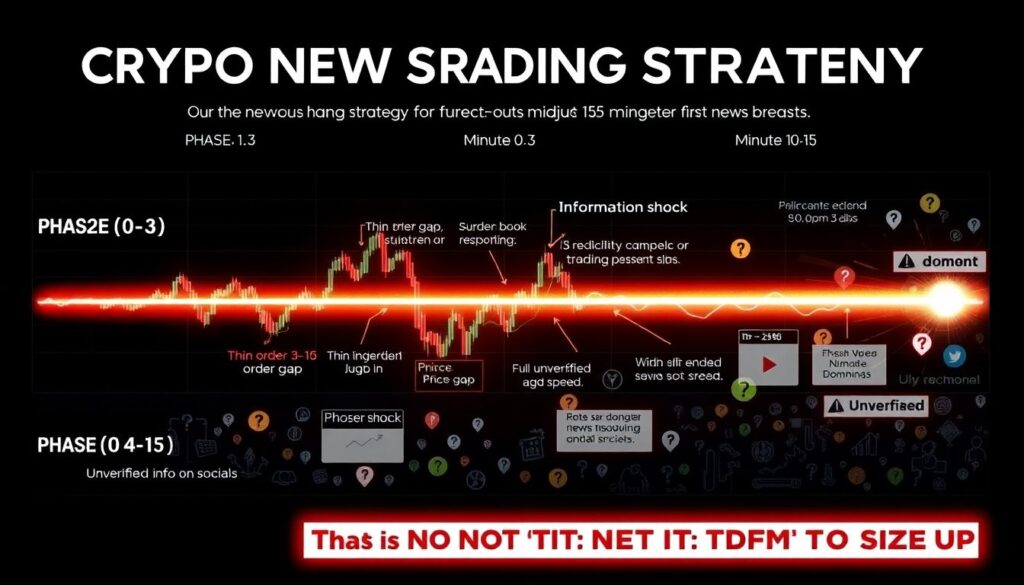
Break the first 15 minutes into three phases and you get a useful mental model for any crypto news trading strategy:
– Minute 0–3: Information shock and price gap. Liquidity is thin, spreads are wide, bots dominate, and half of the “info” on socials is still unverified. This is *not* the time to size large unless you have direct, validated data feeds and automation.
– Minute 3–8: Confirmation and filter. The headline is digested; bigger players update orders; news is cross‑checked; early on-chain flows show up. This is where the best crypto signals with on-chain data usually fire: you have enough context to avoid pure noise, but the move isn’t fully priced.
– Minute 8–15: Alignment or divergence. Price action, order books and on-chain flows either reinforce the same direction or start to diverge. This is your decision point: join, fade, or stand aside.
Over 2022–2024, you can see in historical charts that a big share of extreme daily candles (±15–30%) on mid‑cap tokens were effectively “locked in” by minute 15–20: once a real news‑backed repricing started, reversing it intraday required a second piece of news or clear evidence that initial info was wrong.
—
Building a News-First Workflow: From Alert to Execution
The goal is to automate everything that *can* be automated, so that human attention is reserved for judgment calls. A pragmatic workflow usually has four layers:
– Ingestion: Aggregated news feeds, social monitoring, official protocol channels and a reliable real-time crypto market data platform for quotes, spreads and depth.
– Verification: Check primary sources (regulatory websites, protocol blogs, GitHub, on-chain events like contract upgrades or governance proposals). Filter obvious misinformation.
– On-chain confirmation: Inspect flows into and out of key smart contracts, bridges and major wallets. Is capital actually moving?
– Execution & risk: Pre-defined order templates, position limits per event type, and clear invalidation rules.
This is also where crypto trading algorithms based on news start to shine. They don’t “understand” the narrative the way a human does, but they’re ruthlessly consistent about:
– Time-stamping when the first valid headline hit the system.
– Measuring the reaction time between headline and price.
– Quantifying typical overreaction sizes per asset and per category of news.
By 2024, several professional desks were already running hybrid systems: humans tag and classify news quality; algorithms handle initial reaction trades within narrow risk parameters; and discretionary traders step in if the move evolves into a larger narrative trend.
—
What the Data from 2022–2024 Actually Tells Us
We don’t have a single canonical dataset, but looking across exchange reports, derivatives metrics and on-chain dashboards, some consistent patterns have emerged over the last three years:
– Concentration of impact: A relatively small set of events — central bank decisions, ETF and listing headlines, major exploits, and regulatory announcements — drive a disproportionate share of intraday volatility. Routine updates barely move the needle.
– Rise of automation: By 2024, a notable share of short‑horizon volume on large pairs (BTC, ETH, top L1s) around news events is executed by systematic or semi‑systematic strategies, compared with a more manual, retail-driven flow in 2021–2022.
– Shorter reaction lags: Latency between initial headline and noticeable order‑book impact has visibly shrunk. Where it might have taken 2–3 minutes for size to hit the book in 2021, by 2024 this can be well under a minute on flagship assets.
On the macro level, the share of total crypto derivatives open interest tied to event‑rich assets (like BTC around ETF/halving cycles or specific L1s/layer‑2s around upgrades) increased across 2022–2024. This reinforces the idea that information events are now a primary axis of positioning, not an afterthought.
—
Economic Aspects: Why News Spikes Are Structurally Profitable (and Dangerous)
Economically, news shocks are moments when the market is forced to reprice information under time pressure. Imperfect information, behavioural biases and heterogeneous access to data create short‑lived mispricings. Three economic drivers dominate:
– Information asymmetry: Even in a transparent on-chain world, asymmetry exists in data collection, processing speed, and interpretation. Those with better pipelines extract more of the “information rent” in the first minutes.
– Liquidity mismatch: New information demands instant price change, but liquidity providers need time to adjust quotes. Until then, order books are thin and dislocated, inviting both arbitrage and slippage.
– Risk transfer: Participants offload unwanted risk quickly at almost any price. The other side—whoever is better capitalized and prepared—earns a premium for warehousing that risk.
Over 2022–2024, the cost of being on the wrong side of these spikes has also gone up. Larger leverage availability on perpetuals, combined with tighter liquidation engines, means that abrupt 5–10% moves in the first 15 minutes can wipe out poorly collateralized positions before traders have time to reassess.
That’s why rational sizing, not just signal quality, sits at the core of any serious news‑driven approach.
—
Designing Robust Rules: Where Discretion Ends and Systems Begin
A big mistake retail traders make is treating every headline as equal. Professional desks classify events and pre‑define responses before anything happens. A robust, conversational-but-strict way to think about it:
– Tier 1 events: Global macro, top‑tier regulatory changes, ETF decisions, critical protocol failures or upgrades. Here you might allow higher size and more complex options structures.
– Tier 2 events: Exchange listings/delistings, large funding rounds, major partnership announcements, mid‑size hacks. Position sizes are smaller; focus is on relative value between correlated tokens.
– Tier 3 events: Routine updates, community drama, minor governance tweaks. Usually noise unless confirmed by on-chain flows.
For each tier you want hard rules on:
– Maximum leverage and notional per trade.
– Required confirmation from both off‑chain news and on-chain signals.
– Time stop: if the trade thesis doesn’t play out in X minutes/hours, you’re out.
When people talk about having the best crypto signals with on-chain data, what they usually mean is not magic alpha, but consistently applied rules that prevent them from overreacting to low‑quality information while still being fast on high‑impact events.
—
Tools and Infrastructure: What You Actually Need (and What You Don’t)
You do not need an HFT-grade setup to exploit the first 15 minutes, but you can’t do it with a phone and a few Twitter tabs either. Realistically, for a serious approach you need:
– A low‑latency, reliable real-time crypto market data platform that covers both spot and derivatives, with depth-of-book and funding data.
– On-chain analytics tools for traders that surface wallet labels, recent flows and contract‑level activity within a few blocks.
– A broker or exchange setup with pre‑configured order templates, API keys, and basic automation for entries, stops and take‑profits.
– Logging and analytics: you want every trade tied to a specific news event, timestamped, so you can measure performance per event type.
A lot of traders chase more signals when they actually need better post‑trade analysis. Over the last three years, desks that systematically tagged their news-driven positions by category and time-to-entry were able to drop entire classes of unprofitable setups and double down on the handful that repeatedly worked.
—
Industry Impact: How News-Driven and On-Chain Trading Are Reshaping Crypto
Zooming out from individual trades, the art of the first 15 minutes is gradually changing the industry’s structure:
– More efficient price discovery: Prices now incorporate major information much faster than in 2017–2019. This reduces the duration of obvious mispricings but increases the number of micro‑opportunities for those with good tooling.
– Professionalization of retail: Many sophisticated “retail” traders now operate small, systematic books with access to institutional‑grade tools, blurring the line between prop desk and individual trader.
– Feedback loops between media and markets: Outlets have learned that certain kinds of headlines reliably trigger flows. This can distort coverage but also creates predictable patterns in sentiment and positioning.
As crypto trading algorithms based on news get more widespread, we can also expect new forms of reflexivity. If too many models respond the same way to a given category of headline, moves may overshoot even more violently, only to mean‑revert when the collective model positioning unwinds. That opens a second class of strategies: trading against the predictable behaviour of other news‑reactive actors.
—
Looking Ahead to 2025–2027: Where the Edge Is Likely to Move
Projecting from 2022–2024 trends, a few plausible developments stand out for the next 2–3 years:
– Richer event taxonomies: Instead of treating “news” as one blob, models will assign granular probabilities and typical PnL distributions to hundreds of distinct event types, specific to each asset.
– Deeper integration of on-chain and off-chain data: The line between sentiment feeds, order‑book data and on-chain traces will blur into unified feature sets inside trading systems.
– More competition in low-latency space, more room in the 3–15 minute window: Latency arbitrage will likely commoditize quickly, but human–machine hybrid strategies in that 3–15 minute band will stay rich for longer.
For individual traders, the sustainable path is not trying to beat co‑located bots in the first 10 seconds, but to use the first 15 minutes as an x‑ray: is this a durable repricing supported by real flows, or a manipulative burst that you should fade or ignore?
—
Wrapping It Up: Principles for Turning Spikes into Structured Edge
If you boil everything down, turning real‑time news spikes into on‑chain edge over the first 15 minutes comes down to a few disciplined habits:
– Separate *headline* from *flow*: never act on words alone; confirm with where capital is moving on-chain.
– Codify tiers and rules: event types, position limits, time stops, and confirmation thresholds should be defined ahead of time, not improvised mid‑spike.
– Measure, don’t mythologize: track performance per event, per asset, per time‑to‑entry. Kill unprofitable patterns ruthlessly.
– Accept that missing trades is fine; taking unstructured risk is not.
In a market that never sleeps and reacts in seconds, the first 15 minutes are where processes are stress‑tested. With clean data, coherent rules and a realistic view of your own speed, those minutes stop being a blur of noise and turn into a repeatable framework for extracting edge from the constant stream of crypto news.