
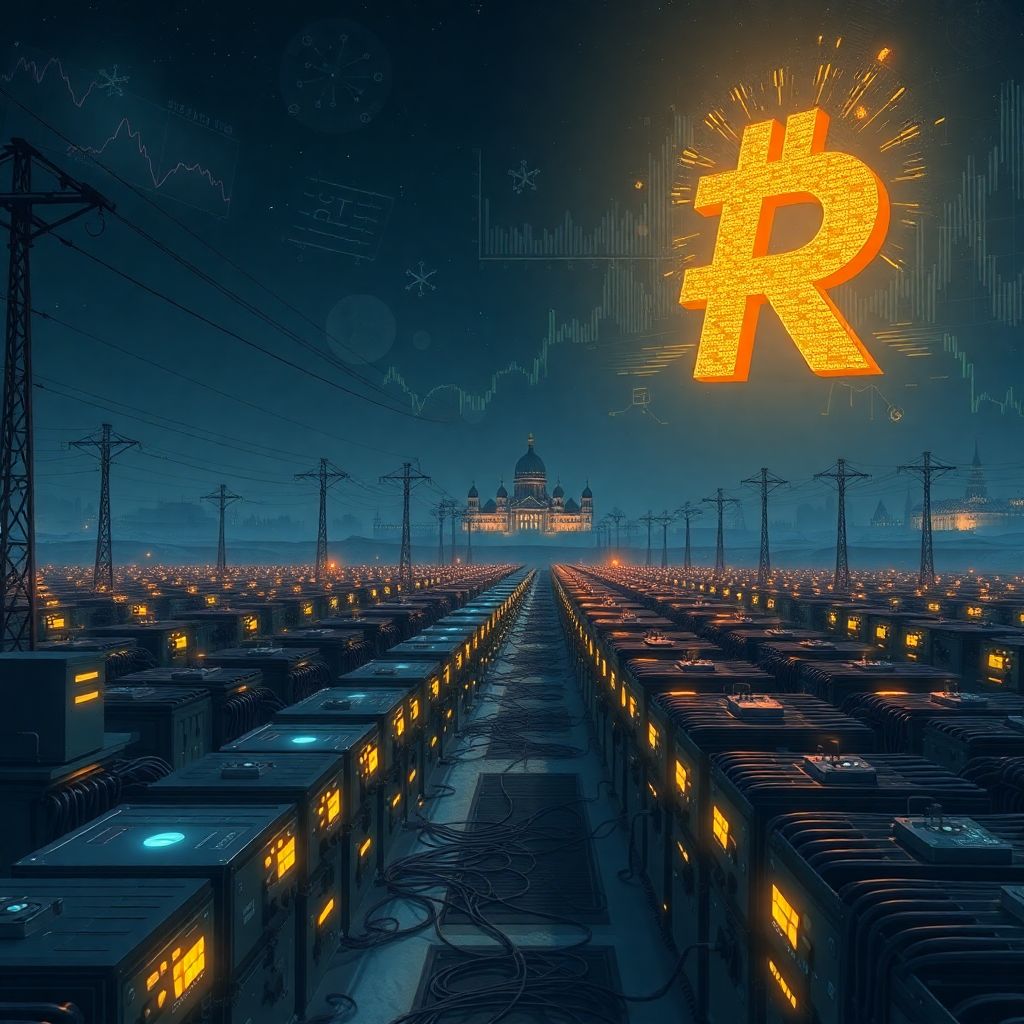
Bitcoin Mining May Quietly Be Shoring Up The Ruble, Russian Central Bank Admits
Bitcoin mining, long treated in Russia as a technical curiosity or an energy story, is now being discussed at the highest levels as a factor in the country’s currency markets. According to Central Bank Governor Elvira Nabiullina, mining activity may be providing modest support to the Russian ruble – even if the scale of that impact is still largely unknown.
Speaking at a press conference, Nabiullina emphasized that it is “probably difficult to quantify” how much crypto mining influences the ruble. A key reason, she noted, is that “a significant part of mining is still in a gray area,” operating outside clear legal and reporting frameworks. Despite this uncertainty, she acknowledged that mining is “indeed one of the additional factors contributing to the strong ruble exchange rate.”
Her remarks highlight a shift in how Russian authorities are starting to interpret crypto-related activity. What was once dismissed as niche is increasingly being woven into discussions about macroeconomics, capital flows, and the structure of Russia’s export revenues.
Mining As A “New Export” – But Hard To Track
Nabiullina’s comments echo earlier statements from Maxim Oreshkin, deputy head of the presidential administration. Oreshkin argued that traditional ruble forecasts have been distorted because analysts underestimated financial flows tied to crypto mining and broader cryptocurrency operations.
In his view, this activity has effectively become a new kind of export. Instead of selling oil, gas, or metals, Russian miners export computational power and electricity in the form of newly created Bitcoin and other digital assets. The proceeds, often received in foreign currencies or crypto, can then be converted into rubles — supporting the domestic currency.
The challenge, Oreshkin underscored, is that these flows tend to move outside conventional banking channels, making them statistically “invisible.” That invisibility complicates both monetary policy and exchange-rate modeling, forcing officials to account for a growing, yet partially hidden, segment of the economy.
No Simple Cause-And-Effect Between Mining And Ruble Strength
Despite acknowledging mining as a contributing factor, Nabiullina was careful to reject any simplistic narrative that a surge in mining alone is responsible for the ruble’s recent strength. She stressed that mining did not suddenly appear in 2025, and therefore it would be incorrect to attribute current exchange-rate dynamics solely to a supposed boom in activity this year.
“This mining did not appear this year, so it is impossible to link the strengthening of the exchange rate specifically to the fact that it has somehow grown sharply,” she said. According to her, while there is “probably some increase” in mining, the currency’s performance is a result of multiple forces, with crypto-related flows being only one of several supportive elements.
This nuanced framing suggests that the central bank is wary of focusing too heavily on mining as a driver of the ruble. Instead, authorities appear intent on integrating it into a broader mosaic of factors, including energy exports, capital controls, interest-rate policy, and global commodity prices.
From Gray Zone To White List: The Push To “Legalize” Crypto
The conversation about mining’s macro impact naturally leads to a second priority for the central bank: bringing crypto activity out of the shadows. Nabiullina’s emphasis on opacity and measurement closely aligns with the regulator’s broader objective to “whiten” the domestic crypto market — in other words, to shift it from a semi-official gray zone into a fully regulated space.
Vladimir Chistyukhin, the first deputy chairman of the central bank, recently underscored that it is now fundamentally important to “legalize” the cryptocurrency sector. By legalization, officials do not mean liberalization; rather, they are calling for explicit laws that would define, limit, and tightly control crypto operations. Chistyukhin has advocated for speedy adoption of regulations governing crypto transactions, including strict restrictions and outright prohibitions in certain areas.
The aim is twofold: to ensure that authorities can see and account for the financial flows associated with mining and trading, and to minimize risks related to money laundering, sanctions evasion, and capital flight.
Coordinated Rules: Central Bank, Finance Ministry, And Regulators
In parallel with these statements, the central bank is actively discussing regulatory frameworks for crypto trading with the Finance Ministry, Rosfinmonitoring (the financial intelligence unit), and other relevant state bodies. The emerging approach points toward a model where cryptocurrency transactions are routed through already-licensed financial and market institutions.
Under this vision, crypto operations would not be left to informal over-the-counter desks or loosely structured entities. Instead, they would be funneled through banks, brokers, and other regulated intermediaries, making the flow of funds more traceable and subject to existing compliance standards.
Such coordination suggests that Russia is preparing a layered regulatory architecture: miners and traders may not be banned outright, but they would be expected to operate within a framework that prioritizes transparency, oversight, and the state’s monetary-policy goals.
Crypto Will Not Become “Money” In Russia, Lawmaker Insists
Despite the growing role of mining in national economic discussions, Russian lawmakers continue to draw a firm line on one crucial point: cryptocurrencies will not replace the ruble as legal tender.
Anatoly Aksakov, chairman of the State Duma Committee on Financial Markets, reiterated last week that cryptocurrencies “will never” function as money inside Russia or in international trade. That position fits with the central bank’s long-standing skepticism toward private digital currencies as a direct competitor to sovereign money.
In practice, this stance means that while mining may be tolerated or even quietly encouraged as an export-like activity, the state is determined to prevent Bitcoin or other coins from becoming a parallel payment system or unit of account within the country.
Why Policymakers Care About Mining Now
For global crypto markets, the headline is not that Russia has officially blamed or credited Bitcoin mining for the ruble’s movements. Rather, the key development is that senior Russian policymakers now treat mining-linked flows as a real variable in currency-market dynamics.
By acknowledging this, the central bank implicitly admits that Bitcoin and other cryptocurrencies are no longer marginal from a macroeconomic standpoint. Mining is consuming energy, generating revenue, and influencing demand for rubles — even if that impact is incremental.
At the same time, the drive to formalize and regulate the sector signals that the state is not willing to leave this new “export channel” completely unmanaged. Bringing miners and traders into a transparent framework would make it easier for authorities to monitor the volume of crypto-related inflows, evaluate their effect on the exchange rate, and align them with broader financial and industrial policy.
How Mining Can Support A National Currency
The logic behind mining’s potential support for the ruble can be broken down into several basic mechanisms:
1. Foreign revenue inflows
Miners effectively sell newly created Bitcoin on global markets, often receiving dollars, euros, or other foreign currencies in return. When those funds are converted into rubles to cover domestic costs — such as electricity, salaries, or equipment — they increase demand for the national currency.
2. Indirect export of energy
In energy-rich countries, mining turns surplus or stranded electricity into a tradable digital asset. This is akin to exporting energy in another form. For Russia, with its significant energy resources, this can be particularly relevant, especially in regions where traditional industrial demand is limited.
3. Diversification of export structure
As traditional commodity exports face price volatility or sanctions pressure, crypto mining offers an additional, less conventional export channel. While smaller in scale than oil or gas, it can still provide a cushioning effect on foreign-currency inflows.
4. Onshore retention of capital
If mining is conducted domestically and profits are at least partly kept inside the country, it can help retain capital onshore instead of letting it migrate to international financial centers.
However, all of these mechanisms depend on how rigorously the sector is regulated, how revenues are reported, and whether miners choose to convert their earnings into rubles rather than holding them in crypto or foreign currencies.
Risks That Worry The Central Bank
Alongside potential benefits, Russian authorities also see clear risks in letting the mining sector grow unchecked.
– Financial stability concerns:
Large, opaque crypto flows can complicate monetary policy, interfere with capital controls, and create channels for capital flight.
– Sanctions and compliance:
In a heavily sanctioned environment, regulators are particularly sensitive to the possibility that crypto could be used for sanctions evasion, exposing banks and companies to additional legal and diplomatic pressure.
– Market volatility:
Bitcoin and other cryptocurrencies remain highly volatile. A sector strongly tied to such assets can experience sudden profit collapses, bankruptcies, and knock-on effects in energy or financial markets.
– Reputational and systemic risk:
If retail investors or poorly regulated institutions become overexposed to crypto, a sharp market downturn could trigger broader confidence issues in the financial system.
These risks explain why the central bank speaks simultaneously about legalization and restrictions: the goal is controlled transparency, not unfettered growth.
What This Means For Russian Miners
For Russian Bitcoin miners, the evolving stance of the central bank is a mixed development. On one hand, the implicit recognition that mining contributes to the ruble’s resilience could be read as a tacit acknowledgment of the sector’s economic value. On the other hand, the call to “whiten” the industry and impose stricter rules means that miners should prepare for tighter oversight.
They are likely to face:
– Mandatory registration and licensing requirements
– More stringent reporting of income and financial flows
– Closer scrutiny of cross-border transactions
– Possible limits on which entities they can sell Bitcoin to and how they can repatriate funds
Over the long term, though, a clear legal framework could also bring benefits: better access to financing, more predictable rules for foreign partners, and reduced regulatory uncertainty for large-scale infrastructure investments.
A Signal To Global Crypto Markets
Russia’s debate over mining and the ruble is part of a broader global trend. As the scale of Bitcoin mining and crypto trading grows, more governments are moving from ignoring the sector to explicitly integrating it into macroeconomic and regulatory thinking.
For traders and investors, the Russian case offers several takeaways:
– States can view Bitcoin mining as a quasi-export industry, capable of influencing currencies and balance of payments.
– Even jurisdictions that are skeptical of crypto as “money” may still tolerate or harness mining for economic reasons.
– The more important mining becomes, the more likely it is to be heavily regulated, taxed, and monitored.
Against this backdrop, Bitcoin itself remains a global asset reacting to a complex mix of macro forces, regulatory developments, and market sentiment. At the time of writing referred to in the original report, Bitcoin was trading around 88,927 dollars, underscoring both its scale and the potential importance of mining revenues to any country hosting significant hash power.
In Russia’s case, the message from the central bank is clear: Bitcoin mining is no longer just about cheap electricity and server racks in remote regions. It has become one of the many moving parts in the machinery that shapes the ruble — and the state now wants to see, measure, and control exactly how that machinery works.