
Bitcoin Losses Are Getting Older: Nearly Half Of Underwater Supply Now With HODLers
On-chain data suggests that the current Bitcoin downturn is becoming increasingly defined by long-term conviction rather than short-term speculation. According to the latest analysis from Glassnode, a growing share of coins sitting at an unrealized loss is now held by long-term holders (LTHs), indicating that pain in the market is slowly “aging.”
How Bitcoin “Supply in Loss” Is Measured
Glassnode’s study centers on a key on-chain metric: Bitcoin Total Supply in Loss. This indicator tracks how many BTC are currently worth less than the price at which they last moved on-chain.
To calculate it, every coin in circulation is examined to identify its last transaction price. If that historical price is higher than today’s spot price, the coin is in profit; if it is lower, the coin is regarded as “underwater” or in loss.
– All coins currently below their last move price are aggregated into the Total Supply in Loss.
– The complementary metric, Total Supply in Profit, sums all coins whose last move price is below the current market price.
These two figures together provide a snapshot of how much of the network’s capital is nursing unrealized gains versus unrealized losses at any point in time.
Losses Spiked After The November Price Crash
The recent price breakdown in November triggered a strong jump in the Total Supply in Loss. As Bitcoin sold off sharply, a broad swath of coins that had been bought closer to the highs flipped into negative territory.
Since that crash, the 7‑day moving average of the Total Supply in Loss has remained elevated in a tight corridor between 6 and 7 million BTC. The latest reading sits around 6.7 million BTC, marking the deepest level of unrealized losses seen on the network since 2023.
Glassnode notes that this environment resembles the early “transition” stages observed in previous cycles, when frustration and exhaustion begin to build among investors before more decisive bearish phases and potential capitulation events emerge.
Echoes Of Prior Bear Market Transitions
Historically, periods where 6–7 million BTC are held at a loss have often aligned with structurally weak phases in the market. During these times, sentiment tends to sour, trading volumes can dry up, and even long-standing bulls start questioning their positioning.
Glassnode highlights that this configuration mirrors the opening chapters of earlier bear market legs:
– Losses become widespread, not just confined to late entrants.
– Price continues to drift or grind lower rather than immediately snapping back.
– Frustration rises as “buy-the-dip” efforts fail to produce sustained upside.
This backdrop creates the conditions for either deep capitulation — where heavily stressed holders finally sell — or, alternatively, a prolonged accumulation zone where patient buyers steadily absorb supply at discounted prices.
Short-Term vs Long-Term Holders: Who Is Hurting?
To better understand who is shouldering the bulk of these unrealized losses, Glassnode divides the market into two major cohorts based on holding time:
– Short-Term Holders (STHs): Coins that have last moved within the past 155 days.
– Long-Term Holders (LTHs): Coins that have remained dormant on-chain for more than 155 days.
This 155‑day threshold has repeatedly proven useful in on-chain research. Over many cycles, coins that remain unspent beyond this window statistically become less likely to move, reflecting stronger conviction and lower sensitivity to short-term volatility.
In the immediate aftermath of the November sell-off, the spike in loss was largely concentrated among STHs. These are typically recent buyers who entered near local highs or during the final stages of the preceding rally and quickly found themselves underwater.
Losses Are “Maturing” Into Long-Term Hands
However, as Bitcoin has drifted sideways to lower levels since that crash, the composition of who holds these underwater coins has begun to change. The share of losses carried by long-term holders is rising, while the portion held by newer market participants has started to decline.
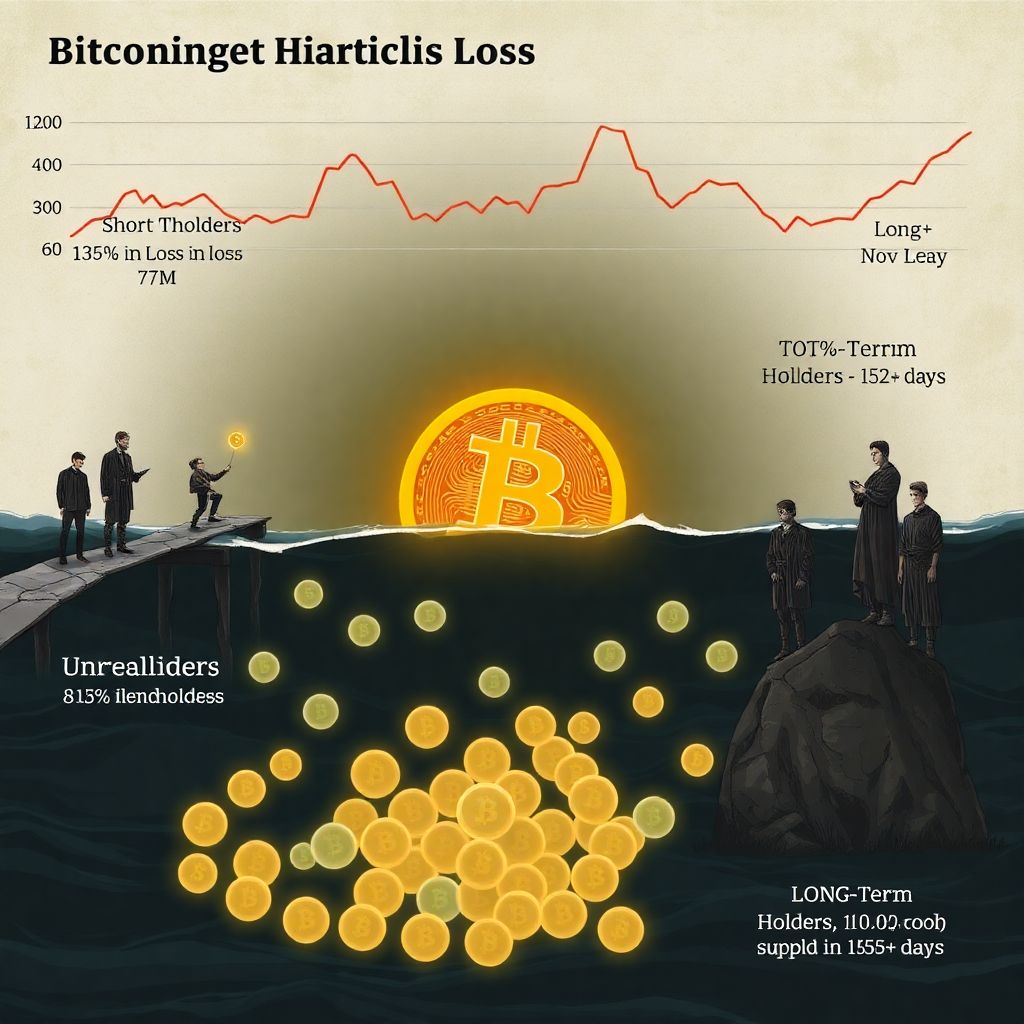
Out of the entire circulating supply, 23.7% is currently held at an unrealized loss. Breaking this down:
– 13.5% of the total supply in circulation is underwater and held by short-term holders.
– 10.2% of the total supply is underwater and held by long-term holders.
In other words, nearly half of all coins in loss are now controlled by investors who have held their BTC for more than 155 days. Glassnode interprets this shift as a sign that coins initially bought by short-term speculators and held in loss are gradually crossing the threshold into the long-term holder cohort as time passes and these investors refrain from selling.
What This Says About Market Psychology
This “aging” of losses is a powerful signal of investor psychology:
– Holders who bought near the top are not panic-selling en masse, even though they are significantly underwater.
– Instead, they are choosing to hold through volatility, thereby transitioning into the LTH category.
– The more coins held by LTHs, even at a loss, the tighter the liquid supply becomes, which can influence how future price moves unfold.
Historically, extended periods during which a meaningful chunk of LTH supply sits at a loss have often coincided with late-stage bear markets or deep corrective phases. These are moments when the market is largely in the hands of high-conviction participants who are either unwilling to capitulate or waiting for much higher prices before distributing their coins.
Why Aging Losses Can Be Structurally Important
From a market structure perspective, the growing share of underwater coins held by LTHs has several implications:
1. Reduced Forced Selling Pressure
Long-term holders are generally less sensitive to short-term shocks, macro headlines, or sharp intraday moves. As more underwater coins migrate into their hands, the risk of cascade liquidations caused by emotional selling or stop-loss triggers tends to diminish.
2. Potential Fuel For Future Rallies
When the market eventually recovers, coins accumulated by LTHs at depressed prices often become the foundation for the next bull leg. Many long-term holders wait for substantial multiples on their cost basis before selling, which can delay heavy distribution until much higher price zones.
3. Capitulation Risk Still Exists
At the same time, if macroeconomic conditions deteriorate sharply or if confidence in Bitcoin’s long-term story were to weaken, even LTHs are not immune to capitulation. Periods where a large share of long-term supply is in loss can become unstable if external stress becomes extreme.
Comparing With Earlier Cycles
The current pattern, where Total Supply in Loss remains elevated while increasingly aging into LTH hands, fits a broader template seen during previous cycle transitions:
– In earlier cycles, sharp drawdowns pushed a large share of recent buyers into loss, similar to the November move.
– Over the following months, those who refused to sell gradually transformed into long-term holders, increasing the proportion of underwater LTH supply.
– This typically coincided with a grinding, emotionally taxing period characterized by low volatility, waning attention, and a general sense of disillusionment.
Only after such phases had sufficiently shaken out speculative interest and consolidated coins into strong hands did lasting, sustainable uptrends tend to emerge.
The Role Of Short-Term Holders Going Forward
Short-term holders remain an important part of the picture. They continue to account for a slightly larger share of the underwater supply (13.5% of the circulating supply) than long-term holders.
Their behavior often dictates short- and medium-term price action:
– If STHs aggressively cut their losses on further dips, it can accelerate downside moves and deepen corrections.
– If instead they exhibit resilience — holding through volatility or even accumulating more — it can reduce sell pressure and help create a price floor.
At present, the balance between weary short-term participants and increasingly committed long-term holders appears to be tilting toward the latter, reinforcing the narrative that the market is gradually transitioning into a more mature phase of the current cycle.
Tightening Margins And A More Difficult Trading Environment
Glassnode also highlights that on-chain activity has shifted from high-reward environments, where volatility and upside momentum are abundant, to a regime characterized by tighter margins. In such conditions:
– Trend-following strategies become less effective.
– Rallies are frequently sold into as holders seek to exit at breakeven or small profits.
– Traders must navigate choppy price action with fewer clear signals and narrower profit windows.
Against that backdrop, the growing weight of LTH-held losses reinforces the idea that Bitcoin is in a more grinding, structurally challenging phase rather than an explosive growth environment — at least in the short term.
Price Snapshot: Market Under Pressure
At the time of writing, Bitcoin is trading around 85,400 dollars, having shed more than 5.5% over the last week. This pullback has kept a large segment of the supply underwater and prolonged the period of elevated unrealized losses.
Yet, the fact that such a significant portion of those underwater coins is now being held by long-term participants highlights a crucial dynamic: the market may be under pressure, but conviction among core holders has not yet been broken.
Whether this sets the stage for a deeper capitulation event or forms the foundation for the next major cycle will depend on how long this aging-loss phase persists, how macro factors evolve, and whether new demand eventually steps in to challenge the resolve of these hardened HODLers.