
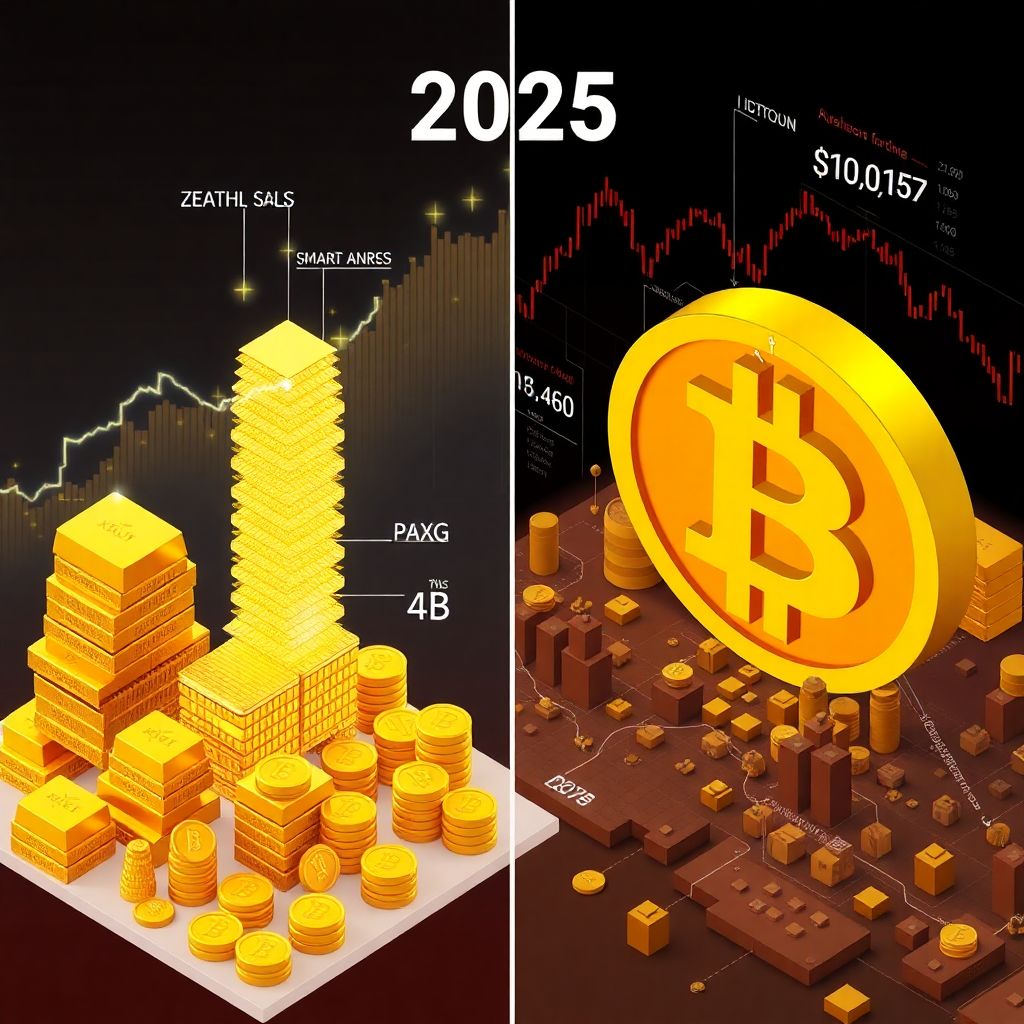
On‑chain gold races past $4B as investors sidestep Bitcoin
—
Tokenized gold has quietly become one of the biggest winners of 2025. While Bitcoin has stumbled after its highs, on‑chain gold products backed by physical bullion have surged past a combined market value of 4 billion dollars – a milestone that sheds light on how investors are now thinking about safety, risk and returns in a volatile macro environment.
Instead of rotating into Bitcoin during bouts of uncertainty – a pattern many traders got used to during earlier crypto cycles – a growing slice of capital is now flowing into gold‑backed stablecoins. The message from the market is clear: when fear rises, a lot of participants still trust gold more than Bitcoin.
—
Gold and silver climb, Bitcoin slips
The macro backdrop sets the stage for this shift.
– Gold has been grinding higher toward the 4,300 dollars per ounce region.
– Silver has broken above 60 dollars.
– Bitcoin, by contrast, has pulled back sharply from above 110,000 dollars to around 88,000 dollars in the period discussed, failing to reclaim momentum.
This divergence has started to reshape how capital is allocated on‑chain. Assets that mirror traditional safe havens – particularly gold – are gaining share, while Bitcoin’s role as a “digital safety trade” is being questioned.
One of the most telling indicators is the Bitcoin‑to‑gold ratio. In 2025, that metric has dropped by nearly 50%, meaning that one Bitcoin now buys far less gold than it did at the start of the year. For portfolio managers who track relative value between assets, that is not a trivial move – it is a loud signal that the market’s confidence in Bitcoin as a superior store of value is being tested.
—
Tokenized gold crosses $4B – and grows faster
Against this backdrop, on‑chain representations of gold have been expanding at a rapid pace.
The total market capitalization of gold‑backed stablecoins has climbed beyond 4 billion dollars, up significantly from levels seen in early 2025. This growth has been driven by two forces moving in the same direction:
1. Rising gold prices – Each on‑chain token is usually backed by a fixed amount of physical gold, so when the underlying metal appreciates, the total value of those tokens rises as well.
2. New capital inflows – More investors are deliberately seeking out these instruments as a way to park wealth in what they perceive as a safer asset without leaving the blockchain ecosystem.
The market itself is highly concentrated. Two products – Tether Gold (XAUT) and Paxos Gold (PAXG) – collectively represent the vast majority of all tokenized gold in circulation. Their supplies have been expanding more quickly in recent months, tracking both institutional adoption and retail interest in on‑chain alternatives to vault accounts and ETFs.
For many users, these tokens offer a mix that traditional options cannot: 24/7 transferability, programmable settlement, and exposure to physical gold, all within the crypto infrastructure they already use.
—
On‑chain behavior mirrors off‑chain accumulation
What is happening on‑chain is not occurring in a vacuum. It is closely aligned with behavior in the traditional financial system.
Throughout 2024 and 2025, central banks across multiple regions have been steady and persistent buyers of gold. Month after month, they have been adding tens of tonnes of bullion to their reserves, turning gold accumulation into a structural, not cyclical, trend.
Data on official sector purchases showed net buying spiking above 70 tonnes in late 2024. After a brief cooling period earlier in 2025, buying picked up again in the middle and later parts of the year. That kind of sustained demand from large, conservative institutions provides a powerful tailwind for gold prices.
At the same time:
– Gold‑focused ETFs have continued to see net inflows, reinforcing the narrative of gold as the preferred hedge.
– Bitcoin ETFs, on the other hand, have been dealing with outflows, and some long‑term holders have been trimming exposure, locking in prior gains or de‑risking.
When traditional institutions and central banks lean heavily into gold, it inevitably influences how crypto‑native investors think about “safe” assets. Tokenized gold becomes a convenient bridge: it allows them to align with global macro flows while staying inside the digital asset universe.
—
Why Bitcoin is losing the safety trade – for now
Market participants increasingly argue that gold’s climb is not a speculative bubble but a rational response to macro stress.
Several structural factors are supporting gold:
– Rising global debt burdens – Governments and corporates are piling on more obligations, raising questions about long‑term fiscal sustainability.
– Compressed yields – Even when nominal interest rates are elevated, real yields can be pressured by inflation and policy expectations, pushing investors toward non‑yielding hedges like gold.
– Policy and geopolitical uncertainty – From elections to trade tensions and regional conflicts, the list of risks that cannot be easily modeled keeps growing.
In this context, gold’s centuries‑long track record as a reserve asset carries weight. It is perceived as politically neutral, outside the direct control of any single government or technology platform, and deeply embedded in central bank strategy.
Bitcoin, while widely held and increasingly integrated into mainstream finance, is still seen by many large allocators as a risk asset tied to liquidity conditions. When interest rate expectations shift or funding conditions tighten, crypto tends to suffer. Traders are now “pricing in” the possibility of a more fragile macro environment by raising their allocation to gold – both off‑chain and on‑chain – while waiting for a clearer liquidity picture before ramping crypto exposure back up.
—
The fading “digital gold” narrative?
One of Bitcoin’s strongest narratives over the last decade has been its role as “digital gold” – a scarce asset that could outperform traditional stores of value over long horizons.
The recent divergence does not necessarily destroy that narrative, but it complicates it:
– In risk‑on periods with abundant liquidity, Bitcoin still tends to outperform, drawing capital from both retail and institutions.
– In risk‑off periods, however, the current cycle shows that investors are not automatically treating BTC as the first stop for capital preservation.
As gold’s performance outpaces Bitcoin’s, some investors are re‑evaluating whether BTC is primarily a macro hedge or a high‑beta play on the broader risk environment. The near 50% slide in the Bitcoin‑to‑gold ratio in 2025 underscores that, in the short to medium term, gold has reclaimed the upper hand as a defensive asset.
This does not mean Bitcoin’s long‑term thesis is broken, but it does challenge the idea that it has already replaced gold as the default safe haven. Instead, markets seem to be moving toward a more nuanced view in which both assets can coexist, playing different roles depending on conditions.
—
Tokenized gold: why investors like it
The surge in tokenized gold is not only about macro trends; it is also about mechanics and usability.
Key reasons investors are comfortable with gold‑backed stablecoins include:
– Accessibility – Users can buy, sell, and transfer fractional amounts of gold around the clock without dealing with physical delivery, vaults, or traditional brokerage accounts.
– Settlement speed – Transfers can be near‑instant across borders, which is attractive for traders, remitters, and treasury managers.
– Integration with DeFi – In some cases, tokenized gold can be used as collateral, lent out, or paired in liquidity pools, combining the stability of gold with the yield‑generating opportunities of decentralized finance.
– Transparency and auditability – Many issuers provide regular attestations of their bullion reserves, which helps build trust, especially compared to opaque off‑balance‑sheet products.
For crypto‑native investors who are used to self‑custody and smart contracts, tokenized gold feels like a natural extension of their existing toolkit, rather than an entirely separate asset class.
—
What this shift means for the broader crypto market
The growing appeal of gold‑backed tokens has deeper implications for how the crypto ecosystem is structured.
1. No single “safe haven” anymore
The idea that Bitcoin is the sole safe asset within crypto is being challenged. Tokenized treasuries, stablecoins, and now tokenized gold are creating a spectrum of perceived safety options. Investors can fine‑tune their risk rather than making a simple choice between BTC and cash.
2. Changing market correlations
As more capital parks in gold‑backed stablecoins during stress, correlations between Bitcoin and other risk assets may strengthen, while gold‑linked tokens behave more like traditional safe havens. This can alter trading strategies and portfolio construction within crypto.
3. New competition for stablecoins
Fiat‑pegged stablecoins remain dominant for payments and liquidity, but for long‑term parking of value, tokenized gold offers an alternative that some users may find more attractive than holding synthetic dollars subject to monetary policy risk.
4. Regulatory and institutional interest
Regulators and institutions watching crypto may view gold‑backed products as a more familiar bridge into the space. That could lead to tailored rules or new institutional offerings over time, further legitimizing on‑chain commodities.
—
Could Bitcoin regain the spotlight?
Despite its current underperformance versus gold, Bitcoin is not out of the game. Its long‑term investment case still rests on several pillars:
– A strictly limited supply schedule, unaffected by future mining output decisions.
– Deep liquidity and market infrastructure, including derivatives, ETFs, and custody solutions.
– A growing base of long‑term believers who treat it as a multi‑cycle asset rather than a short‑term trade.
If macro conditions shift – for example, if central banks signal easier policy, liquidity expands, or risk appetite returns – Bitcoin could again become a leading beneficiary. Historically, strong gold performance has sometimes preceded or coincided with later rallies in other alternative assets as investors broaden their search for returns.
In that scenario, the current wave of capital moving into tokenized gold might eventually rotate back into higher‑beta crypto assets, including BTC, as confidence in the growth outlook improves.
—
What investors should watch next
Going into the next phase of the cycle, several indicators will be critical for understanding whether the on‑chain gold boom continues and how Bitcoin responds:
– Central bank gold purchases – If official sector buying stays strong, it reinforces the structural case for gold and its tokenized versions.
– ETF flows into gold vs. Bitcoin – Persistent divergence in flows will continue to shape relative performance and investor sentiment.
– Macro data and policy guidance – Inflation trajectories, growth forecasts, and central bank communications will heavily influence the appeal of safe‑haven assets.
– Liquidity in tokenized gold markets – Tighter spreads, deeper order books, and broader exchange support would make gold‑backed stablecoins even more competitive as a parking lot for capital.
– Adoption in DeFi – Wider use of gold tokens in lending, collateralization, and structured products could entrench them as a central pillar of on‑chain finance.
—
The bottom line
Gold’s rise – both in the physical world and on‑chain – is reshaping how investors think about safety inside the crypto universe. With tokenized gold surpassing 4 billion dollars in value and central banks continuing their accumulation spree, traditional bullion has reasserted itself as the dominant safe‑haven asset.
Bitcoin, meanwhile, has faced price pressure, weaker ETF flows, and growing competition from tokenized alternatives when fear dominates the narrative. The sharp drop in the Bitcoin‑to‑gold ratio in 2025 underscores this changing balance.
Rather than a simple story of “gold versus Bitcoin,” the current market looks more like a reordering of roles: gold – including its on‑chain versions – is leading the defensive play, while Bitcoin increasingly behaves like a high‑conviction, high‑volatility bet on the future of digital finance and liquidity cycles.
How long this phase lasts will depend on macro conditions, policy decisions, and investor psychology. For now, though, the message from capital flows is unmistakable: in an uncertain world, gold – even when wrapped in code and smart contracts – is winning the safety trade.