
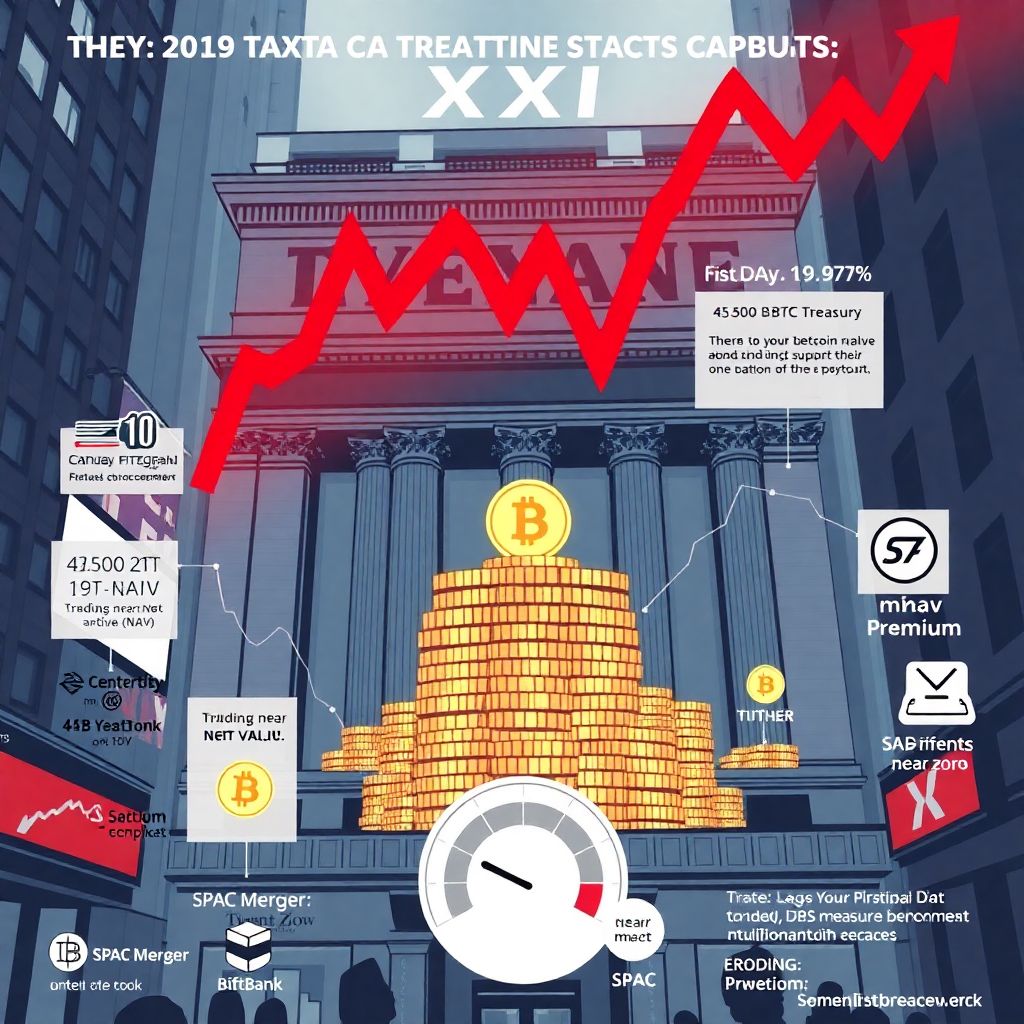
Why Twenty One’s First-Day Drop Matters for Bitcoin-Backed Stocks
Twenty One Capital’s debut on the New York Stock Exchange was expected to be a showcase moment for Bitcoin-native corporations. Instead, its nearly 20% first-day slide became a clear signal: the market is no longer willing to pay up just because a company sits on a large pile of BTC.
Behind the headline move is a deeper story about how investors now think about Bitcoin-tied equities, SPAC listings and what a “Bitcoin-native” public company must deliver to justify a premium.
What Twenty One Capital Actually Is
Twenty One Capital is an institutionally backed, Bitcoin-first public company whose central ambition is simple but aggressive: to become the largest listed corporate holder of Bitcoin.
The firm went public through a merger with a special-purpose acquisition company (SPAC) sponsored by Cantor Equity Partners and began trading on the NYSE under the ticker XXI. From day one, its identity was framed around Bitcoin rather than a traditional operating business.
At listing, Twenty One disclosed a treasury of more than 43,500 BTC, valued at roughly $3.9–4.0 billion at the time. That immediately put it among the biggest corporate holders of Bitcoin globally.
Structurally, the company is designed as a Bitcoin-centric corporate vehicle. Its founders and backers emphasize that Twenty One is not meant to be a passive BTC hoard, but a platform to build financial and infrastructure products aligned with the Bitcoin ecosystem. Jack Mallers, also known as the founder of Strike, has described Twenty One’s long-term objective as creating corporate infrastructure for Bitcoin-focused financial services.
This places Twenty One in the same broad category as digital asset treasury (DAT) companies, but with important distinctions. Its backers include:
– Cantor Fitzgerald, a primary dealer with the US Federal Reserve
– Tether, issuer of USDt (USDT) and a major holder of US Treasurys
– Bitfinex
– SoftBank
This level of institutional sponsorship makes Twenty One one of the most heavily backed Bitcoin-native firms ever to access the public equity markets.
The Debut: High Expectations, Sharp Repricing
The company came to market against a backdrop of growing interest in Bitcoin-aligned corporate strategies, many of them inspired by the approach popularized by MicroStrategy (now Strategy). However, Twenty One repeatedly signaled that it did not intend to simply copy a “buy-and-hold BTC” playbook. Instead, it pitched a hybrid model: maintaining a significant Bitcoin treasury while also pursuing revenue-generating products and services.
Given its balance sheet size and the caliber of its financial backers, expectations were high going into the NYSE listing. Yet the first trading session on December 9, 2025, delivered an unexpectedly cautious response.
When Cantor Equity Partners’ SPAC shares rolled into the new XXI security, the stock opened at $10.74, already below the SPAC’s previous close of $14.27. A mild bounce in after-hours trading failed to offset the weakness. By the end of the first full trading day, XXI closed around $11.96 — a decline of roughly 19.97% from the SPAC’s earlier level.
That performance left the newly public company trading at or near its net asset value, meaning that the market effectively valued Twenty One’s equity almost entirely on the basis of its underlying Bitcoin holdings, with little to no additional premium for management, strategy or future growth.
Trading Close to Net Asset Value: Why It Matters
The key metric in this context is the multiple-to-net-asset-value (mNAV) ratio — a way of comparing a company’s market capitalization to the value of its underlying assets, in this case largely Bitcoin.
Historically, listed firms that hold substantial BTC treasuries have often traded at a meaningful premium to their net asset value during bullish phases of the crypto cycle. That premium was interpreted as a vote of confidence: investors were willing to pay more than the value of the Bitcoin on the balance sheet because they believed management could generate incremental value through leverage, additional accumulation, business development or innovative capital allocation.
With Twenty One, the opposite signal emerged. XXI traded close to its NAV, indicating that investors were reluctant to ascribe much, if any, extra value beyond the BTC already owned. In practical terms, the market treated Twenty One less like an ambitious financial infrastructure company and more like a quasi-closed-end BTC fund with limited perceived upside beyond price appreciation of its existing holdings.
This muted mNAV behavior is especially notable given the profile of the sponsors and the size of the Bitcoin position. It suggests a recalibration in how public-market investors price crypto-treasury stories.
Three Headwinds Behind the First-Day Slide
The nearly 20% drop in Twenty One’s stock price was not purely about the company itself. It also reflected broader macro and market-specific forces converging at the end of 2025:
1. Erosion of the mNAV Premium
Investors have become less inclined to grant automatic valuation premiums to companies simply for holding large amounts of Bitcoin. After multiple market cycles, many shareholders are more skeptical about the idea that “BTC on the balance sheet” alone justifies a rich multiple.
2. Persistent Crypto Volatility
Bitcoin’s price swings remain substantial. For equity investors, this introduces a layer of embedded volatility that must be compensated either with high expected returns or with a clear operational strategy that can dampen the impact of market moves. Absent that, risk-averse capital often demands a discount, not a premium.
3. Fading Enthusiasm for SPAC Listings
The SPAC boom lost momentum well before Twenty One’s debut. Many SPAC-led listings underperformed, breeding skepticism about the quality and readiness of companies using this route to go public. XXI’s slide is consistent with a market that now tends to view SPAC mergers as a negative or at least a neutral signal, rather than a bullish one.
Taken together, these dynamics made it difficult for Twenty One to command the sort of valuation multiple that earlier Bitcoin-aligned firms enjoyed in previous cycles.
Investor Caution: From Speculation to Selectivity
The reaction to Twenty One’s debut underscores a broader shift in how public investors approach crypto-linked stocks. In earlier phases of the market, the mere combination of “public equity + Bitcoin exposure” was often enough to attract speculative demand and premium valuations.
Today, the bar is higher. The subdued mNAV, the immediate discount to pre-merger SPAC pricing and the first-day drawdown all point to a more selective investor base that asks:
– How will this company make money beyond passive BTC appreciation?
– What is the path to recurring, diversified revenue?
– How resilient is the business if Bitcoin enters a prolonged drawdown?
– Does management have a track record outside of crypto narratives?
Without compelling answers to those questions, equity investors appear unwilling to bid these names substantially above the value of their on-chain assets.
What the Market Now Wants from Bitcoin-Heavy Firms
Twenty One’s experience suggests that the era of “Bitcoin balance sheet = automatic premium” is waning. Instead, the market seems to be rewarding companies that:
– Pair BTC holdings with clear, scalable, fee- or service-based business lines
– Demonstrate disciplined capital allocation and risk management
– Show they can withstand BTC drawdowns without dilutive equity raises or fire sales
– Use Bitcoin strategically — for treasury optimization, payment rails or settlement — rather than as the sole foundation of their equity story
For Bitcoin-focused firms, this shift is both a challenge and an opportunity. The challenge is straightforward: they can no longer rely primarily on bull market exuberance and scarcity of BTC exposure in traditional markets. The opportunity lies in using Bitcoin as a backbone for differentiated financial products, infrastructure and services that can generate sustainable income.
Twenty One’s Strategic Positioning in This New Environment
Despite the disappointing first session, Twenty One still occupies a strategically important niche. Its large BTC treasury gives it instant credibility within the crypto ecosystem, while its institutional backers provide access to capital markets and regulatory expertise.
To convert that positioning into a durable equity premium, the company will need to:
– Clarify how it plans to monetize its Bitcoin-centric infrastructure vision
– Communicate a roadmap for revenue streams that are not purely dependent on BTC price appreciation
– Prove that its relationships with players like Cantor Fitzgerald, Tether, Bitfinex and SoftBank translate into unique deal flow or product capabilities unavailable to competitors
– Demonstrate governance and risk controls that reassure traditional investors wary of crypto market blowups
If Twenty One can do this, the initial discount to NAV may eventually narrow or flip into a premium. If it cannot, XXI may continue to trade primarily as a proxy for spot Bitcoin with corporate overhead attached.
The SPAC Overhang: A Structural Discount?
Another layer to the story is structural. SPACs, once a favored shortcut to public markets, now carry their own stigma. Many investors associate them with:
– Aggressive forward projections that fail to materialize
– Poor alignment between sponsors and long-term shareholders
– Post-merger selling pressure as early holders exit
Twenty One’s conversion from SPAC to operating company exposed it to this pattern. The sharp move lower from the SPAC’s pre-merger level indicates that some holders used the transition as a liquidity event, regardless of the longer-term fundamentals.
This may mean that part of XXI’s first-day weakness was technical rather than purely fundamental. However, in public markets, technical selling and sentiment often combine to set the baseline valuation from which a company must then fight upward.
Implications for Other Bitcoin-Backed Public Listings
For other Bitcoin-heavy companies contemplating a listing — especially via SPAC — the lesson is clear: markets are no longer paying experimental premiums. Instead, they are actively discounting:
– Pure “BTC-on-balance-sheet” stories with limited operational substance
– Listings that arrive via structures perceived as investor-unfriendly or hype-driven
– Business models that lean too heavily on the next bull run to justify valuation
Future issuers will likely need to emphasize diversified revenue, strong governance, transparent disclosure of treasury management policies and clear hedging or risk mitigation strategies around Bitcoin exposure.
mNAV as a Sentiment Barometer
The behavior of Twenty One’s mNAV ratio is more than a technical curiosity; it is a sentiment barometer for Bitcoin-equity hybrids.
When mNAV premiums expand, it usually signals that equity investors believe management can grow BTC holdings, leverage balance sheet strength or build complementary operations that justify a mark-up. When mNAV collapses to parity or below, as with XXI’s debut, it indicates skepticism about incremental value creation.
In that sense, Twenty One’s first-day pricing is a snapshot of where the market currently stands: cautious, disciplined and unwilling to pay ahead of evidence.
The Bigger Picture: From Narrative to Execution
Ultimately, Twenty One’s NYSE debut crystallizes a broader transition in the crypto-equity landscape:
– Narrative alone is no longer enough. Being “Bitcoin-native” or “the largest corporate holder” is a starting point, not a valuation thesis.
– Execution is under the microscope. Investors want to see operating metrics, product adoption, risk management and capital discipline, not just treasury size.
– Market cycles leave scars. After multiple booms and busts, many institutional investors now treat crypto-linked stocks with the same scrutiny they apply to any high-volatility sector: rewards are available, but only for models that can survive the downside.
Twenty One’s first-day slide does not preordain its long-term fate. It does, however, send a clear signal about where investor sentiment is right now. For Bitcoin-backed stocks, the message is unambiguous: the market will pay for proven, durable business models — not just for a large stack of coins.